

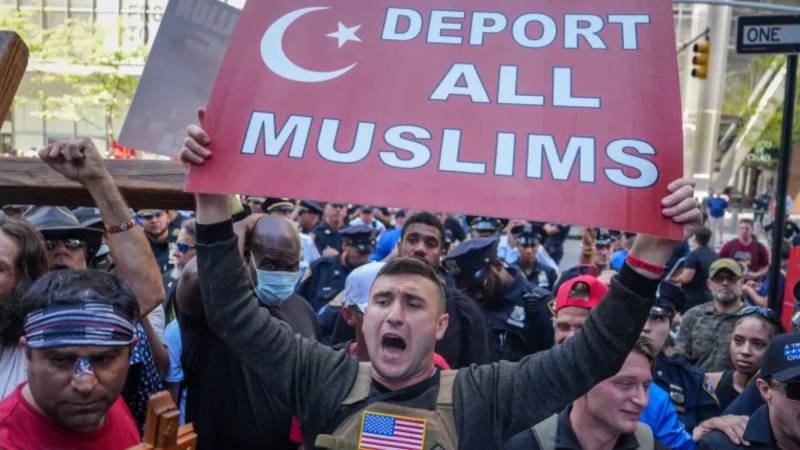
Almost fifty years after the publication of Edward Said’s Orientalism, the West has remained obstinate in clinging to its entrenched prejudices against the ‘Orient’, manifested most clearly in the case of Islam. Said’s seminal work incisively unmasked the thicket that the Occident had so systematically constructed in an attempt to ‘essentialise’ the East and, at its core, employ fabricated conceptions to advance colonial ventures and serve imperial agendas. Most importantly, what underpinned the entire edifice of Western scholarship on the East was a systematic attempt to ‘otherise’ it: to draw a dichotomy between ‘us’ and ‘them’; the ‘rational’, ‘civilised’, and ‘modern’ versus the ‘exotic’, ‘irrational’, and ‘backward’. Though the formal institution of colonialism may have dissipated long ago, its residues and legacy continue to shape Western perceptions of Islam and Muslims, most clearly evidenced by the steep rise in Islamophobia.
The Pew Research Center, in a recent poll, found that “51% of U.S. adults now say Islam is more likely than other religions to encourage violence, a sharp jump from 25% in 2002.” Another survey revealed that two in five Britons believe “Muslims cannot integrate into British society”. More worryingly, and in tandem with this, about half of Muslims living in the United Kingdom reported having experienced racism in some form, while 92% said they felt “much less safe”. These figures echo Europe’s longstanding practice of demonising Islam and ‘otherising’ Muslims. However, what is more important is to understand the reasons that have contributed to perpetuating this highly skewed image of the faith.
Let us start with academia, the exemplars of ‘objectivity’ and ‘dispassionate’ inquiry. The Clash of Civilisations thesis, posited by Samuel P. Huntington, sought to manufacture a fundamental and yawning gap between the West and Islam. Arguing that the former was diametrically opposed to the latter, conflict was ultimately portrayed as a permanent and ineluctable feature of their encounter. Now, consider what this implies: the problem is not merely extremist fringes that contort Islam to serve their political agendas, but rather the entirety of its supposedly ‘monolithic’ theology. Every Muslim is painted with the same brush, while the enormous diversity that defines the global Muslim community is blatantly ignored. Furthermore, such framing, as critics point out, was driven by ulterior motives that sought to portray Islam as the new enemy in the wake of communism’s decline; Europe constructed another ‘them’ to fill the void left behind.
From the genesis of Orientalism, which moulded the early European lens, to the so-called ‘war on terror’ that profoundly altered Islam-West discourse, it has consistently been the Western world that has positioned itself as superior, endowed with the ability to define, condemn, and judge.
Besides, in the aftermath of the fateful September 11 attacks, the ‘White Man’s Burden’ was invoked anew to justify imperial ambitions dressed up as a grand, cosmic battle between civilisation and ‘barbarity’, once again evoking colonial tropes. Intervention in sovereign states was justified by engineering a narrative that repeatedly conceptualised the conflict in religious terms. It was not a nation-state against its opponent; it was the West against Islam. Europe had to unite against its perennial adversary, which was portrayed as challenging its cherished ideals and the liberal ethos that imbued it. The ‘Clash of Civilisations’ was in full play.
To top it off, nearly a quarter of Europe is now backing far-right parties. From Germany’s AfD, which recently won a historic state election, with Elon Musk congratulating its leader, Alice Weidel, to the Netherlands’ PVV, whose platform has prominently focused on opposition to Islam and immigration, the far right has grown, giving fresh impetus to anti-Muslim rhetoric. Portraying an existential threat against which to rally has remained a recurrent gambit of fascism. It is this gambit that the far right has been deploying to unify its supporters: ordinary Muslims are routinely conflated with marginal extremists; a spiteful anti-Islam discourse is perpetuated; and anti-immigration policies and border controls dominate political debates in an attempt to ‘stifle’ the intermingling of those deemed ‘incompatible’ with Western liberal values.
For far too long, Muslims have been demeaned and demonised. From the genesis of Orientalism, which moulded the early European lens, to the so-called ‘war on terror’ that profoundly altered Islam-West discourse, it has consistently been the Western world that has positioned itself as superior, endowed with the ability to define, condemn, and judge. It is high time Europe cast an introspective eye inward and engaged in self-scrutiny. Only then will it realise the ironic paradox of attempting to square its lofty ideals with a murky history marked by chaos and destruction.