

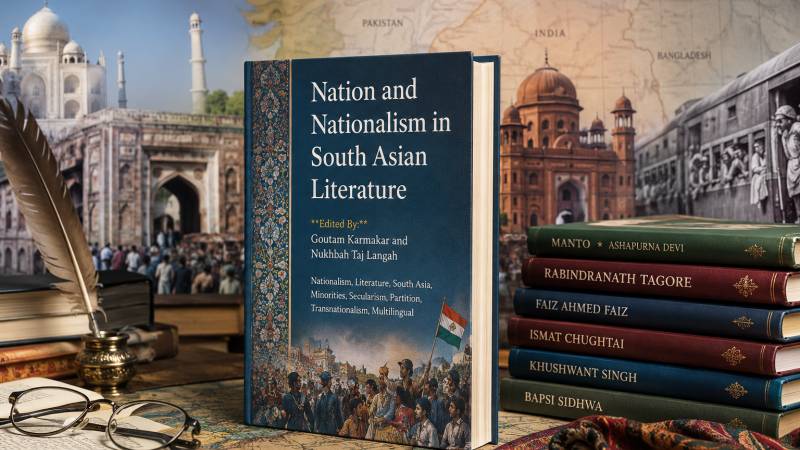
Book: Nation and Nationalism in South Asian Literature
Edited By: Goutam Karmakar and Nukhbah Taj Langah
Publisher: Routledge, 2026, pp. 276
A map can divide territory with a line. It cannot so easily divide memory, language, faith, family, or belonging. This is the insight that animates Nation and Nationalism in South Asian Literature a new collection edited by Goutam Karmakar and Nukhbah Taj Langah. Through seventeen essays, the volume examines how South Asian writers have grappled with the idea of nation not as a fixed political identity, but as an unstable literary construction continually contested by history, religion, gender, and migration. The collection’s central achievement is to show that nationalism in this region is not a single story but a battlefield of competing narratives, and that literature offers one of the few spaces where these contests can be examined with nuance.
The book begins from a premise that is both appropriate and necessary: nationalism in South Asia fragments into religious nationalism, linguistic nationalism, ethnic sub-nationalism, and long-distance nationalism among diasporas. Religion, the editors argue, is not merely a private belief but a key shaper of political structures: from Pakistan’s Islamisation to India’s Hindutva and Sri Lanka’s Sinhalese-Buddhist majoritarianism. Literature, with its capacity to give voice to the marginalised and to imagine alternatives, becomes a vital archive of these tensions. The central question running through the volume is how South Asian writers depict the clash between secular aspirations and communal realities.
The first part, Narrating the Nations: Minoritization, Partition, and Intersectionalities, focuses on Partition and its aftermath. John C. Hawley opens with a comparison of Intizar Husain’s Basti and Megha Majumdar’s A Burning that reveals how the wounds of 1947 never healed; they merely changed shape. Husain’s allegorical novel about Pakistan’s early disillusionment finds a modern echo in Majumdar’s story of a poor Muslim woman crushed by India’s majoritarian politics. Madeline Clements then examines Osman Haneef’s legal thriller Blasphemy, which draws on the 2011 assassination of Salman Taseer. Clements argues that Haneef navigates the minefield of religious offence by offering a “radical secular” critique that does not simply dismiss Islam but rereads it from a human-rights perspective: a rare and difficult achievement in Pakistani English fiction.
Several essays recover forgotten histories. Rajender Kaur reads Kamila Shamsie’s A God in Every Stone as an attempt to recover Pakistan’s syncretic past, invoking Buddhist and Sufi heritage to challenge the Islamic nationalist narrative of Pakistan’s origins. Sheelalipi Sahana examines Khadija Mastur’s Urdu novels about Partition, showing how women created “counterspaces” within the household, an alternative history of 1947 in which survival, rather than statehood, was the primary concern. Muhammad Safdar’s chapter on Shamsie’s Broken Verses critiques the secular ontology of Pakistan’s Women’s Action Forum, suggesting that even progressive movements can become rigid and exclusionary. This is a provocative argument, though its theoretical apparatus occasionally overwhelms the literary analysis. Arju Khatun’s study of the Bengali Muslim journal Kafela (1981–1993) is particularly useful because it treats the periodical as a “counterpublic”, a space in which Bengali Muslims could negotiate an identity that neither majoritarian nationalism nor a homogenising secularism could fully accommodate. The chapter offers a crucial reminder that minority anxieties are not confined to Pakistan; they are alive in India too.
Two essays stand out for their visceral intensity. Thilini Meegaswatta analyses Anuk Arudpragasam’s The Story of a Brief Marriage, set in the final days of Sri Lanka’s civil war. Using Foucault’s idea of “heterotopia,” she shows how the novel turns the war zone into a space where bodies are obliterated and grief is rendered unspeakable; a direct challenge to the Sri Lankan state’s triumphalist post-war narrative. Saumya Lal closes the first section with a reading of Arundhati Roy’s The Ministry of Utmost Happiness, arguing that Roy’s novel redefines Indian nationhood through the lives of its most marginalised characters—Dalits, Muslims, and transgender people, who find happiness not in state recognition but in mutual care and alternative communities.
The collection's central achievement is to show that nationalism in this region is not a single story but a battlefield of competing narratives, and that literature offers one of the few spaces where these contests can be examined with nuance.
The second part Identity, Transnationalism, and South Asia extends the conversation beyond the subcontinent. Asif Iqbal writes about Syed Manzurul Islam’s Song of Our Swampland, which tells the story of a Bihari Muslim family persecuted during Bangladesh’s 1971 Liberation War. The chapter exposes how the birth of a nation can simultaneously exclude and victimise those who do not fit the dominant ethnic narrative: a necessary corrective to triumphalist accounts of 1971. Lopamudra Basu connects Salman Rushdie’s novels and Deepa Mehta’s films, showing how both have been targeted by Hindu right-wing censorship. The real battleground, she argues, is female sexuality: when Rushdie or Mehta portray women as autonomous beings, they challenge a patriarchal vision of the Hindu nation.
Basil Diengdoh introduces Kynpham Sing Nongkynrih, a Khasi writer from India’s Northeast whose monumental novel Funeral Nights weaves together myth, folklore, and contemporary politics to ask how an indigenous community can speak of itself in a nation that treats it as a security problem. The Barak Valley chapters further unsettle the assumption that language and territory naturally produce national belonging, showing instead how communities construct identities that exceed both Assamese and Bengali nationalist frameworks.
Sanghamitra Dalal’s analysis of Channa Wickremesekera’s Distant Warriors explores how Sri Lankan Tamil diaspora communities forge “micro-solidarities” across borders, maintaining nationalist feelings even when they have no intention of returning; a phenomenon that resonates with Pakistan’s own diaspora. Khaoula Chakour examines Rashma Kalsie’s play Melbourne Talam, which uses the metaphor of Indian classical rhythm to stage how Australian-based Indians perform their national identity through daily cultural practices. Barnali Sarkar closes the volume by comparing Sunjeev Sahota’s The Year of the Runaways and Aravind Adiga’s The White Tiger, showing how both novels critique India’s neoliberal development by focusing on the exploited: migrant workers and a lower-caste entrepreneur.
The collection’s greatest strength is its multilingual and regional range. It covers Urdu, Bengali, Nepali, Khasi, Assamese, and other languages, giving space to women writers, Dalit and tribal voices, and LGBTQ+ characters. This prevents it from becoming exclusively Anglophone in orientation. However, breadth is also its structural challenge: the chapters do not always enter into sustained dialogue with one another, and the transition from Partition and minoritisation to transnational identity can sometimes feel more organisational than argumentative. A more substantial concluding essay might have drawn these strands together and clarified the volume’s larger theoretical intervention. At its weaker moments, the collection allows theoretical vocabulary to overshadow the literary texts it seeks to illuminate. The discussion of Agarwalla’s Assamese poetry, for instance, occasionally remains descriptive where the collection’s strongest chapters are interpretive.
For readers concerned with Pakistan’s cultural politics, the chapters on blasphemy, feminist secularism, and minority citizenship acquire particular urgency. The book does not offer easy answers, but it offers something rarer: a framework for thinking about these issues with nuance and historical depth. Nation and Nationalism in South Asian Literature is both a scholarly achievement and a political intervention. It reminds us that nations are not natural; they are narrated. The map may fix borders, but South Asian literature keeps exposing everything those borders cannot contain.