

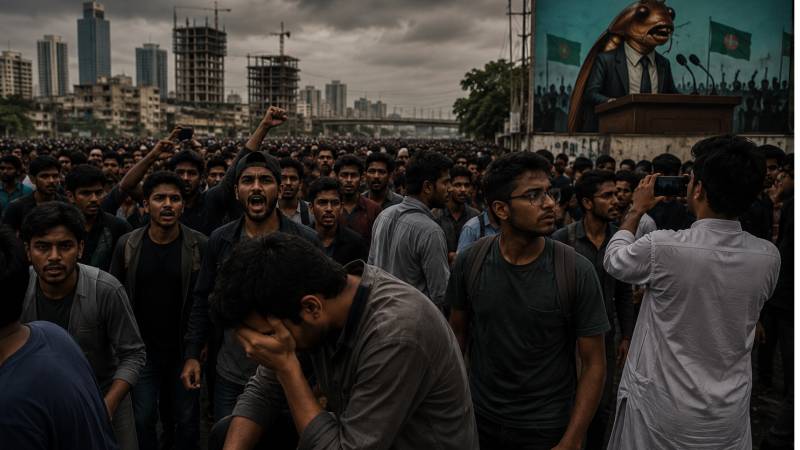
Pakistan has one of the youngest populations on the planet, our so-called ‘youth bulge’. Younger than India's. Younger than almost anywhere outside sub-Saharan Africa. By every demographic model political scientists use, this should be the loudest country in South Asia right now.
And yet… It isn't.
India got a cockroach party marching on Parliament. Nepal got a Gen Z uprising that toppled a government last year. Pakistan got memes, a few viral tweets, and then Monday morning. That gap between the raw material and the actual output is the real story here, more than the cockroach costumes themselves. A youth bulge is supposed to be a countdown clock. Ours seems to have stopped ticking and it's worth asking why instead of assuming the answer is obvious.
Start with what political scientists call relative deprivation, the idea that people don't revolt because they're poor, they revolt because they expected better and didn't get it. India's NEET protesters had one exam, one scandal, one date on the calendar, one villain in a ministerial office. A single wound everyone could point to at the same moment. Pakistan's failures are just as real but they're scattered. A collapsing school system here, a stalled hiring freeze there, a currency that keeps eating us alive, provinces that don't even agree on the medium of instruction. You cannot build a cockroach out of six different, unrelated bruises. There's no single choke point for a generation to gather around, so the grievance stays diffused instead of becoming a symbol.
Then there's the exit valve, and this one I think about a lot, mostly because I know people who used it. The angriest, most plugged-in twenty-somethings in this country don't organize. They apply for a UK or Australia’s master's, Gulf contract, or the ‘dunki’ route if nothing formal works out. Every cohort that might have become a movement instead becomes a diaspora of success stories, checking in from Manchester or Dubai about how bad things have gotten back home. Movements need bodies who are staying put and furious in the same city at the same time. We keep exporting the furious ones before they can find each other.
There's a household economics piece too, though less glamorous but probably heavier. Protest movements like Nepal's and India's ran mostly on students, unmarried, dorm-adjacent, with slack time and no dependents yet. Pakistan's lower enrollment numbers and earlier household responsibility mean fewer people ever get that clustered, bored, collectively resentful campus phase. You need people with nothing urgent pulling them home by six. A lot of our twenty-somethings are already someone's income.
Every cohort that might have become a movement instead becomes a diaspora of success stories.
And then, quietly, there's the fact that grievance here rarely gets to stay youth-owned for long. In India, the anger built its own vocabulary, a satirical party, a cockroach, a slogan nobody's uncle came up with. In Pakistan, economic frustration tends to get absorbed almost immediately into structures that already exist, and not always the ones you'd expect. So I mean not only a political party, but sect, ethnicity, province, or even if you’re the matric or O-level student. A Karachi graduate's economic anger and a Peshawar graduate's economic anger get filtered through different identity lines before either one becomes a chant, and by the time they reach the street they're rarely chanting the same thing. In-group loyalty is one hell of a drug, and it's very good at converting a shared economic wound into a dozen separate, mutually suspicious ones.
None of this means Pakistani Gen Z is apathetic. As hard as I’d want to admit, but despite being the millennial adult on the other side of thirty, I push back hard on anyone reading it that way. There's a bias at play here, the kind marketers exploit all the time: we remember the movement that made headlines; and assume the one that didn't simply never existed. It's called the availability heuristic, and it's basically your brain mistaking "I heard about it" for "it happened." Pakistani youth’s anger that did not make it to international media is not absent, just diffused. And diffused anger doesn't trend, but it is still absolutely valid. Perhaps more dangerous when the time comes.
What India's cockroaches actually prove, if anything, is that mockery needs a single target to stick to. Ours doesn't have one yet. Whether that's a mercy or a delay is the part we can keep going back and forth on, without landing anywhere close to an answer.