

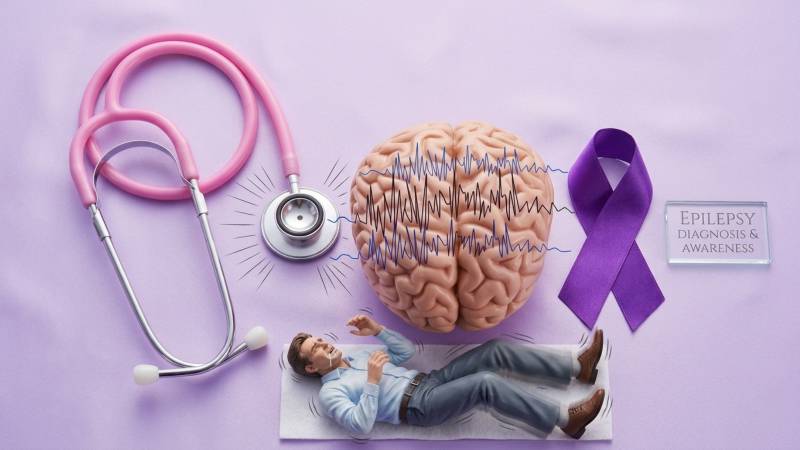
A teenager collapses in a Lahore classroom, body convulsing. Someone shouts for a spoon. Another holds the child down. A third backs away, confused and scared. No one calls for real help because no one knows what real help looks like. This is not a rare scene. It is, by the available evidence, closer to the norm in Pakistani schools than the exception.
Epilepsy is one of the most common neurological disorders on earth, yet in Pakistan it remains one of the least understood not for lack of information, but because that information has never been allowed to compete with the myths that came first. It is a non-communicable disease of the brain that affects people of all ages. Epilepsy is one of the world’s oldest recognized conditions, with written records dating back to 4000 BCE. Seizures are brief episodes of involuntary movement that may involve a part of the body or the entire body and are sometimes accompanied by loss of consciousness. Seizure occurs when there is excessive electrical activity in a cluster of cells in the brain. They may be very brief, such as loss of focus or muscle spasms, or they may be more intense and last longer. We cannot currently delete or “ remove” epilepsy from a person’s genes in every day medicine.
Schools are where our children spend most of their waking hours, which makes them one of the most important frontlines of public health and one of the most neglected. Research in Pakistani educational institutions shows most students cannot even name epilepsy as a brain disorder, let alone respond safely to a seizure. The instinct to force an object into a seizing person's mouth is not malice; it is panic filling a vacuum left by zero first-aid instruction.
Teachers fare a little better. Some believe the condition is contagious. Some have resisted having an epileptic child in their classroom at all. When the adult in the room treats a medical event as a threat, the child learns a lesson that outlasts the seizure by years of damaged self-esteem, in academic decline, in quiet isolation. The fix here is not exotic. Wherever epilepsy education has actually been introduced in schools, misconceptions have measurably dropped. Ignorance responds to teaching. What's missing is not a cure. It's a curriculum.
Epilepsy is one of the most common neurological disorders on Earth, yet in Pakistan it remains one of the least understood, not for lack of information, but because that information has never been allowed to compete with the myths that came first.
Helping takes far less than most people fear. Stay calm and note the time. Clear the space around the person and cushion their head. Loosen anything tight around the neck. When the convulsions stop, gently roll them onto their side so they can breathe, and stay until they are fully alert. Call an ambulance if the seizure lasts more than five minutes, if another follows immediately, or if the person is injured or does not wake up.
Equally important is what never to do: do not restrain the person, do not pour water on them, and do not put anything in their mouth. Nobody swallows their tongue during a seizure. The spoon, on the other hand, can break teeth, injure the jaw and block the airway.
Children don't invent stigma in the classroom; they inherit it. Long before any science lesson, they absorb what their families believe, and in Pakistan that belief system is still heavily supernatural. Even among educated adults, the idea that seizures signal possession by a jinn remains common, alongside the belief that epilepsy is contagious. This isn't confined to remote villages; studies have found it among literate, urban populations, and disturbingly, among healthcare workers themselves. At one Lahore hospital, most nurses surveyed could not correctly say that epilepsy is non-contagious. The consequences are not merely social. Patients and families who see seizures as a spiritual affliction are less likely to stay on medication, and treatment that is abandoned is treatment that fails.If misinformation has penetrated the institutions built to treat the condition, it's no surprise it thrives in ordinary homes.
Families without accurate information often turn first to traditional healers, losing critical time before a child ever sees a neurologist. This is not a failure of love, it's a failure of access to basic medical literacy, and it hits rural families with less education and fewer clinics hardest of all.
A child's home is where they first learn how to feel about their own condition. A household steeped in fear or shame sends that child into school already carrying a psychological weight the school then does nothing to lift and often makes heavier.
Behind every statistic is a young person quietly rehearsing their worst fear: having a seizure in public, and watching how everyone reacts. In a society where people with epilepsy are too often dismissed as "crazy," that fear is not irrational. It feeds low self-esteem, self-doubt and, in many cases, a hopelessness that is harder to treat than the seizures themselves. Many students live with two burdens: the condition, and the dread of being seen with it. Uninformed classrooms, superstition-laden communities, and under-informed parents don't operate separately; they reinforce each other. And most existing research studies them in isolation, in samples too narrow to capture how they collide in a city like Lahore.
Three changes would move the needle immediately: Make seizure first-aid mandatory in school health curricula not a footnote, but a rehearsed skill every teacher and student can perform under pressure. Target the "contagious" and "possession" myths directly in public health messaging in hospitals as much as classrooms, since healthcare workers are clearly not immune either. Fold mental health support into neurology care, so the psychological toll of epilepsy is treated as seriously as the physical symptoms.
Epilepsy in Pakistan is not just a medical condition. It is a social one, kept alive by silence and unchallenged folklore. The next seizure in a Lahore classroom doesn't have to end in panic and a shoved spoon. It could end with a teacher who knows exactly what to do, and a room full of students who aren't afraid to help.