


Pakistan’s most expensive economic problem is not debt, taxation, or even corruption in the conventional sense. It is a political economy where access to the state has become one of the country’s most profitable businesses.
In the earlier article, I estimated that elite capture costs Pakistan roughly Rs 6.7 trillion annually — equivalent to about 5.8 percent of GDP, or about $25 billion in 2024-25. This was the first comparable estimate since the 2020 United Nations Development Programme (UNDP) study on elite privilege, which attempted to quantify the benefits received by powerful groups using available official data.
My estimate attracted attention because, unlike the UNDP report, it started with officially documented fiscal costs and then examined additional channels through which state-created advantages transfer resources to privileged groups. It also included: electricity-sector capacity payments, losses of state-owned enterprises and other identifiable drains on public resources. But the more important conclusion was not the number itself because this figure captures only the part of elite capture that appears in published or official accounts.
Elite capture does not require direct corruption in every case. It can occur whenever political influence allows particular groups to obtain economic advantages unavailable in a competitive market. Many of the largest transfers of wealth in Pakistan never appear in these documents. They occur through privileged access to land, regulatory protection, restricted competition, under-taxation of assets and state-created economic advantages. These channels are harder to measure, but they may be far larger in aggregate. The Rs 6.7 trillion estimate should therefore be viewed not as the total cost of elite capture, but as its minimum measurable cost. The question is how much larger the real burden might be.
Understanding the Rs 6.7 trillion floor
The original estimate was deliberately conservative because its main components could be directly linked to official data. Federal tax expenditures amounted to approximately Rs 2.35 trillion in FY2024-25. Electricity-sector capacity payments reached roughly Rs 2.14 trillion. Losses from state-owned enterprises approached Rs 833 billion. Together with other identifiable fiscal leakages, these channels generated an annual burden of approximately Rs 6.7 trillion.
What is striking is not only the size of the figure. It is that none of these categories capture some of the largest sources of elite wealth creation in Pakistan: asset transfers and regulatory privilege or arguably, abuse of authority.
Tax expenditures represent benefits already visible in fiscal accounts. Capacity payments represent guaranteed returns embedded in contracts. SOE losses represent inefficiencies ultimately financed by taxpayers. But they do not capture what happens when land is allocated below market value, when zoning decisions create windfall gains, when protected industries charge consumers above competitive prices, or when regulations are designed in ways that limit competition. The gains are concentrated among beneficiaries, while the costs are spread across society.
A framework for estimating the hidden burden
Elite capture in Pakistan operates through four broad channels.
The first consists of direct fiscal privileges visible in government accounts. These include tax exemptions, subsidies, guarantees and fiscal losses. This category is largely captured in the Rs 6.7 trillion estimate.
The second consists of contracting rents — value extracted through public procurement when contracts are awarded, priced or modified without the transparency and competitive pressure needed to protect the public interest.
The third consists of wealth transfers through assets, especially land and real estate. These rarely appear in annual budgets, yet they often involve some of the largest transfers of economic value in the country.
The fourth consists of market-power rents, where businesses earn extraordinary returns not because they are more productive or innovative, but because competition is restricted through policy, regulation or political influence.
Together, these four channels describe different ways of achieving the same outcome: converting public authority into private wealth.
A tax exemption transfers value through the fiscal system. Procurement transfers value through public spending itself. Cheap land transfers value through public assets. Regulatory protection transfers value through higher prices and restricted competition. The mechanism changes, but the result does not. Wealth that could have accrued to the public is redirected to a relatively small group of beneficiaries. The Rs 6.7 trillion estimate captures much of the first category because it is visible in official accounts. The larger challenge is that the remaining channels operate largely outside them. They leave fewer traces in budgets, audits and financial statements, even though their economic impact may be just as large — and in some cases much larger.
The Rs 6.7 trillion estimate should therefore be viewed not as the total cost of elite capture, but as its minimum measurable cost.
The second layer: public procurement: the hidden cost of a captured state
Government procurement remains one of the largest and least measured channels through which elite capture imposes an economic cost on Pakistan. The difficulty is that procurement losses rarely appear as a separate item in government accounts. They are embedded in inflated contracts, weak competition, poor project preparation, excessive contract variations and ineffective oversight. Unlike a subsidy or a tax exemption, there is no budget line that reveals the cost of weak procurement.
The scale of the issue matters because the state is one of the largest buyers in the economy. On the Public Procurement Regulatory Authority’s own estimate, Pakistan allocates about 20% of GDP to public procurement annually, and Transparency International and audit reports suggest 10–30% of that may be lost to corruption and inefficiencies. On that basis, procurement leakage alone could amount to roughly 2–6% of GDP.
Available evidence suggests that the potential losses are substantial. A World Bank assessment of Pakistan’s Medium Term Development Framework infrastructure portfolio, based on surveys of contractors, consultants and other stakeholders, estimated corruption-related costs at approximately 10–15 percent of project value. Applied to the US$16.55 billion infrastructure portfolio examined in the assessment, this implied potential losses of roughly US$1.6–2.5 billion. The estimate was not an audit of proven theft; rather, it measured the economic cost associated with corruption risks, weak transparency and procurement failures reported by participants in the infrastructure sector.
The broader institutional diagnosis is equally troubling. The IMF’s 2025 Governance and Corruption Diagnostic identified public procurement and public investment management as areas where governance weaknesses reduce the effectiveness of government spending. It highlighted fragmented oversight, weak controls, limited transparency and inadequate enforcement as factors that increase corruption vulnerabilities and allow rents to emerge.
Infrastructure projects provide visible examples of these risks.
Peshawar’s Bus Rapid Transit system was initially approved at approximately Rs49 billion but ultimately cost more than Rs70 billion — an increase of over 40 percent. A provincial inspection team attributed the escalation partly to faulty planning and design, while the Auditor General identified Rs2.77 billion in irregularities, including unauthorised payments.
The Dasu Hydropower Project illustrates another recurring problem: weak project preparation followed by cost escalation during implementation. A reported Rs29 billion increase linked to design modifications highlights how changes after approval can create opportunities for costs to rise without adequate scrutiny. Design changes are sometimes unavoidable in complex projects, but repeated revisions across major projects impose a significant burden on public finances.
Concerns have also emerged in projects financed by international institutions. Parliamentary committees have questioned procurement decisions in Asian Development Bank-funded CAREC corridor projects worth around Rs172 billion, while transparency concerns have been raised regarding disclosure practices in the World Bank-funded Sindh Solar Energy Project.
None of these cases, individually, proves criminal wrongdoing. Large infrastructure projects are inherently complex, and cost increases do not automatically indicate corruption. The larger problem is institutional: Pakistan has struggled to create procurement and public investment systems capable of consistently ensuring transparency, competition and value for money. The economic cost of procurement failures is therefore not limited to bribery. Elite capture often operates through privileged access: who gets contracts, who benefits from regulatory discretion, who influences project selection and who bears the cost when projects become more expensive than originally approved.
Land: the hidden subsidy
Land has arguably been the one of the largest, if not the largest, mechanism through which economic privilege has been created in Pakistan. Successive governments and state institutions have allocated urban land, agricultural land, development rights and housing plots at prices below market value. The beneficiaries have included military foundations, housing authorities, politically connected developers, bureaucratic elites and influential private actors.
State land represents one of Pakistan’s largest pools of unpriced public wealth. Yet its allocation remains among the least transparent areas of governance. There is no comprehensive public accounting of the market value of land transferred, leased, or placed under privileged use each year. Individual cases, however, show that these transfers can involve assets worth hundreds of billions of rupees, often provided at nominal rents or preferential terms.
The economic cost is not simply the accounting value of land transferred. The real cost is the difference between what public assets could have generated through transparent market allocation and what they actually produced through privileged access.
Two examples illustrate the scale of the issue.
An investigation by the Organized Crime and Corruption Reporting Project (OCCRP), based on leaked Dubai property records obtained by the Washington-based Center for Advanced Defense Studies (C4ADS), found that around 17,000 Pakistani nationals were linked to more than 23,000 properties in Dubai, with reported values of around $11 billion. The investigation was part of the global “Dubai Unlocked” project, which involved more than 70 media organisations. The origin of every dollar in that portfolio cannot be determined from available data. However, a significant portion represents wealth generated in Pakistan, and some of it reflects assets that left the country without first passing through Pakistan’s formal tax system.
Separately, in 2019, Bahria Town Karachi — built partly on land that the Supreme Court found had been irregularly acquired from the Malir Development Authority and surrounding communities — was allowed to continue after agreeing to a settlement of roughly Rs 460 billion. It was one of the largest sums ever ordered from a private developer in Pakistan in relation to land it was already occupying. That is a single project and a single settlement larger than the annual budget of many federal ministries.
Neither figure provides a national estimate of land-related rents. But together they demonstrate the scale of the underlying issue: billions of dollars of private wealth linked to Pakistani assets abroad and hundreds of billions of rupees involved in a single domestic land dispute. They establish a strong basis for concluding that privileged access to land represents one of Pakistan’s largest hidden transfers of economic value — even though the precise annual cost remains difficult to measure.
Government procurement remains one of the largest and least measured channels through which elite capture imposes an economic cost on Pakistan.
Market power: when state protection becomes private advantage
Pakistan's economy contains several sectors where profits depend not only on efficiency or innovation but also on policy decisions that shape access to markets, inputs and protection from competition. The mechanisms differ across industries, but the outcome is often the same: economic rents created or protected by the state.
Fertilizer illustrates how privileged access to inputs can generate rents. Urea producers have long received natural gas at preferential rates on the grounds of food security and agricultural support. According to the National Fertilizer Development Centre, the implicit subsidy embedded in preferential feed-gas pricing amounted to approximately Rs121 billion in FY2023-24. Yet companies receiving very different gas prices frequently sold urea at similar market prices, raising concerns that part of the benefit was captured in producer margins rather than passed on to farmers. The Competition Commission of Pakistan (CCP) subsequently initiated proceedings against the Fertilizer Manufacturers of Pakistan Advisory Council and major producers over alleged coordinated pricing behaviour.
Sugar demonstrates a different mechanism: political influence combined with regulatory discretion. Export permissions, import restrictions, support prices and stock-management decisions give government policy a direct influence over industry profitability. The 2020 Sugar Inquiry Commission documented how export subsidies, financing arrangements and policy interventions repeatedly benefited mill owners while consumers faced rising prices. CCP later imposed a Rs44 billion penalty on the Pakistan Sugar Mills Association and 84 mills for alleged anti-competitive conduct, though the decision remains under litigation.
Automobiles show how rents can emerge through protection from competition. For decades, high tariffs and import restrictions shielded domestic assemblers from external competition. The result was a market where consumers often paid substantially more for vehicles than comparable international benchmarks while facing long delivery times and limited choice. Economic protection intended to nurture domestic industry frequently translated into higher prices and reduced competitive pressure. By 2025, effective protection rates in parts of the automotive value chain remained among the highest in Pakistan's manufacturing sector, despite repeated reform efforts.
Cement provides another illustration. A handful of producers account for most domestic capacity, and the sector has repeatedly faced competition investigations over alleged coordinated pricing and cartel-like behaviour. CCP imposed penalties of approximately Rs6.3 billion on cement manufacturers and their trade association in one of its most prominent cartel cases. Regardless of the legal outcomes, repeated investigations point to persistent concerns about market concentration and pricing power.
The common thread across these sectors is not corruption in the narrow sense or even formal cartelisation. It is the use of state policy—through subsidised inputs, trade protection, regulatory discretion or barriers to entry—to create economic advantages that would be difficult to sustain in more competitive markets. These transfers rarely appear in government accounts, but they represent one of the largest hidden channels through which economic value is redistributed from the public to well-positioned private interests.
From 5.8 percent to 8–9 percent of GDP
Once these omitted channels are considered, the arithmetic becomes an exercise in estimation rather than precise accounting. The documented fiscal burden already amounted to approximately 5.8 percent of GDP in 2024-25 The additional hidden costs can be conservatively estimated as follows:
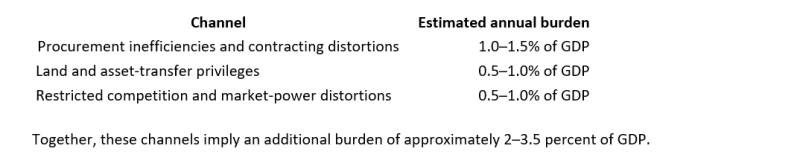
Combined with the 5.8 percent of GDP in documented fiscal costs, this suggests that the broader economic burden associated with elite capture could plausibly amount to 8–9.5 percent of GDP — around Rs10–12 trillion annually at current output levels (FY2025–26 GDP: Rs126.87 trillion), or approximately $36–43 billion.
This should not be interpreted as a precise accounting figure. Unlike tax expenditures, subsidies, or capacity payments, many costs associated with elite capture are not recorded as explicit losses in government accounts. They arise through corruption, abuse of public authority, politically connected access to state resources, preferential allocation of land and contracts, protected markets, regulatory manipulation, subsidised inputs, and policies that enable powerful groups to extract economic rents.
The estimate therefore captures the approximate scale of economic value affected by corruption, rent-seeking, and elite capture — through misallocation of public resources, higher costs, reduced competition, and weaker productivity. It does not suggest that the entire amount represents stolen funds; rather, it reflects the wider economic cost of a system where political influence and privileged access can shape who receives state support, market protection, and economic opportunity.
Why this matters
Pakistan’s economic debate often focuses on taxation, IMF programmes and fiscal deficits. But the deeper problem is not simply that Pakistan cannot collect enough taxes. It is that state power has repeatedly been used to create and protect private economic advantages: through exemptions, privileged access to assets, protection from competition, subsidised inputs and contracts that concentrate gains among the powerful while leaving the public to absorb the costs.
The result is a system that taxes consumption heavily, imposes some of the highest electricity prices in the region, repeatedly seeks external financing and still struggles to fund basic public services.
The problem is not merely inefficiency. It is distribution. The gains are concentrated, while the costs are shared across society. Every additional fuel levy, electricity surcharge and indirect tax imposed on ordinary citizens finances a system that continues to protect powerful interests from comparable scrutiny.
The real fiscal crisis
Pakistan is often described as an under-taxed country. That diagnosis is only partly correct. A country that loses resources equivalent to 8–9 percent of GDP annually through elite capture does not merely suffer from insufficient taxation. It suffers from a deeper misallocation of economic power.
The debate therefore needs to move beyond revenue collection and individual corruption scandals. The central question is how economic advantages are created, who receives them and who ultimately pays the cost. The Rs 6.7 trillion estimate established that elite capture can be measured. The larger lesson is that what can be measured is only part of the story.
The visible bill is already enormous. The hidden bill may be larger still. Taken together, these estimates suggest that Pakistan’s most expensive economic problem is not debt, taxation or corruption in isolation. It is a political economy in which proximity to the state has become one of the most profitable businesses in the country. The full cost cannot be precisely measured because the same system that creates these privileges also conceals them. What appears in official accounts is only the visible bill. The larger transfer of wealth occurs off-budget: through land allocations, protected markets, regulatory favours and discretionary state power.