

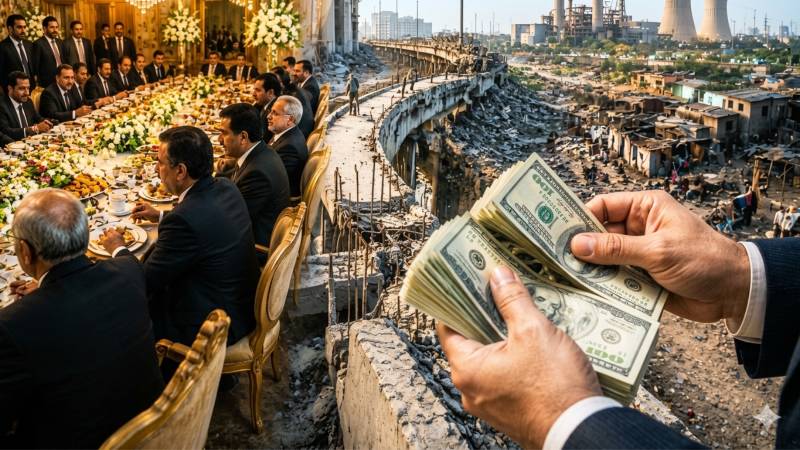
Pakistan’s politics and economic stagnation cannot be understood merely as a problem of corruption, weak taxation or excessive debt, nor reduced to a simple binary of civilian versus military rule. It is the outcome of a deeper political economy in which control over state resources has become a means of creating and distributing wealth among ruling elites, whether elected or unelected. From the allocation of valuable urban and agricultural land, housing schemes and development rights to tax exemptions, power contracts, procurement decisions and regulatory privileges, the state has repeatedly created rents for those with access while shifting the costs onto those without it. The result is an economic model in which ordinary citizens pay through fuel levies, electricity bills and indirect taxes, while politically connected groups benefit from concessions and assets whose value is often created not through competitive markets, but through decisions made by the state itself.
The scale of this rent creation is most visible in real estate, where state decisions over land and development rights have generated fortunes far beyond anything captured in official accounts. The Bahria Town Karachi case, involving thousands of acres of land, resulted in a Supreme Court-approved settlement of approximately Rs460 billion. In Islamabad, the controversy over the allotment of plots in sectors F-14 and F-15 exposed another dimension of the same system: the allocation of some of the capital’s most valuable public land to powerful officials and institutions at prices far below market value. These are not simply property disputes; they illustrate how control over state assets can become a mechanism for transferring enormous economic value to privileged groups.
On 17 July 2026, the state demonstrated the other side of the equation. Pakistan’s government did what it has repeatedly done whenever global oil prices move against it: it passed the cost directly to those least able to absorb it. Petrol increased by Rs5.44 a litre to Rs316.15. Diesel — the fuel that powers trucks, tractors and the transport network that moves everything from agricultural produce to every sack of flour reaching the market — surged by Rs31.05 to Rs354.35 a litre. The official explanation was familiar: higher international oil prices and increased import costs. That explanation is true, but incomplete.
Once the international cost of crude oil is accounted for, what remains is not an economic inevitability but a political decision: how much of the final price the state chooses to extract from consumers through taxes and levies. For example, the 11 July price notification showed petrol priced at Rs310.71 per litre, of which approximately Rs93.84 represented government taxes and levies — an effective burden of about 43 percent of the tax-exclusive price. Diesel was even more heavily burdened: of its Rs323.30 per litre price, around Rs102.36 went to the state, equivalent to roughly 46 percent.
The effective burden exceeds both the headline GST rate of 18 percent and the top personal income tax rate of 35 percent. That comparison captures the central unfairness of Pakistan’s tax system: the state can impose and collect taxes instantly from millions of fuel consumers, but repeatedly struggles to collect taxes from politically connected businesses, protected industries and privileged groups that have the power to resist.
The government points out that the standard 18 percent GST is not charged on petroleum products. It does not need to be. The state has already created other mechanisms to extract nearly half the value of the fuel from a highly inflationary taxes on petroleum products. This is not a coincidence. It is by design.
Pakistan’s ruling elite — politically connected industrialists, landed families represented in parliament, bureaucrats who administer exemptions, and the interest groups that lobby for them — has built a system that taxes the powerless through unavoidable transactions while distributing privileges to the powerful through formal and informal arrangements. No one needs to steal when a system is structured to deliver privilege legally, quietly and predictably. Put a number on it, and the scale becomes impossible to ignore.
Pakistan’s politics and economic stagnation cannot be understood merely as a problem of corruption, weak taxation or excessive debt, nor reduced to a simple binary of civilian versus military rule.
Visible costs
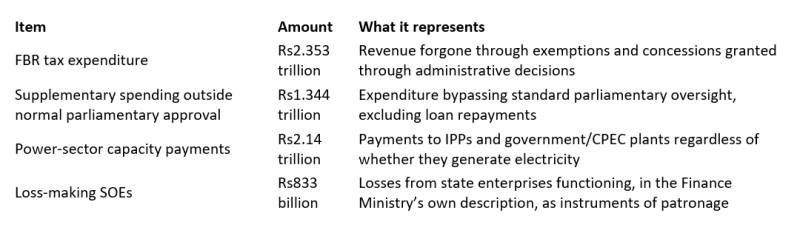
Add together four separate, officially documented flows for FY2024–25 — none based on estimates from foreign lenders or agencies, all drawn from Pakistan’s own fiscal data — and the total comes to approximately Rs6.7 trillion, or around 5.8 percent of GDP, against nominal GDP of Rs114.692 trillion for the year.
It excludes the Rs1.927 trillion in unrecovered foreign loan receivables owed by state entities — a stock rather than an annual flow. It also excludes the additional Rs2.1 trillion injected by the government into state-owned enterprises (SOEs) to prop up balance sheets and manage circular debt, much of it linked to the wider dysfunction of the power sector. Many of these enterprises remain overseen by boards populated by serving bureaucrats who receive director fees on top of their government salaries, with reports repeatedly questioning the transparency of these arrangements and the disclosure of associated income.
The Rs 6.7 trillion estimate excludes the accumulated costs of cement-sector collusion, project overruns, procurement failures and other governance lapses repeatedly identified in Pakistan's own audit and regulatory reports Even with these exclusions, the figure approaches the 6 percent of GDP estimate that has entered public debate as a shorthand for the economic cost of corruption and governance failure.
That number originally gained prominence through a 2020 UNDP report based partly on earlier tax-expenditure estimates. It was never intended to capture every form of institutional privilege. The calculation here is narrower: it is built line by line from the state's own accounts and measures only the identifiable fiscal cost of decisions made within a single year. It excludes the much larger and harder-to-measure transfer of wealth generated through preferential access to land, real estate, public assets and regulatory privilege. The true economic cost of elite capture is therefore almost certainly far higher than 6 percent of GDP.
The exemptions the powerless never see
The FBR’s Tax Expenditure Report 2026 places federal tax expenditures in FY2024–25 at Rs2.353 trillion — roughly one-fifth of everything the tax authority collects in a year.
Income tax expenditures amounted to Rs579.7 billion, customs duty exemptions accounted for another Rs499.1 billion, while sales tax concessions represented much of the remaining amount.
Every tax system contains exemptions. The issue is not whether exemptions exist; it is who receives them, how they are granted and whether the public can scrutinise them. In Pakistan, Rs2.353 trillion in annual concessions are not generally the outcome of open parliamentary debate. They are often granted through SROs and administrative decisions taken within the finance ministry and FBR.
These decisions frequently emerge from negotiations between government officials and powerful industry groups — the same associations, business lobbies and politically influential sectors that repeatedly appear during budget discussions demanding preferential treatment. Nobody votes for a customs exemption or a sector-specific sales tax concession. These benefits are negotiated away from public view and then quietly incorporated into law. The motorcyclist paying a 43 percent burden at the fuel pump has no equivalent negotiating table. That asymmetry is at the heart of Pakistan’s fiscal problem.
Where privilege actually lives
This is not merely a theoretical argument. The evidence comes not from a multilateral institution but from the former head of Pakistan’s own tax authority.
In 2023, former FBR chairman Shabbar Zaidi said that after FBR issued a tax notice to a politically connected landowner from Multan, around 40 MNAs from PTI, PPP and PML-N approached him, led by then foreign minister Shah Mahmood Qureshi, and pressed him to withdraw the case.
In 2022, the government’s attempt to broaden the tax base by imposing a fixed tax on traders was reversed within days after political pressure. When traders protested, Maryam Nawaz publicly asked Finance Minister Miftah Ismail on Twitter to withdraw the measure. The government subsequently backed down, highlighting how organised and politically influential groups can block tax reforms that challenge entrenched privileges.
The broader lesson is not about one party or one individual. It is about a system in which the application of law is shaped by political influence. Former FBR chairman Shabbar Zaidi has also publicly alleged that then Chief of Army Staff General Qamar Javed Bajwa intervened when FBR sought to revise property valuations in Defence Housing Authority areas.
Former Army Chief General Raheel Sharif received an agricultural land allotment of around 90 acres under the military land-allotment system. The issue is not the individual beneficiary; it is the institutional principle. Access to valuable public land remains one of the state’s longest-standing mechanisms for distributing privilege.
Civil bureaucracies have operated through a parallel system of privilege. Documents reviewed by Dawn showed that 588 senior officers were allotted luxury houses at subsidised rates under a federal housing scheme, with some receiving additional plots in Islamabad’s prized F-14 and F-15 sectors. Those allotments were later suspended by the Islamabad High Court, which referred the matter to the federal government to consider against the constitutional principle of equal opportunity. Separately, senior police officers and bureaucrats were found to have received plots in Islamabad’s E-11 sector at prices fixed more than two decades ago — reportedly around 1.5 percent of prevailing market value.
The FBR’s Tax Expenditure Report 2026 places federal tax expenditures in FY2024–25 at Rs2.353 trillion — roughly one-fifth of everything the tax authority collects in a year.
None of this land was acquired through theft in a legal sense. The transactions were carried out within the rules. That is precisely the point. The rules themselves created the opportunity for privilege because the institutions benefiting from them were often the same institutions responsible for designing and enforcing them.
Mega infrastructure projects follow the same logic. Motorways and highway "dualisation" schemes are not simply popular symbols of progress; they are the most efficient channel the state has for converting public money into private wealth — large, lump-sum contracts to a handful of connected firms, cost overruns that are easy to justify and hard to audit, and a finished road to inaugurate before the next election. A rural clinic or a public school offers none of this: its budget moves in small, recurring, dispersed tranches that no single actor can meaningfully capture. The numbers show where this logic leads. The M-12 Sialkot–Kharian Motorway's cost ballooned 264 percent, from Rs22.5 billion to nearly Rs82 billion, while sitting largely on paper for four years — yet infrastructure projects still claimed roughly 65 percent of the entire FY2026–27 federal development budget, against just 7 percent for education and 2.2 percent for health.
Protected industries and political privilege
The same pattern extends beyond taxation and land. The fertiliser sector illustrates how state-created advantages can become private windfalls. For decades, fertiliser companies have benefited from subsidised gas and preferential access to a critical input. As fertiliser prices rose, major producers recorded exceptionally high profits, raising questions over whether public support was being passed on to farmers or captured by producers.
Pakistan’s sugar industry has benefited for decades from support prices, protective tariffs and export incentives. During successive sugar crises, government investigations found evidence of artificial shortages, hoarding and questionable financial practices, while FIA inquiries highlighted concerns over collusion and irregular transactions.
The cement sector illustrates a similar dynamic. The Competition Commission of Pakistan’s 2020 inquiry found evidence of anti-competitive pricing and estimated that consumers bore costs of approximately Rs40 billion. At the same time, the sector benefited from reductions in federal excise duty.
The power sector: rent embedded in every electricity bill
The power sector represents perhaps the most visible example of institutionalised rent because the cost appears directly on every household electricity bill. Pakistan paid approximately Rs2.14 trillion in capacity payments during FY2024–25. Of this, around Rs1.069 trillion went to government-owned plants, Rs707 billion to CPEC-related projects, and Rs165 billion specifically to private independent power producers contracted under the 1994 and 2002 power policies.
The original rationale behind these policies was straightforward: Pakistan faced chronic electricity shortages and needed private investment to expand generation capacity. The failure was not the decision to attract investment. The failure was designing contracts and expanding capacity without creating a system capable of absorbing the electricity produced.
Pakistan built generation capacity faster than it built demand, transmission infrastructure and a competitive power market. The result is a system where consumers pay not only for electricity they use but also for capacity that remains idle. Energy-sector researchers who have examined these contracts have argued that some independent power producers benefited excessively through flawed assumptions, weak oversight and inadequate contract design. Pakistan's own regulator has confirmed the scale of the problem: NEPRA's State of Industry Report (2024), cited in a 2025 PIDE study, found that 30 to 35 percent of the electricity tariff consists of non-energy charges — debt-servicing surcharges and inefficiency costs — rather than the actual cost of power generated. The power crisis, therefore, is not merely a technical failure. It is the financial consequence of policy choices that transferred risk from investors and institutions to consumers.
Pakistan’s political economy is not broken. It works exactly as designed — for the elite, not the people.
State-owned enterprises: when public assets become instruments of patronage
That dysfunction flows directly into Pakistan’s state-owned enterprise sector. Loss-making SOEs — particularly in the power sector and entities such as the National Highway Authority — recorded aggregate losses of Rs832.8 billion in FY2024–25 alone. During the same period, the government injected a further Rs2.1 trillion into SOE balance sheets, largely to address financial weaknesses and circular debt pressures.
For decades, successive governments have used state-owned enterprises as instruments of political distribution. Employment, appointments and contracts have frequently reflected political considerations rather than commercial performance. The result is a permanent fiscal burden. Every rupee used to sustain inefficient state enterprises is a rupee unavailable for education, healthcare, infrastructure or targeted support for vulnerable citizens. Pakistan’s challenge is not simply that it lacks resources. It is that too many resources are absorbed by systems designed around political convenience rather than economic efficiency.
Procurement: where state power becomes economic opportunity
Public procurement may be the most direct channel through which political influence is converted into economic rent. The IMF’s Governance and Corruption Diagnostic Assessment identified procurement weaknesses as a major governance problem, highlighting preferential treatment for state-owned enterprises, exemptions from competitive bidding and inadequate transparency mechanisms. It recommended reducing SOE procurement advantages and making electronic procurement mandatory.
The problem is not merely that systems fail occasionally. It is that discretion itself becomes valuable. A procurement official who can waive competitive bidding does not need to accept a bribe in an envelope to produce the same economic outcome: a contract directed towards the connected, a rule adjusted for the influential. The Auditor General’s review of the Rs1.24 trillion Covid-19 stimulus package identified weaknesses in financial controls and procurement compliance.
Foreign-funded projects have not been immune. The Senate Standing Committee on Economic Affairs raised concerns over procurement issues in ADB-funded CAREC corridor projects worth approximately Rs172 billion, transparency issues in the World Bank-funded Sindh Solar Energy Project, and a Rs29 billion discrepancy associated with a design change in the Dasu Hydropower Project.
Auditor General findings also placed unrecovered foreign loan receivables from state entities at approximately Rs1.927 trillion as of 30 June 2025. These are not merely accounting entries. They represent borrowed money transferred to public institutions that ultimately becomes a burden on taxpayers.
Accountability that arrives too late
Pakistan’s governance failure is compounded by weak enforcement. Audit reports regularly identify irregularities, but corrective action often moves slowly through bureaucratic, investigative and judicial processes. Of 71 audit reports reviewed on foreign-funded projects, officials confirmed action on only 20. The remainder remained pending with agencies such as FIA, NAB or the courts.
The Auditor General’s FY2024–25 report also identified Rs3.177 trillion in supplementary grants issued outside normal parliamentary approval. While approximately Rs1.833 trillion represented loan principal repayments, another Rs1.344 trillion involved spending that bypassed the normal oversight mechanisms designed to impose fiscal discipline.
What fairness would require
Pakistan’s economic problem is often described, somewhat simplistically, as “corruption.” That description misses the deeper issue. Corruption refers to individuals violating rules for private gain. Rent-seeking describes a system in which the rules themselves create opportunities for privilege.
The distinction matters because Pakistan has spent decades creating accountability institutions, yet rent-seeking has survived every change of government, political party and institutional arrangement. The problem is not the absence of laws. It is the persistence impunity.
Pakistan’s problem is not a shortage of economic reform ideas; it is a political order built around patronage and privilege. The real reform agenda is to break the nexus between political influence and economic advantage — where access to the state, rather than productivity and competition, determines who gets rich. Until that changes, Pakistan will continue to tax the less powerful while protecting the privileges of the powerful.
Pakistan does not suffer from a shortage of resources alone. It suffers from a breakdown of its social contract. It is a state that can find unlimited capacity to tax a diesel-buying farmer down to the last rupee, yet continues to absorb Rs6.7 trillion annually through tax concessions, capacity payments for electricity not consumed, and losses from state enterprises operated as instruments of patronage.
That is not a foreign estimate. It is what Pakistan’s own numbers, for one ordinary fiscal year, reveal about itself. The country’s fiscal crisis is not simply a problem of insufficient revenue. Pakistan's political economy is not broken. It works exactly as designed — for the elite, not the people.