

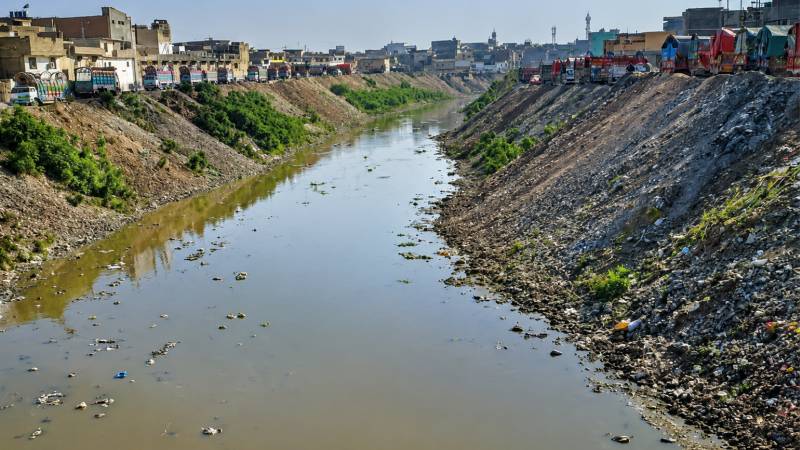
Residents of Nadeem Colony, Javed Colony, Arya Mohalla, and Dhoke Elahi Bakhsh observe a ritual at this time of year. Mattresses go up on shelves. Cash and ration move to the highest room in the house. Someone stays by the door, listening. Nobody here is waiting for a storm to pass; they are waiting to see whether Nullah Lai, a rainwater-fed natural stream that runs through the city of Rawalpindi, stops at the threshold this time, or comes inside.
It happened again overnight into 17 August. Rain that began around 3 a.m. dumped roughly 120mm on Rawalpindi, with the heaviest rain upstream; most reports put the day's highest total at 144–145mm in Golra, with Bokra close behind at around 132–134mm. The surge sent Nullah Lai to 20 feet at Kattarian and 17 feet at Gawalmandi before sirens could sound, and water pushed into Dhok Khabba and Sadiqabad within hours.
Downstream, in Khayaban-e-Sir Syed, officials pointed to a specific, avoidable cause: the channel narrows sharply near Ganjmandi Bridge, where illegally parked trucks and dumped debris have eaten into the waterway, despite a WASA letter demanding the Rawalpindi Municipal Corporation clear it out. The same truck stand behind Ganjmandi Police Station was flagged again as recently as June this year, and it was still there in August. That's the story of Nullah Lai in miniature: not a hazard nobody saw coming, but one the state watched arrive on paper and never removed.
Nullah Lai runs roughly 18 to 22 kilometres from the Margalla Hills through Rawalpindi's oldest, poorest quarters before joining the Soan River. It ran clean enough to drink from until the 1950s. Partition-era migration and unplanned growth slowly turned the stream into the city's default sewer, even as low-income families built homes on its floodplain, often because it was the only land within reach.
The worst disaster came on 23 July 2001, when a cloudburst dropped 620mm of rain on Islamabad in about ten hours, still Pakistan's heaviest recorded rainfall in a single day. The flood toll is remembered differently by different sources: figures range from 61 to 74 dead, with losses above $250 million. What's agreed is that over 400,000 people, nearly all of them among the twin cities' poorest, were affected, and 9 in 10 surveyed households lost property outright. The same basin has seen nineteen floods between 1944 and 2002, a serious flood roughly once every three years, ever since.
Twenty years later, the same failure repeated a few kilometres upstream. On 28 July 2021, heavy rain flooded Islamabad's E-11 sector, part of the same catchment. A mother and her seven-year-old son drowned when floodwater filled the basement of their home in a private housing scheme. Officials called it a cloudburst; the Met Office disputed that any cloudburst had occurred in Islamabad that day, one government office contradicting another while a family lay dead. A later review using satellite images found that a housing society had straightened and narrowed the nullah's natural path at the exact spot where the mother and child died, and it later emerged the society had never even been approved for the construction.
Downstream, in Khayaban-e-Sir Syed, officials pointed to a specific, avoidable cause: the channel narrows sharply near Ganjmandi Bridge, where illegally parked trucks and dumped debris have eaten into the waterway, despite a WASA letter demanding the Rawalpindi Municipal Corporation clear it out.
The same pattern shows up in Golra Sharif, on the Islamabad side. A resident of Mother Arcade, a building along the nullah there, described the flooding in August 2024 that filled his building's basement and destroyed every car parked in it; his own repair bill alone came to 350,000 rupees. Rescue teams took nearly two days to pump the basement out. His main complaint was about the building itself: the nullah runs wide through most of the area, he said, but narrows sharply right where it reaches his building, and nobody has ever explained who approved that or why. (This account was shared with the reporter directly and hasn't been independently checked against official records.)
This year alone, Rawalpindi has seen the same warning play out three times. Around 1 August, the Nullah reached a pre-alert 10 feet at Kattarian, flooding Sadiqabad, Dhoke Khabba, Arya Mohalla and Nadeem Colony. About ten days later, a heavier spell pushed it to a 22-foot danger mark, triggering evacuation sirens and sending water into Holy Family Hospital's maternity and children's ward mid-emergency; one local account reported a death that day, a woman who drowned in the Soan River. Then came the 17 August spell described above. None has matched 2001, but each follows the same script: a few hours of heavy rain, a fast rise at the same gauges, evacuations in the same neighbourhoods, then a quiet stretch before it happens again. Nationally, Pakistan's monsoon death toll has reached 155 since the season opened on 26 June, with around 450 injured.
The gap between plans and reality shows most clearly in the budget. WASA asked Punjab for Rs140 million this year to clear Nullah Lai and thirteen other drains; the province released Rs60 million. Silt that was dug out couldn't even be trucked away for lack of transport funds and washed straight back in during the first few spells of rain.
An estimated 700,000 residents and traders live in Rawalpindi's flood-prone zones. For them, the gap between the flood plan on paper and the one on the ground is measured in hours of warning and inches of water inside their homes. Pakistan has signed international agreements recognizing the right to adequate housing and health, and its own constitution guarantees a right to life that courts have read as including a right to a safe environment. Treating sirens and relief camps as routines that can slip past their own deadlines, rather than obligations, means accepting a level of risk here that wouldn't be tolerated in wealthier parts of the city. A large share of Pakistan's urban population, estimates vary from roughly a quarter to over half, depending on the source, lives on land like this simply because formal housing is out of reach.
Most of the plan already exists on paper: desilting schedules, lists of vulnerable points, evacuation procedures. What's missing is the discipline to carry it out, and real consequences when it isn't. Ring-fencing flood budgets so they can't be cut mid-monsoon, treating relief camps as ready before the season opens rather than as a target that can slip, and giving flood-zone residents an actual say in resettlement would all matter more than another new plan. Rawalpindi doesn't have a rainfall problem it can't see coming; it has an accountability problem, and its cost is paid every year by the people who can least afford it.