

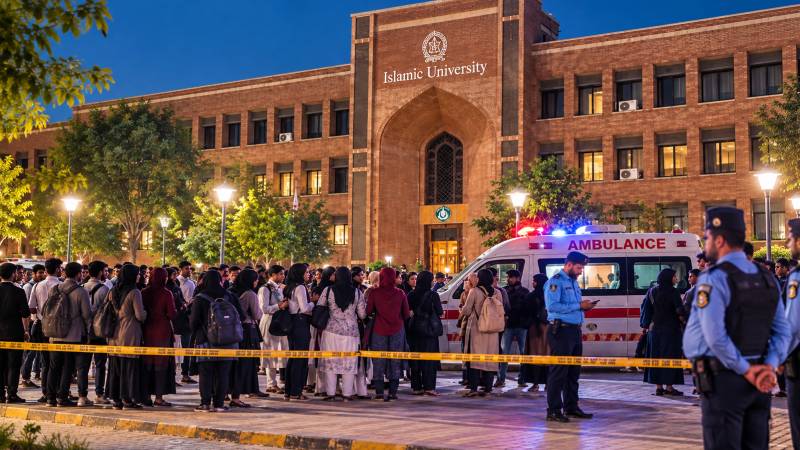
Laiba Ijaz finished her degree at the International Islamic University Islamabad with a gold medal. This month she was found dead in the capital. Police says it appears to be suicide, after she discovered that the US university admission, her family had paid millions of rupees for, was forged. Her father sells milk. According to her family, he sold a plot of land and her mother pawned her jewellery to pay for a future that was never real. Within days, the prime minister had taken notice, the interior minister was calling it a "test case," and a suspect was in custody. The state can move fast when it wants to. It just needed a body first. Laiba's story is not an aberration. It is what a cornered generation looks like from the inside.
To be young in Pakistan right now is to live with one thought: get out. Leaving has stopped feeling like ambition and started feeling like evacuation. Wages crawl while prices sprint, and a degree has become a participation certificate that guarantees neither a living nor any dignity. For a growing number of families, "abroad" is not a luxury. It is the only place a future still seems possible.
Billboards and Facebook ads promise a golden passage overseas, while the consultants behind them operate with little meaningful oversight of who they are or what they are actually selling. Working-class families sell land, pawn jewellery, and empty out decades of savings on the strength of a glossy brochure and a confident voice on the phone. When the letter turns out to be forged or the number goes dead, there is no consumer court fast enough to matter, no regulator who checked in advance, and no institution that can give back a stolen year, let alone a stolen life. What remains is shame, debt, and the awful discovery that the door was painted on the wall. The scammers are not the only gate, though. For those who do get through, who borrow the money, survive the paperwork, and secure a genuine visa, the state is waiting in the departure hall.
When the letter turns out to be forged, or the number goes dead, there is no consumer court fast enough to matter, no regulator who checked in advance, and no institution that can give back a stolen year, let alone a stolen life.
In 2025, Pakistan offloaded 66,154 passengers from international flights, nearly double the roughly 35,000 the year before. The Federal Investigation Agency says the surge is a response to human smuggling, and the argument is not frivolous: after the 2023 boat disaster off Greece drowned hundreds of Pakistanis, no serious person wants traffickers waved through. But enforcement without accountability is just power. Travellers holding valid visas have described being pulled out of line with no written order and no stated reason. A parliamentary committee demanded a redress mechanism. The FIA itself has told the Senate it penalised 85 of its own officials for misuse of authority, with complaints including an alleged Rs500,000 bribe demand at Lahore airport. When an agency has to discipline its own officers by the dozen, "trust us" stops being an answer.
Then comes the hypocrisy, which is hard to stomach. Pakistan received a record $41.6 billion in remittances last fiscal year, with Saudi Arabia and the UAE accounting for nearly half of it. That money patches the balance of payments. It props up the reserves. Ministers praise "overseas Pakistanis" at every opportunity. But the state wants the dollars without the departures, as if the money mailed itself.
Look at the whole picture, and the shape is obvious. At home: an economy with little room for ordinary ambition. In the middle: a fraud market that feeds on that desperation. At the airport: an apparatus that treats leaving as suspicious in itself. Each piece, on its own, is a policy failure. Together, they form a trap. A government that can arrest a suspect within days of a death but could not, or would not, police an industry for years beforehand has told us exactly where its urgency lies. Laiba Ijaz did not need a country's sympathy. She needed a country that was as fast before she died as it was after.