

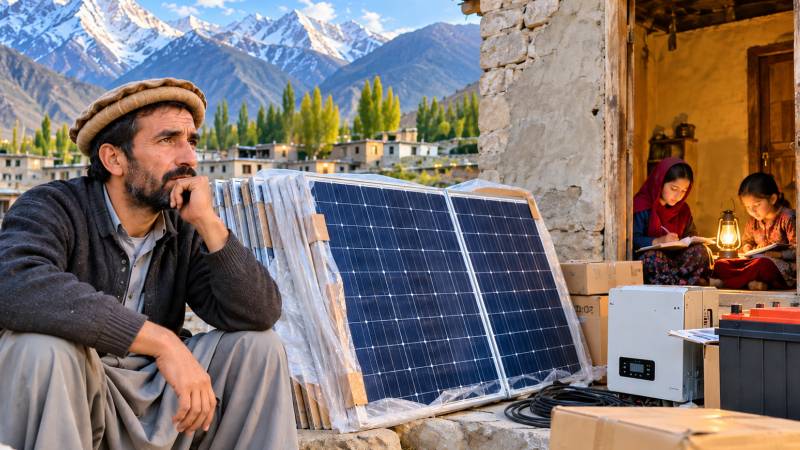
GILGIT: When Karim Baig, a 46-year-old grocer in Ghizer, saw his name on the selected list in April, he closed his shop early and walked home to tell his wife. For years the family has spent evenings around a single kerosene lamp, his daughters doing homework by its flicker while the village transformer sat silent. Then came the second piece of news. The panel had arrived, but it was useless on its own. "They told me the panel is free, but the inverter is compulsory and I must buy it," Baig said, sitting beside the six panels stacked in his courtyard, still in wrapping. "The battery is my choice, but without it, what do I do at night? I have a free panel and I still cannot light one room after dark."
In February, when Prime Minister Shehbaz Sharif's office announced a free solar scheme for Gilgit-Baltistan, one number made a wave among locals: 147,873, the number of households that media said would receive panels at no cost. Residents here, like the rest of Pakistan, have long been frustrated by unreliable and expensive grid power, which has held back both an equitable energy transition and the region's development. At the formal launch in May 2026, Federal Minister for Power Sardar Awais Ahmad Khan Leghari struck a grander note still, saying that "a prosperous Gilgit-Baltistan is the foundation of a prosperous Pakistan." That number and that sentiment are still the version most people in the region have heard. The scheme’s own portal data now makes the gap between the promise and the reality.
What squarely contradicts the "panels at no cost" claim is that beneficiaries in the remote, off-grid valleys must arrange and pay for their own batteries and inverters. Many cannot afford them, which raises doubts about whether the region’s poorest will actually benefit from the "gift" of clean energy. What the Economic Coordination Committee approved in February was the transfer of 144,875 solar panels, with a combined capacity of 58.8 megawatts, confiscated by Customs at Karachi’s ports under the Customs Act of 1969. Rather than auction the seized stock, as is standard practice, the federal government redirected it north. Moving that stock has cost about Rs 240.1 million, roughly Rs 1,623 per panel. Far from a "free gift", the Gilgit-Baltistan government was instructed to front the money and recover it from beneficiaries afterward. The 147,873 figure describes how many households could theoretically be served if every confiscated panel reached a separate home. It was never a delivery commitment, and the scheme’s own district-by-district numbers show it isn’t one.
What the Portal Shows
A district-wise check of the allocation dashboard shows:
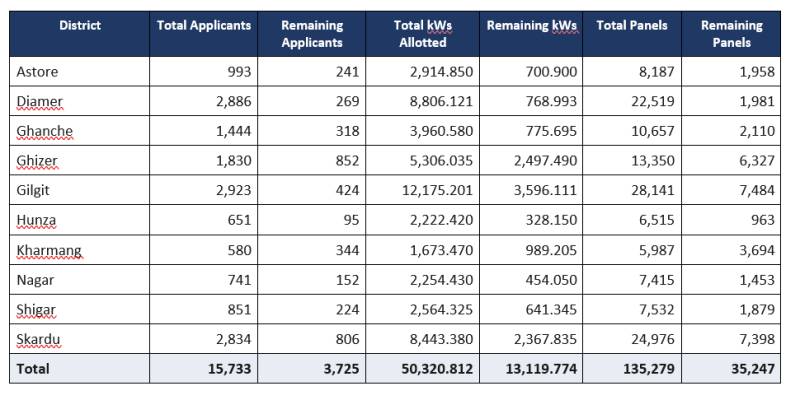
Three things stand out.
First, the total capacity allotted across all ten districts is 50,320.812 kilowatts, in the same range as the district eligibility list published in March, but below the widely quoted 58.8-megawatt figure from February.
Second, 15,733 applicants have been selected through electronic balloting — a number close to what the Prime Minister himself cited at the May launch, when he told the gathering that more than 50,000 applications had come in and roughly 15,000 beneficiaries had been chosen on merit.
Third, 3,725 of those selected applicants — about a quarter — remain in the "reserved but not issued" column. The dashboard is specific about what this means: remaining allocations are systems that have been reserved for a selected applicant but not yet issued. That is a description of an applicant not having come forward to collect an allotted system, not a department failing to dispatch one. Read that way, the pendency shown in the portal sits on the applicant’s side of the ledger, not the department’s — which raises a different, and arguably more important, question than a supply delay would: why would a selected household not come to collect a "free" panel it has already won?
A scheme announced as free power for nearly 148,000 of the region’s underserved has, in practice, delivered to roughly a tenth of that number, while a further quarter of those selected have yet to collect their allotted systems.
A Deadline, and a Question About Damaged Stock
The most recent official record available for this story confirms that the collection gap above is not a reporting artefact — it is now urgent enough to have its own deadline. On September 28, 2026, the Provincial Steering Committee for the scheme met in Gilgit under the chairmanship of the Chief Secretary, Gilgit-Baltistan, specifically to review "the progress of solar panel distribution and the arrangements for completing the remaining distribution process." That framing, from the province’s highest administrative body overseeing the scheme, matches this story’s own reading of the portal data: what remains is a collection problem, not a dispatch problem, and it has reached the point of requiring direct intervention.
The Committee’s response was to order a final public notice giving selected applicants exactly one week to collect their solar panels, with a hard deadline of October 4, 2026. The Secretary of the Information Department was directed to publicise the notice widely across print, electronic, social and local media, and Deputy Commissioners in every district were told to facilitate citizens during collection and coordinate closely with district storekeepers. Two further details from the same meeting add new dimensions to the story. First, Deputy Commissioners were separately directed to submit verified stock details distinguishing undamaged, available panels from damaged panels, for stock reconciliation — the first official acknowledgment that some portion of the confiscated stock sitting in district stores may have deteriorated or been damaged while awaiting collection. Given that beneficiaries are billed retroactively for the transport cost of the specific panel allotted to them, a damaged unit sitting unclaimed raises its own unanswered question: who absorbs that cost if a panel is written off before it ever reaches a rooftop? Second, NATCO was separately directed to ensure timely transport of panels allocated to IT businesses to their respective districts, suggesting the commercial and IT-sector allocation stream has faced its own, distinct transport bottleneck apart from the household track this story has focused on.
The Cost of "Free": Four Public Versions, and One Disputed Claim About the Application Stage
Even for the households whose panels have arrived, what "free" includes has never been a single, consistent story in public statements made after the scheme launched. The record shows at least four official versions.
Version one, from February’s initial coverage: batteries and inverters are the beneficiary’s own responsibility, along with transport.
Version two, from later local reporting: the inverter is included in the scheme, but the battery is not.
Version three, from officials quoted at provincial launch events: the "most deserving" BISP-registered families would receive both battery and inverter at no cost.
Version four: Former Additional Chief Secretary Mushtaq Ahmed told reporters in Gilgit that the inverter is compulsory, since a panel cannot be used without one, but the battery is a household’s choice, and government funds cover neither. What officials have negotiated, he said, is below-market pricing from vendor companies, not free supply. None of these versions has been formally retracted or superseded in public statements.
Is a Battery Actually Optional?
A more recent official explainer, circulated after criticism of the battery cost began to spread, makes the strongest public case that a battery isn’t necessary. It frames the scheme against a regional shortfall the government puts at 200 to 250 megawatts, and notes that a single panel retails at roughly Rs 25,000 to Rs 30,000. That makes a 3-kilowatt household system, the scale envisioned for most beneficiaries, an in-kind subsidy of about Rs 140,000.
The system can run directly off daylight through an inverter alone, enough for lights, fans and daytime charging. A battery is needed only to store power for after dark. Set against Ahmed’s account, this holds up on the battery question but not on the inverter. Ahmed has said explicitly that the inverter is compulsory and not supplied free. Even the “minimal, battery-free” setup the explainer describes requires a household to buy an inverter at whatever rate the government’s negotiated vendors charge, a figure that has not been made public. There is also a timing problem the explainer does not address. If the region’s power crisis is felt most acutely after dark, a daytime-only system may do comparatively little for the hours when darkness is the problem — the exact complaint Karim Baig raised about his daughters’ evening homework.
After the Panel Goes Up
There is a second, quieter risk that rarely makes it into launch-day coverage: what happens after installation. Solar hardware is not maintenance-free. Panels need periodic cleaning where dust and, at high-altitude locations, snow are seasonal realities; inverters fail; and batteries degrade within a few years of hard use in a climate that swings between intense high-altitude sun and sub-zero winters.
"Every solar programme I have seen fail did not fail on installation day. It failed in year two, when the first inverter burned out and nobody within 200 kilometres knew how to fix it," said Naveed Abbas, an engineer who has worked on village electrification projects in the north. "Without trained local technicians, spare parts and a service line, you are not delivering electricity. You are delivering a set of quietly dead rooftop panels, just on a delay." No after-sales or maintenance-training component has been publicly announced alongside the scheme. That gap also holds an opportunity the scheme seems to have neglected. A maintenance network built around local technicians would create the steady, distributed employment that a remote, tourism- and agriculture-dependent economy needs — work that doesn’t require migration to Karachi or the Gulf.
The Larger, Slower Half: Officially Behind, Officially Frozen
Running alongside the confiscated-panel scheme is a second, larger initiative: a 100-megawatt package comprising an 82-megawatt utility-scale solar cluster and an 18-megawatt rooftop programme across 499 government buildings. An official project status brief dated August 11, 2026, the most detailed accounting of progress to surface publicly, shows this half is further behind and more expensive than earlier statements suggested, and that key parts of it have stopped moving entirely.
"One day the inverter will come. I only hope my children are not grown by then." — Karim Baig, grocer, Ghizer
Back in his courtyard in Ghizer, Karim Baig is still waiting. The panels are stacked against the wall, and the kerosene lamp is still what it has always been — a small, stubborn hope, especially with winter coming. "One day the inverter will come," he said. "I only hope my children are not grown by then."
Pull the threads together, and the fair summary is neither the celebratory one in February’s coverage nor a simple story of official failure. But a scheme announced as free power for nearly 148,000 of the region’s underserved has, in practice, delivered to roughly a tenth of that number, left a further quarter of even that smaller group without a reason on record for why they haven’t collected their allotted systems, and produced four different public accounts — after the fact — of what "free" actually means. The grid-scale half of the project that would carry power through the night is, by the government’s own internal accounting, three percent complete a year after approval, with its true combined cost never stated as one figure and its third-party validation process halted before it began. Awais Leghari called a prosperous Gilgit-Baltistan the foundation of a prosperous Pakistan. On the evidence gathered here, the foundation is still barely poured, and the family deciding whether it can afford to collect the "free" panel it already won is the same family the scheme was announced to help.