

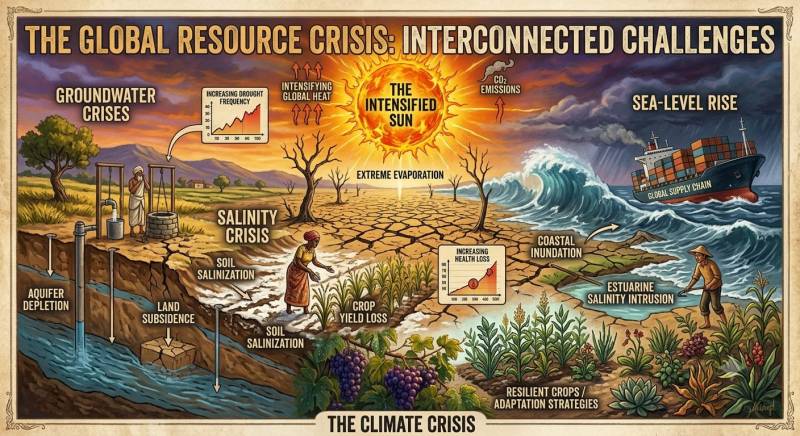
Beneath Punjab’s lush green fields, a reservoir is running dry — and nobody is counting the drops. For decades, the subterranean aquifers of Punjab have been the unsung lifeline of our agrarian economy. Today, however, a macabre combination of policy paralysis, technological shifts, and institutional neglect is draining these hidden reserves at a breakneck pace, leaving behind a toxic legacy of salinity and scarcity.
The sheer scale of this extraction is staggering. Pakistan is the third-largest user of groundwater for irrigation globally, with a whopping 73% of its agricultural footprint relying directly or indirectly on groundwater. Out of the 68 billion cubic meters (bcm) of groundwater extracted nationally, a lion’s share — 60 bcm — is pumped from beneath the earth, and Punjab alone accounts for 90% of this massive depletion. To put it bluntly, we are extracting water at a rate 142% higher than the rate at which nature can replenish it.
The latest data from the Water Resources Zone (WRZ) of the Punjab Irrigation Department (PID) paints a grim picture. The groundwater table is declining at an alarming rate of 0.5 to 1.0 meters per annum. Pre- and post-monsoon piezometer readings from boreholes reveal that districts such as Pakpattan, Okara, and Multan are witnessing annual declines of 1.81 feet, 1.72 feet, and 1.52 feet, respectively. In volumetric terms, Okara and Rahim Yar Khan alone are losing approximately 4.15 and 4.08 million acre-feet (MAF) of groundwater annually. Cumulatively, Punjab’s groundwater withdrawals have surpassed a staggering 53 MAF — narrowly mirroring the province’s entire allocated share of canal surface water, which stands at 56 MAF.
How did we get here? The answer lies in a paradoxical twist of technology. In 1960, Punjab had merely 4,500 tube wells; today, that number has expanded to more than 1.5 million. Historically, the high cost of electricity and diesel acted as a natural, albeit unintended, regulator. Farmers pumped water only when absolutely necessary. The advent of solar panels, however, has altered this equation. With the sun powering pumps almost free of cost, groundwater extraction has become easier, leading to excessive and continuous pumping. When water is perceived as free, it is often treated as limitless.
But the crisis does not end with quantity; the quality of groundwater is equally under threat. This is where the specialized wings of the Water Resources Zone (WRZ) of the Punjab Irrigation Department (PID) play an indispensable yet underappreciated role. The Surveyor Wing conducts detailed circle-level surveys to monitor groundwater levels and quality parameters. This data is then transferred to the Salinity Research Wing, which analyses water-borne salinisation and determines the suitability of water for irrigation. Working together, these two wings have uncovered a deeply disturbing trend: unchecked pumping of "fit" irrigation water is rapidly altering aquifer dynamics, drawing saline water upward and causing secondary salinisation of the soil.
The Salinity Research Wing, through its salinity assessments and bioremediation efforts at PID research farms, has long warned about the delicate relationship between water and soil. The white, crusty salt spreading across fertile lands is the consequence of mismanaged water resources. Furthermore, contemporary research highlights a high risk of arsenic and heavy metal contamination in Punjab’s groundwater hotspots — carcinogenic and mutagenic threats that are gradually turning rural drinking water into a silent poison.
Punjab’s dying aquifers reveal the hidden cost of unchecked extraction.
Amid this crisis, the Water Resources Zone has emerged as a vital institutional anchor. In a significant step towards data-driven governance, the Water Resources Zone has recently completed a geo-referenced database project, enumerating and geo-tagging every tube well across Punjab. This digital footprint provides the foundation upon which future groundwater regulation must be built. One cannot manage what one cannot measure, and the Water Resources Zone has finally provided the measuring tool.
Yet, the bureaucratic and political response remains inadequate. Under the Punjab Government, the prevailing approach has been to rely on command-and-control measures — licensing tubewells and imposing extraction tariffs. This approach risks creating more problems than solutions. Price-based deterrents may burden farmers while creating opportunities for rent-seeking and corruption during enforcement. The challenge is not to punish farmers for pumping water but to restore the delicate balance between groundwater withdrawal and recharge. Tehran’s sinking plains serve as a warning of what awaits us if we fail to act. Instead of coercion, we need strategic recharge interventions.
To truly understand the gravity of this crisis, step into the worn-out shoes of Haji Shams Ul Haque Bohar, a smallholder farmer on the outskirts of Shujabad. A decade ago, Haji Shams Ul Haque Bohar would turn on his diesel tubewell with hesitation, calculating rising fuel costs against the market value of his wheat crop and mango orchard. He irrigated his fields only when absolutely necessary.
Then came the solar panel salesman, promising free water from the sky. Haji Shams Ul Haque Bohar took a loan and installed a solar tubewell. The constant hum of the pump became a familiar sound. He began irrigating his fields more generously, even allowing water to overflow onto pathways. Why not? The sun did not send a bill.
But last year, the music stopped. By mid-May, the pump began sputtering. The water table, which once stood at 30 feet, had fallen beyond 80 feet. When water finally reached the surface, it left behind a white, chalky residue that damaged crops. The groundwater was becoming saline. Today, as warnings from the Water Resources Zone’s piezometers echo through government corridors, Haji Shams Ul Haque Bohar stands in his field, staring at a dry, salty crust where his livelihood once flourished. The sun still shines on his solar panels, but there is increasingly less underground water left to extract.
Pakistan routinely struggles with unmanaged excess surface water during monsoon seasons and floods. The Punjab Irrigation Department must repurpose abandoned canals and emergency escape channels into groundwater recharge ponds. Thousands of historic village drinking-water ponds on government land, many of which have been encroached upon, should be reclaimed and converted into recharge structures. Furthermore, the government must launch a dedicated Annual Development Programme to subsidise farm-level recharge wells — boreholes designed to channel excess rainwater back into aquifers while simultaneously preventing waterlogging and restoring depleted reserves.
Pakistan can no longer afford the reactive short-sightedness of its decision-makers. It is time for the government to demonstrate the political will required to address this crisis. Otherwise, future generations will inherit a barren landscape — high, dry, and saline. The time to recharge and regulate is now.