

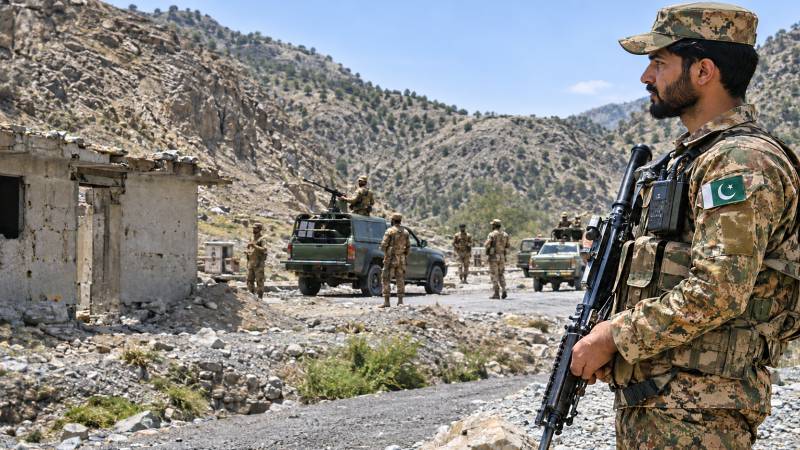
In the rugged districts of South Waziristan, Bannu, and Tank, the pattern is grimly familiar. Credible intelligence leads security forces to a hideout, followed by intense exchanges of fire. Pakistani security forces report the elimination of another group of militants: 22 members of the Indian-sponsored Fitna al-Khawarij during operations on 16-17 November 2026, following the neutralisation of 74 others just days earlier in Khyber Pakhtunkhwa and Balochistan. Statements from Inter-Services Public Relations are precise, and the reported casualty figures are presented clinically. Yet the group that continues to replenish its ranks, Tehrik-i-Taliban Pakistan, survives because its strategic rear base has never been closed. That base is Afghanistan, under the current authorities in Kabul.
The TTP did not appear on its own. It formed after the 2001 U.S.-led invasion of Afghanistan, when thousands of Taliban fighters, al-Qaeda members, and foreign militants crossed the porous Durand Line into Pakistan’s Federally Administered Tribal Areas. Limited central oversight under the old Frontier Crimes Regulations, along with strong Pashtun ethnic and cultural ties across the border, made the area an ideal sanctuary. Pakistan’s choice to join the United States in the Global War on Terror upset the tribal balance. Traditional jirga authority weakened, resentment grew, and commanders like Nek Muhammad Wazir took advantage of the unrest.
In December 2007, Baitullah Mehsud called a shura that officially announced the Tehrik-i-Taliban Pakistan as a group uniting about thirteen militant factions. Their goals were clear: stop Pakistani military operations in FATA and Swat, enforce a strict Deobandi version of Sharia, resist NATO forces in Afghanistan, and turn Pakistan into an Islamic emirate. Early funding came from local protection taxes, kidnappings for ransom, donations, and cross-border smuggling. The group’s decentralized structure helped it grow quickly but also led to future internal rivalries.
From 2008 to 2014, the TTP reached its peak in both territory and violence. Under Baitullah and later Hakimullah Mehsud, the group set up parallel rule in large parts of Swat, South Waziristan, and North Waziristan, with mobile Sharia courts, vice squads, systematic taxes, and targeted killings of pro-government tribal elders. Alliances with Punjabi militants, the Islamic Movement of Uzbekistan, and al-Qaeda made the group stronger. Major attacks followed, including the assassination of Benazir Bhutto, the attack on the Army’s General Headquarters in Rawalpindi, the shooting of Malala Yousafzai, and the December 2014 Army Public School massacre in Peshawar that killed 149 people, including 132 children. That attack is still the deadliest terrorist incident in Pakistan’s history and was a turning point that united the country.
Pakistan responded with greater force. Operations Rah-e-Haq in Swat and Rah-e-Nijat in South Waziristan cleared militants but caused significant humanitarian costs. In June 2014, Operation Zarb-e-Azb in North Waziristan marked the peak of these efforts. Up to 30,000 troops, backed by air strikes, destroyed hundreds of hideouts, seized large amounts of explosives and weapons, and killed thousands of militants. Nearly one million civilians were displaced, but attacks across the country dropped sharply. By 2016-2018, the TTP’s core strength was down to about 2,000 fighters, many based near the Afghan border.
When Mufti Noor Wali Mehsud became emir in June 2018, the group began a period of renewal. He called for more restraint against civilian targets, focused on wearing down security forces, increased central control through the Rahbari Shura, and improved propaganda that presented the conflict as defending tribal rights. He also managed alliances with the Afghan Taliban carefully. These changes helped the group survive its toughest period.
The TTP's revival under Mufti Noor Wali Mehsud was not merely a return to its former methods. It was a strategic transformation built around greater central control, selective restraint against civilian targets, sustained pressure on security forces and sophisticated propaganda portraying the insurgency as a struggle for tribal rights.
In August 2021, the U.S. and NATO withdrew, and the Afghan Taliban quickly took over Kabul. This gave the TTP new strategic depth. Afghanistan became a rear base with safe havens, training camps, weapons stores, financial channels, and free cross-border movement. The TTP leadership publicly renewed its loyalty to the Islamic Emirate. Ceasefires did not last because the TTP refused to disarm or give up its goals.
United Nations monitoring reports have regularly shown the scale of the problem. They estimate about 6,000 TTP fighters and their families are in Afghanistan, mainly in Kunar, Nangarhar, Paktika, Khost, and Paktia. Later reports noted that around 2,000 fighters and families were moved deeper into Afghanistan, making them less visible near the border but still active. Training, weapons movement, and support continued. The UN also found that the group had access to advanced equipment like M4 carbines, optics, and night-vision devices.
Financing networks quietly keep the group going. Besides local extortion and smuggling, UN monitoring has reported that TTP leaders get financial help from people linked to Taliban networks, with earlier reports mentioning monthly transfers of tens of thousands of dollars. Hawala systems, contributions from the diaspora, and now cryptocurrency wallets have added to traditional funding. Mining revenues and protection rackets in Afghan border provinces also support the group. As a result, the TTP is not short on cash and can maintain professional fighters, propaganda, and new technology.
The group’s use of technology is most obvious in its drone campaign. Commercial Chinese quad-copters, easy to find in Kabul markets, are modified to drop mortar rounds or used as first-person-view attack drones. Pakistani security forces recorded hundreds of these attacks in 2025 alone, and dozens were stopped each month in Khyber Pakhtunkhwa through 2026. Both the TTP and Afghan Taliban use the same commercial drones, showing that supply chains and technical know-how cross the border easily. The human and material costs are difficult to quantify. Security forces have suffered thousands of fatalities. Civilians have been repeatedly displaced, lost their homes and schools, and experienced long-term trauma. The insurgency has deterred investment, disrupted CPEC projects, and increased defence expenditure. It has also exacerbated ethnic tensions and perpetuated cycles of radicalisation.
Pakistan’s countermeasures are multi-layered: intelligence-based operations, border fencing and surveillance, and targeted strikes against camps launching attacks into Pakistani territory. When Pakistani aircraft have hit targets inside Afghanistan, the reason given is the right of self-defence. The Afghan Taliban’s failure to dismantle TTP infrastructure is not just a diplomatic issue; it is the main reason the insurgency continues. After five years of control, the choice is clear: protect the sanctuary or fulfill obligations to neighbors. Until Kabul treats the TTP as a terrorist group, not just an ideological ally or tool, the Durand Line will keep being a route for violence. Pakistan has paid dearly for believing that shared ethnicity and old alliances would outweigh the reality of sanctuary. That belief is over. The sanctuary must be closed, either by Afghan action or continued Pakistani pressure. There is no other way to protect Pakistani lives or regional stability.