

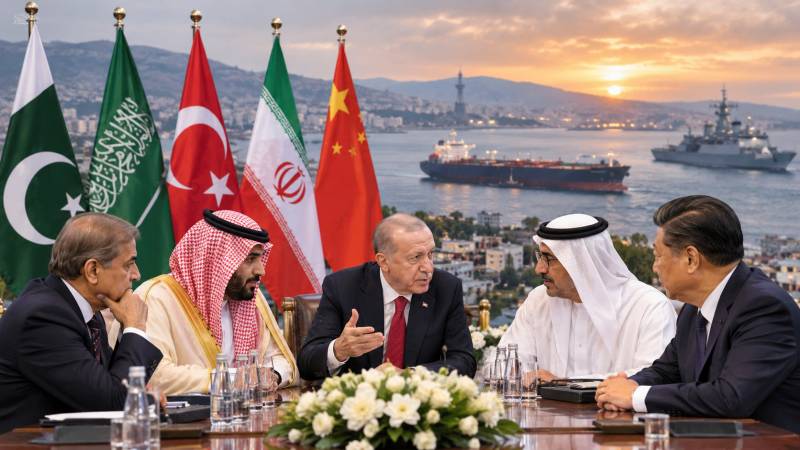
The outbreak of the Iran-U.S.-Israel war on February 28, 2026, transformed the Middle Eastern security architecture. Iran's resilience in its armed conflict with the United States, coupled with the Republican Party's electoral rout in the midterm elections, means that Tehran has emerged as a major player and power in the Persian Gulf region. Efforts by Pakistan, Saudi Arabia and Turkiya to prevent another escalation of the conflict in the Gulf region reflect the fact that the signatories of the Makkah Pact, during their meeting held in Tehran in October, succeeded in persuading Iran to use diplomacy and dialogue to promote peace in the region.
What is the regional security architecture, and how has it transformed as a result of the U.S.-Iran armed conflict, the closure of the Strait of Hormuz and periodic threats made by Washington and Tehran against each other? How can the regional security architecture be transformed to ensure peace and stability? These are the questions raised by those concerned about the sustained Iran-U.S. conflict. According to an editorial published in Daily Dawn on April 20, 2026, titled "Pakistan Emerges as the Harbinger of a New Regional Security Paradigm":
"China and Pakistan have recently unveiled a joint five-point initiative for restoring peace and stability in the Gulf and Middle East region, calling for an immediate ceasefire and an end to the hostilities, the launch of peace negotiations as soon as possible, the protection of civilians and non-military targets, the safeguarding of maritime shipping security, and upholding the central role of the United Nations Charter. Pakistan, which shares a border with Iran, has signed a security agreement with Saudi Arabia, and maintains friendly relations with the US. As a key player in the broader Middle East region, it has a direct stake in regional stability, and these unique advantages enable it to play an important role in the efforts to de-escalate tensions and advance peace negotiations."
China's application of soft power to build peace and stability in the Persian Gulf and the Middle East is a reality. However, four countries have been at the forefront of efforts to prevent further escalation of the U.S.-Iran armed conflict in recent months: Pakistan, Saudi Arabia, Turkiya and Qatar. Yet, the question arises: How can regional security be stabilised when Saudi Arabia, Turkiya and Qatar follow a pro-American approach, whereas Pakistan is trying to maintain a balance between Iran and the United States? Furthermore, regional security in the Gulf and the Middle East cannot be ensured without India's involvement, as it is a major South Asian country with the world's largest population and the fifth-largest economy.
At present, the focus of regional security remains on the Iran-U.S. armed conflict. However, since Israel and the United States attacked Iran on February 28, 2026, the regions of South Asia, West Asia, the Persian Gulf and the Middle East have faced instability. The closure of the Strait of Hormuz, Houthi attacks on Saudi Arabia, threats to close the Bab el-Mandeb Strait, and surging oil and gas prices, which have contributed to an escalating global economic crisis, can be identified as major challenges to regional security.
Can the Makkah Pact, involving Pakistan, Saudi Arabia and Turkiya, stabilise regional security, particularly when Iran has reservations about the pact and considers it an attempt to further isolate Tehran? A recent visit by delegations from Saudi Arabia, Turkiya and Pakistan to Tehran, aimed at persuading Iran to adopt a flexible stance on the Strait of Hormuz and pursue a comprehensive peace agreement with the United States, failed to yield positive results. Iran has made it clear that, without the U.S. accepting its four demands, it will not make any progress towards a permanent ceasefire. These four demands are the unblocking of Iranian ports by the United States, the lifting of sanctions, the unfreezing of Iranian assets and respect for Iran's sovereignty. The United States has also put forward its own demands, which focus on freezing Iran's nuclear programme, lifting the blockade of the Strait of Hormuz and ending Iran's support for Hezbollah and the Houthis. Following the Republican Party's setback in the November 2026 midterm elections and Israeli Prime Minister Benjamin Netanyahu's failure to secure a majority in the general elections, the threat of further escalation of the regional security crisis has diminished.
Only through mediation, dialogue and diplomacy can the security challenges threatening the region be managed, while confidence-building measures and conflict management can reshape regional security paradigms on pragmatic lines.
The changing regional security paradigm encompassing South Asia, West Asia, the Persian Gulf and the Middle East needs to be examined from three perspectives. First, without an agreement between Iran and the United States on a permanent ceasefire and peace, regional security will remain elusive and vulnerable to further escalation. Unless the Strait of Hormuz is reopened and the Houthis are prevented from blocking the Bab el-Mandeb Strait, regional security will remain susceptible to escalating crises. For this purpose, an agreement between the United States and Iran on reopening the Strait of Hormuz is essential to stabilise the global economy, which is facing serious challenges because of the oil and gas crisis.
Interestingly, at the beginning of the U.S.-Iran-Israel war, the Strait of Hormuz was not the central issue. The primary objective of the United States and Israel in attacking Iran was regime change and depriving Tehran of its nuclear capabilities. While the nuclear issue remains on the agenda, neither Israel nor the United States now talks about regime change in Tehran. It was the closure of the Strait of Hormuz and Iranian missile attacks against pro-American Gulf countries that destabilised regional security.
Second, the signing of the Makkah Pact is regarded as a gateway to stabilising regional security. However, Iran has not approved the pact because Saudi Arabia and Turkiya are pro-American, whereas Pakistan is trying to balance its relations with both Iran and the United States.
It would have been more plausible if the signatories of the Makkah Pact had focused on Israeli aggression in the Middle East and its expansionist designs in the region. Saudi Arabia, Turkiya and Pakistan should have addressed the threat posed by Israel, as the Jewish state is the only nuclear power in the Middle East and has pursued a policy of aggression against Lebanon, Syria, Gaza and the West Bank. The lack of wisdom, prudence and perseverance among Arab and Muslim countries in recognising Israel as a major threat to the Middle East has provided enormous opportunities and space for the United States and the Jewish state to sustain their dominance in the region.
Finally, redesigning the regional security architecture for the Middle East, the Persian Gulf, West Asia and South Asia would require the exclusion of external powers and a focus on developing a consensus involving India, Iran, Pakistan, GCC countries and Turkiya. Such a consensus should aim to formulate a security system that respects sovereignty and territorial integrity while reducing militarisation in the region. Instead of portraying Iran as a major threat in the Persian Gulf and the Middle East, the focus should be on preventing Israeli aggression and expansionist designs in the region. For this purpose, reopening the Strait of Hormuz, stopping the Houthis from conducting attacks on Saudi Arabia and preventing threats to close the Bab el-Mandeb Strait are the need of the hour.
The U.S. midterm election results and Israeli Prime Minister Benjamin Netanyahu's failure to secure a majority in the recent general elections provide regional states with a valuable opportunity to consider formulating a security architecture that guarantees peace and stability without American involvement. Reconciliation between Iran and the Arab Gulf countries is also the need of the hour because the events of 2026 have destabilised the region through armed conflicts and the closure of the Strait of Hormuz, resulting in an oil, gas and economic crisis. Only through mediation, dialogue and diplomacy can the security challenges threatening the region be managed. Henceforth, confidence-building measures and conflict management, alongside such diplomatic initiatives, can help reshape regional security paradigms along pragmatic lines.