

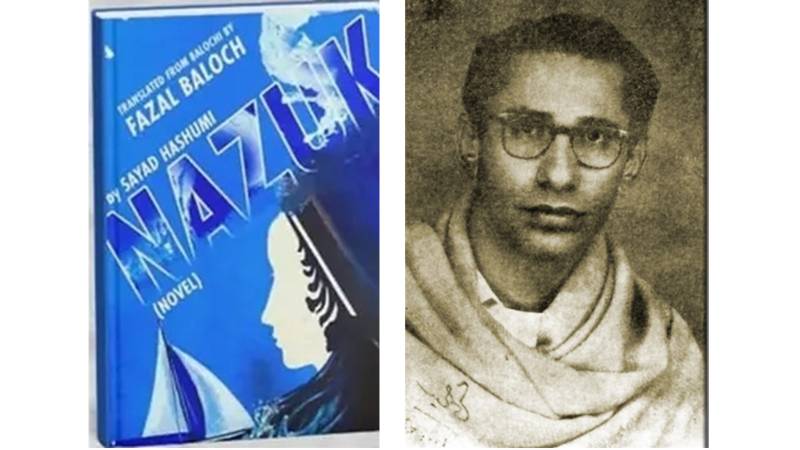
The depth of classic fiction proves that truly great literature leaves a timeless impression on readers across generations. Outstanding literature always fascinates readers beyond linguistic and cultural boundaries.
Originally written in Balochi, Syed Hashmi's seminal 1976 novel Nazuk opens up a new world of literature to a broader readership. This classic captivates readers, proving that great literature knows no boundaries.
Syed Zahoor Shah Hashmi is a renowned and celebrated Baloch poet, novelist, and literary titan of the 20th century. His stylistic writing is distinctive, his sentence construction is masterfully precise and laced with metaphors, while his language is rich yet transformative. He produced his magnum opus novel, Nazuk, at a time when long-form fiction was almost non-existent in the Balochi language. This landmark novel marked a decisive turning point and was nothing short of revolutionary for Balochi literature.
After first being translated into Persian in 2005, the novel is now also available in English through Fazal Baloch's translation. Its recent English publication immediately caught my attention. It took me back to my school days when I first read Nazuk in Balochi. That first reading sparked my interest in fiction.
Fazal Baloch stands out as an incredibly acclaimed translator of the Balochi language, who has made the creative works of numerous Baloch authors and poets accessible to an expanded readership. His latest translation of Nazuk is particularly noteworthy, as it has been selected for the 2026 Himal Southasian Fiction in Translation List.
At a time when long-form fiction was almost non-existent in the Balochi language, this landmark novel marked a decisive turning point
Nazuk is a groundbreaking work that holds the distinction of being the first and pioneer novel in Balochi, considered a prototype of modern Balochi fiction. Many later Balochi novels fostered its narrative techniques, marking the beginning of the novelistic tradition in the Balochi language. The impact of this transformation became increasingly visible in the decades that followed.
Before this shift, Balochi prose fiction was predominantly confined to short stories published in monthly literary journals. For centuries, oral tradition remained the dominant form of literary expression in Balochi. Stories, ballads, folktales, and love epics were passed down from one generation to another. Women, despite often lacking formal education, played a vital role as custodians of this cultural memory. On winter nights, families gathered around dimly lit oil lamps, sharing stories and listening to tales of love, heroism, sacrifice, and loss.
Nazuk also represented a definitive shift from oral storytelling to modern Balochi prose fiction. Yet a quiet irony remains: despite its rich literary legacy, Baloch literature is rarely represented in English-language discourse. Fazal Baloch has helped bridge this gap by introducing some of the finest works of Balochi literature to readers who do not know the language.
His exquisite translation of Nazuk's dazzling story made this classic reachable to a wider audience. Translation itself upholds a noble tradition; carrying an author's voice across linguistic boundaries, it enables writers who might otherwise remain unknown to reach a global audience.
Translating classical fiction is not just about words; it is an art that demands precision, skill, and creativity. Fazal Baloch strikes a fine balance between staying faithful to the original text and making it relatable to the target audience. His carefully chosen words preserve the novel's meaning, depth, and natural rhythm.
This exceptional English translation spans 91 pages and is divided into 19 numbered sections. Each section exhibits qualities whereby the more a reader reads and rereads, the more they become reacquainted with the classics.
Set against the backdrop of Baloch coastal life, where people rely almost entirely on fishing for their livelihood, the novel explores the emotional and psychological world of fisherfolk and their families with seamless expression. The author takes a familiar story and makes it relevant to the deepest and darkest realities of life in the Baloch fishing communities along the coast.
At the time the novel was written, Baloch fishermen traditionally fished from small wooden skiffs, using hand lines with baited hooks rather than modern fishing equipment. They often risked being attacked by large fish or losing their lives in violent sea storms.
Nazuk is primarily a dialogue-driven novel with a framed (or layered) narrative. Its opening sections introduce many characters and conversations before gradually focusing on the main plot and central character. Much of the story unfolds through conversations, and Syed Hashmi’s sparse style relies heavily on dialogue, with plot progression occurring largely through these conversations.
The story centres on Nazuk, the central protagonist, her three husbands—each believed to have perished in storms at sea—and Gazabek, the village elder and mediator. In the novel, the themes of fate, social superstition, and mythical beliefs run throughout the story, portraying Nazuk's painful ordeals and personal tragedies as events interpreted by society as destiny or a curse. The story also depicts the hardships of a seafaring Baloch community and offers a vivid portrayal of the maritime culture of that era.
Nazuk, the novel's lead character, marries three times, but each of her husbands dies while fishing. Widowed on three separate occasions, she is superstitiously regarded as an unlucky and ill-fated woman. In a cruel twist of myth, the deaths of her husbands are attributed to her supposed bad luck, and she is satirically labelled a "husband-killer." She is unfairly subjected to social exclusion.
Nazuk's setbacks in the novel can also be traced to a long lineage of female characters in traditional societies whose lives are marked by suffering, loss, and social stigma for reasons beyond their control. The novel powerfully reveals how patriarchal societies mythologise women's lives and transform personal tragedy into social ostracism.
The novel also offers a sharp critique of how powerful individuals exploit the weak. As the story unfolds, Gazabek, a respected Kâhûda (village leader and decision-maker), commonly addressed as Wàjja (an honorific title of respect), acts as a landlord and mediator. Through a traditional Balochi Déwan, with the involvement of a Qazi, he intervenes to help Nazuk recover her land from a close relative. Initially, he appears to be a wise arbitrator and guardian of justice. However, his true motives gradually emerge. He is ultimately portrayed as a self-serving patriarch who, under the guise of dispensing justice, is merely fishing in troubled waters and exploiting Nazuk's predicament for his own personal gain.
The translator's rendering is both compelling and meticulous. However, in this translation, the translator to some extent uses monotonous word choices and repetitive diction in certain passages, which somewhat reduces the stylistic variety of the text, but this does not detract from its overall impact or excellence.
Taken as a whole, the translation is exceptionally lucid, employing simple language and clear expression without unnecessary complexity. The translation of Nazuk makes for an engrossing read; it is easily accessible for young and general readers alike.
By and large, the translation of regional literature into English helps promote local voices through intercultural dialogue. Indeed, Fazal Baloch, through his magnificent translation, has done a stellar job of elevating the rich Baloch literary legacy and its cultural heritage onto the global stage.