

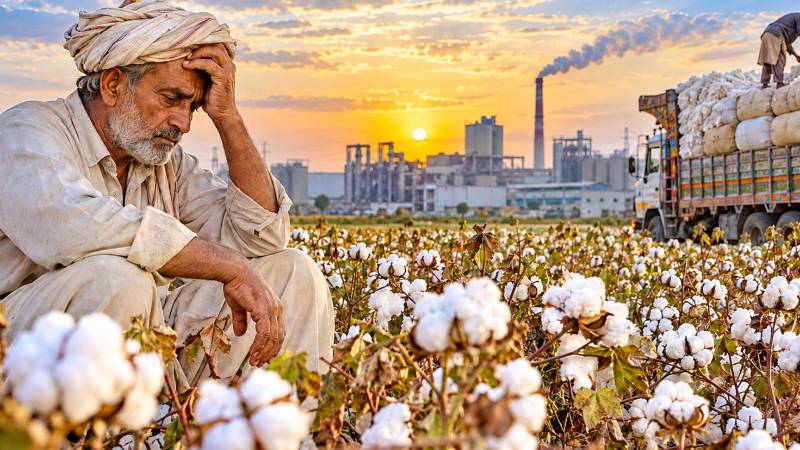
The Federal Committee on Agriculture met in Islamabad this month and confirmed what the fields had already announced. Cotton production in 2026-27 is estimated at 6.71 million bales against a target of 9.64 million. A shortfall of 30 per cent, in a season the ministry itself has not blamed on the weather. It is the sixth consecutive miss. Over the last five years, the state has promised between roughly 10 and 13 million bales and delivered between five and eight and a half. Each spring a target, each autumn an apology, each winter a seminar. The ritual is now so familiar that the ginners have stopped pretending to believe it. They call these drawing-room estimates, and they are right.
The more honest number of this season is not production. It is acreage. Cotton area fell 12.6 per cent in a single year, from 4.97 million acres to 4.35 million, that is over 600,000 acres. In Punjab the fall was 16.4 per cent. This was not a decision taken by the Ministry of National Food Security. It was taken by a few hundred thousand farmers, each alone at the sowing window, each doing arithmetic the state refuses to do. There is a revealing twist. Cotton yield per acre actually improved by nearly nine per cent this season, according to preliminary reports, yet total production fell because farmers planted substantially less of it. The immediate crisis is not simply that farmers cannot grow enough cotton. It is that they increasingly choose not to. Look at where the land went. Sugarcane area expanded 11.2 per cent, maize 11.5 per cent and rice 3.9 per cent. Farmers are not abandoning agriculture. They are abandoning cotton, and they are doing it for reasons that would be taught in any introductory economics class.
The economics are stark. In a comparison of Punjab's 2022-23 crops, the government's Agriculture Policy Institute estimated net income of about Rs64,000 per acre from cotton, against Rs42,000 from sugarcane. Cotton could compete. But a more recent assessment by Fauji Fertilizer put the provisional 2025-26 net income at barely Rs5,000 an acre for cotton, against Rs54,000 for sugarcane. While these two assessments use different methods and cover different seasons, their contrast illustrates a stark shift in relative returns. Cotton promises a return when things go right, but offers no protection when they do not. A single poor season consumes the savings from earlier harvests.
Sugarcane is hardly free of risk. It demands more water, occupies land longer and exposes growers to payment delays and mill disputes. But near an established sugar mill, its marketing arrangements may appear more predictable than cotton's. The buyer is more identifiable and structured purchasing arrangements exist, and the price, though no longer officially notified, moves in a narrow, predictable band. Farmers are not necessarily choosing a crop with higher potential returns. They are choosing one whose risks they believe they understand and can manage.
The cotton grower's worries begin before sowing and never end. Will the seed germinate? Is it genuinely the variety printed on the bag? Will canal water arrive at flowering, when a missed irrigation can be costly? And after all that, will the price cover the cost, or will imported bales, carried by policy preference, undercut him at the gin? Start with seed, the first decision of the season. In 2025, the federal food ministry acknowledged widespread uncertified seed sales and took action against hundreds of non-compliant companies. Yet much of what Pakistan's cotton farmers sow remains informal. A farmer cannot test every packet before sowing. When seed fails, there is no claim, no compensation, no accountability. The farmer absorbs the loss alone and remembers it at the next sowing.
A law that is not enforced is a condolence, not a reform.
Then there is research. Pakistan's cotton yields remain substantially below those achieved by leading producers. Yet the institution responsible for developing better varieties, the Pakistan Central Cotton Committee, has spent years struggling to finance its own existence. Despite winning 63 of 65 court cases to collect its dues, outstanding cess liabilities exceeded Rs 3.44 billion in 2025, forcing 50 to 80 per cent cuts in staff salaries and pensions since 2022. An enforcement mechanism approved in late 2025 remains unimplemented. Research without money is not research. It is press releases.
Water deserves a paragraph of its own. Cotton in Punjab and Sindh is a canal crop with exacting timing. I farm at the tail of a canal in south Punjab. I know that an allocation on paper is not water in the watercourse in the week the crop needs it. Canal deliveries are unpredictable, and groundwater, the farmer's insurance, is depleting across the cotton belt. Punjab replaced the Canal and Drainage Act of 1873 with a modern irrigation law in 2023, a statute I helped write, built on the premise that water would be accounted for, priced with some honesty and delivered equitably. The framework exists. The delivery does not. A law that is not enforced is a condolence, not a reform.
And then there is the market, where the state's choices have disadvantaged the domestic supply chain. In the 2024-25 budget, the government imposed an 18 per cent sales tax on domestically produced cotton, while imports of cotton, yarn and grey cloth entered tax-free under the Export Facilitation Scheme. By the industry's own account, yarn and grey fabric imports surged from $2.2 billion in 2023-24 to $3.6 billion in just the first ten months of 2024-25. The government reversed course in July 2025 and taxed imports too, but the 18 per cent tax on domestically processed cotton and its by-products remains, and this tax burden is ultimately transmitted through ginners into the lower prices farmers receive. This tax distortion has created a ghost crop. Pakistan now effectively has two cotton harvests. The official estimate for 2025-26 was 7.05 million bales, while the Pakistan Cotton Ginners Association recorded arrivals of about 5.6 million bales. The USDA estimates that 28 to 30 per cent of the domestic crop escapes formal reporting, incentivised by the tax structure. A state that cannot count its crop cannot govern it.
Imports are not the scandal. Pakistan's mills spin finer counts that need long-staple cotton the country has never grown in commercial quantity, and even in the 2014-15 high of nearly 14 million bales, the industry brought in foreign cotton for blending. That kind of import is a sign of a healthy, upgrading industry. The scandal is what the import bill now covers. Domestic supply now covers barely half of the industry's requirement. Imports are projected to meet nearly half of mill requirements, costing over a billion dollars even in a soft market. They are no longer filling a quality gap; they are filling a production collapse. Pakistan spent $2.69 billion importing raw cotton in 2024-25 and $1.53 billion in 2025-26, in a country whose textile exports, around $18 billion last year, are its largest manufacturing earner.
The state does not need a new cotton policy. It needs to address the poor incentives and weak regulation that define the current one. It requires equalising the tax treatment of domestic and imported cotton permanently, closing loopholes, and paying refunds in weeks, not years. It requires a traceable, certified bag of seed within reach of every grower, and prosecutions for counterfeiters rather than press releases. It requires delivering canal water at the exact growth stages where cotton’s year is decided, enforcing the water accounting the 2023 law already mandates. And it requires publishing one reconciled crop number, with the methodology on the table. Pakistan's cotton crisis will not be resolved by asking farmers to produce more. It will be resolved only when the institutions governing seeds, water, research and markets give them a compelling economic reason to return. The state keeps asking why the farmer will not grow cotton. He has been answering for years, and this year he answered with 625,000 fewer acres. The crisis is not in the soil. It is in the system. Fix the institutions, and the cotton will follow.