


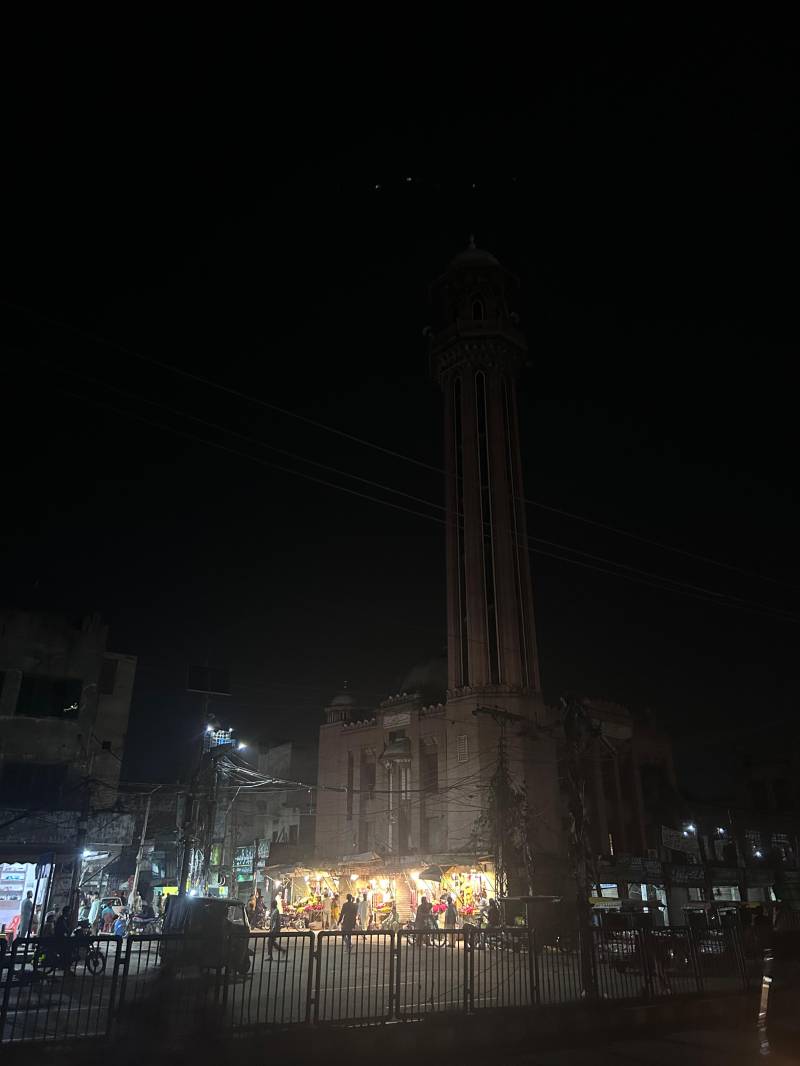
A gentle peace comes over me, shrouding me in its embrace whenever I walk through the city with ever-inquisitive eyes. Not long ago, while standing in front of the Lohari Gate, I convinced my cousin to accompany me on a walk inside one of the thirteen gates of the Walled City. Coming from Urdu Bazaar or Anarkali Bazaar, one’s eyes catch a glimpse of the towering minaret of Muslim Masjid, beneath which sit flower and garland sellers and, facing them, the dhaba wallas, or local restaurateurs.
Though in varying states of preservation, the gates still stand and can be witnessed. Yet the once-formidable wall around them, which provided protection to the rulers of the time, no longer exists. Much of it was knocked down during British rule after the War of Independence in 1857. The purpose was to dismantle Lahore’s defensive structures and suppress any possibility of local resistance. The remaining damage was caused by the communal violence that accompanied the Partition of India.
From the looks of it, the partly whitewashed façade of the Lohari Gate, with distemper flaking off at different points, hints at the glory and magnificence of decades gone by. It is also considered the oldest gate of the Walled City. It was named so because its bazaar was inhabited by a class of merchants who were primarily Lohars, or blacksmiths.
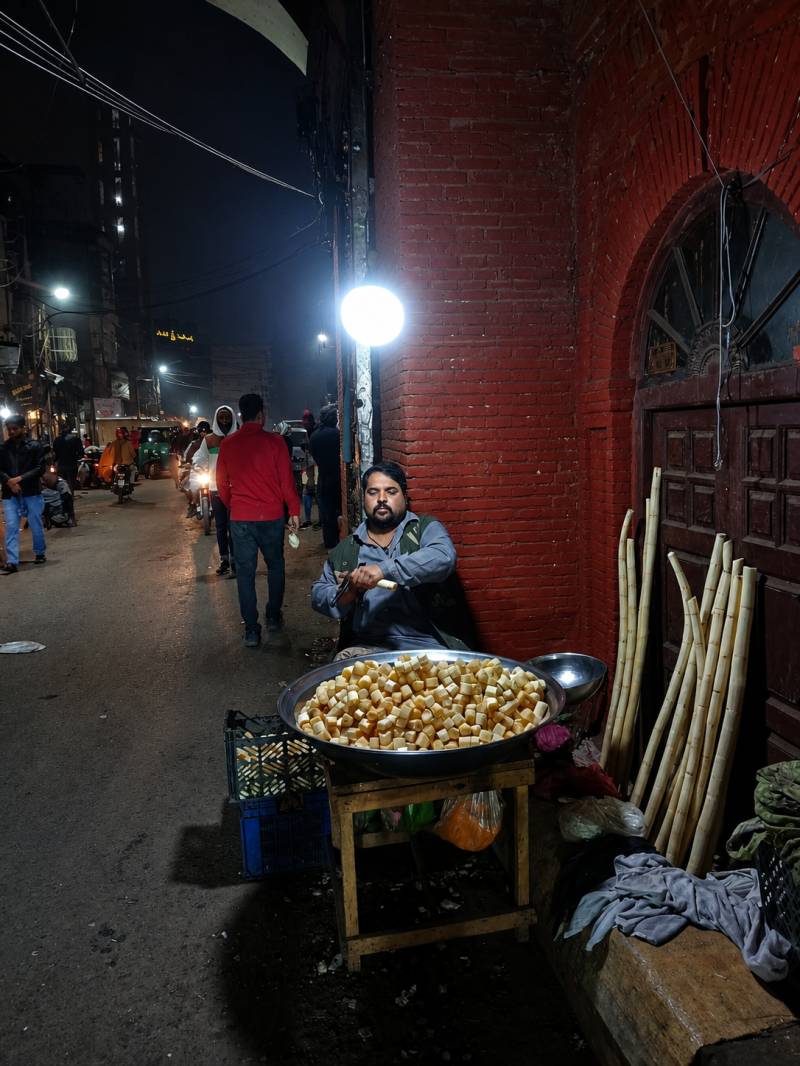
As I entered the gate, I saw a stout man sitting beside one of its doors and cutting sugarcane into small chunks. A dusty bulb hung from a single plaited wire, while he busied himself with the job at hand. By his appearance, he looked more like a pehlwan, with a black, desi amulet tied around his neck. I approached him and asked how long he had been working there. He listened to me somewhat distractedly before replying, “Saadiyan kaafi naslaan eh kaam kardiyan raiyan ne.” (Many generations of our family have been doing the same job.)
We watched him work for a while before moving on.
All this while, my cousin, who was visiting the area for the first time, was looking at the people and old buildings in awe. His eyes were wide open when he suddenly remarked, “Enu kehnde ne community.” (This is what we call community.)
He said so because people freely greeted each other and enquired about those whom they had not seen or met for days at a stretch. There was an ease in these interactions, a familiarity that seemed to have survived the passage of time.
He was following me closely when we stopped by a shop bearing RC Cola signs. Remnants of Royal Crown Cola, or RC Cola, as it is popularly known, were still intact in the streets of the Walled City of Lahore, holding on to the legacy of a beverage that had once been part of our lives.
My cousin was looking at the people and old buildings in awe. His eyes were wide open when he suddenly remarked, “Enu kehnde ne community” (This is what we call community)
And when we looked closely, just as there was hardly any difference among the many painted RC Cola signs, there was little to distinguish the uncle from his son, save for the colour and length of their beards and hair. The son was the Xerox of his father. It felt as though, in the years to come, he would look exactly the same.
I went near the counter to seek permission to take their photograph. The father was dealing with young and old customers, while his son was perched on the freezer. “Jinniyan marzi photoan lavo, puttar!” the father said. (Take as many photos as you like, son!)
Then, reaching the first crossroads, from where we had to turn towards Lohari Mandi Bazaar, we inhaled a fragrance pregnant with an amalgam of dried black and red spices and fresh lime rising from Sheikh Chatkhara House. In front of this local eatery stood a fruit seller, with a welcoming smile lighting up his face. Our brief encounter with him was equally heartwarming and jolly. “Main Lohari sirf jumeraat de jumeraat aana wan,” he said. (I come to Lohari only on Thursdays.)
On the other days, he sells his fruit on the Circular Road. He gave no particular reason for following this routine, saying instead that he had been doing so out of habit for decades.
As we continued our banter with the uncle, I noticed a narrow, arched doorway through which only one person could pass at a time. Arabic inscriptions above the door signalled that it was a mosque. The time for Isha prayer was fast approaching. After a while, the unseen speaker of the mosque blared forth the sound of the muezzin clearing his throat, followed by a sonorous Azaan.
An aged uncle from the shop that shared a wall with the house of God rose from his seat and entered the mosque. Most probably, his place was taken by his son, who remained engrossed in his phone. One after another, men came, greeted each other and showed the courtesy of asking the other to enter the mosque first.
Before we retraced our steps, I realised that it was not just the mosque whose entrance was narrow. Many structures here — shops, houses and even the streets themselves — seemed to be defined by narrowness. But the hearts of the people who lived there were capacious and welcoming.
Life inside the gates of Lahore has an élan of its own and every day here seems to be a celebration. For those living inside the gates, relationships among residents are free-flowing. People know one another, look out for one another and, perhaps without even realising it, remain connected to one another in ways that are becoming increasingly rare.
Many resourceful families have, unfortunately, moved out of these streets to settle in housing societies. It sometimes becomes unbearably hard to deal with the monotonous lifestyle of these posh societies. The houses may be bigger, the roads wider and the surroundings more organised, but something seems to be missing.
I often wonder what becomes of those who leave behind the lively streets where they were born and raised. Do they ever miss the narrow lanes, the familiar faces, the greetings exchanged at shopfronts, or the effortless sense of belonging that comes with being known?
Perhaps this is what my cousin meant when he said, “Enu kehnde ne community.”
Inside the gates of Lahore, that sense of community lives on!