

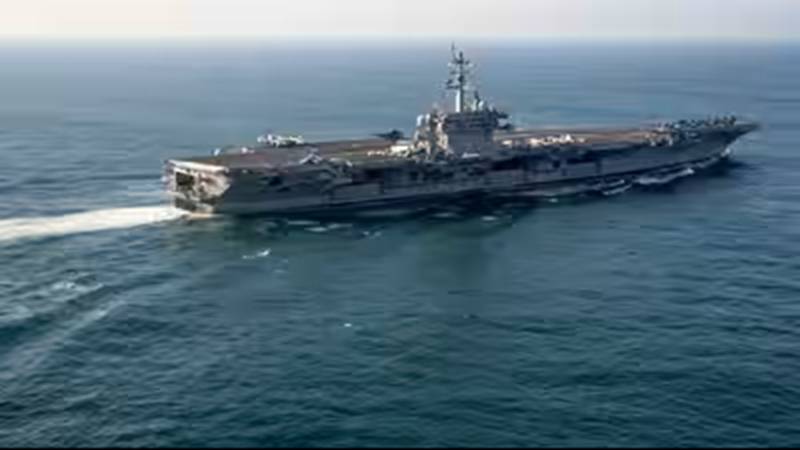
There is a saying in naval circles that nothing sends a message quite like 100,000 tons of diplomacy. That is what a United States nuclear-powered aircraft carrier represents. It is a floating city, a projection of superpower muscle capable of launching dozens of fighter jets into hostile airspace at a moment’s notice. When a US carrier strike group sails into a region, allies breathe easier and adversaries recalibrate.
But when a carrier leaves, and, moreover, leaves no replacement behind, that is a powerful message of the opposite kind.
The United States has pulled its last deployed aircraft carrier from the Pacific region. The USS George Washington is currently sailing away from the Asian theatre, rerouted to the Middle East to replace the USS Abraham Lincoln.
Why? Because the Trump administration’s ongoing war against Iran is stretching the US Navy to its absolute operational limits. The open-ended conflict has created an insatiable black hole for American military assets, running sailors to the point of psychological exhaustion and forcing the Pentagon into a perilous game of geopolitical musical chairs.
By pulling its pre-eminent symbol of maritime dominance out of the Pacific to fight a war in the Middle East, Washington has once again exposed a glaring contradiction in American foreign policy. For over a decade, the United States has loudly broadcast its grand strategic "Pivot to Asia." Yet, in 2026, as China flexes its muscles from the Taiwan Strait to the South China Sea, America's actions are sending a very different message: the Middle East is still steering its ship.
The Gravitational Pull of the Middle East
The concept of the "Pivot to Asia"—later rebranded as the "Rebalance"—was officially introduced in 2011 during the Obama administration. The logic was ironclad and enjoyed rare bipartisan consensus. The economic and geopolitical centre of gravity of the 21st century was undeniably shifting to the Indo-Pacific. China’s meteoric rise, its rapid military modernisation, and its growing confidence meant that the United States needed to orient its foreign policy towards East Asia.
The Middle East, for all its volatility, was increasingly viewed as a tragic, resource-draining distraction of the 20th century.
Every successive administration conceptually agreed with this premise. The consensus in Washington has long been that China is the "pacing threat"—the only nation with both the intent and, increasingly, the capability to reshape the international order.
The open-ended conflict with Iran has created an insatiable black hole for American military assets, running sailors to the point of psychological exhaustion and forcing the Pentagon into a game of geopolitical musical chairs
Yet, translating that consensus into steel on the water has proven nearly impossible. The Middle East possesses an almost gravitational pull on American foreign policy. Whether it is the fight against ISIS, control of global shipping lanes in the Red Sea, or, currently, the Trump administration's direct military engagements with Iran, the result is always the same.
The Pacific gets the rhetoric; the Middle East gets the resources.
"The administration says that the Pacific is supposed to be the most important behind the Western Hemisphere," notes Greg Poling, director of the Southeast Asia Program at the Center for Strategic and International Studies. Instead, the US is "doing the exact opposite" of its previously expressed goal.
The current Iran conflict has pushed this contradiction to a breaking point. The USS Abraham Lincoln has had its deployment extended well past its original May return date. The Navy, facing the harsh realities of maritime logistics and crew fatigue, had no choice but to tap the USS George Washington to relieve them. The Pacific was left empty-handed.
Beijing’s Narrative Victory
Does the absence of a US aircraft carrier mean that the People's Liberation Army is going to launch an amphibious invasion of Taiwan tomorrow? Absolutely not. War is a calculus of monumental risks, and the temporary departure of a single strike group does not fundamentally alter the mutual deterrence that keeps the Taiwan Strait from erupting. Nor does China feel the need to exercise military options when it is already gaining the upper hand politically in its region.
For Beijing, the departure of the George Washington is a golden opportunity to win another narrative victory.
China has long sought to convince the nations of the Indo-Pacific that the United States is a declining, distracted power in terminal retreat. Beijing’s message to Manila, Tokyo, Jakarta, and Seoul is simple and potent: that the United States makes promises about guarding the Indo-Pacific, but the moment things get difficult in the Middle East, they pack up their ships and leave.
By contrast, China presents itself as the permanent reality of the region.
For American allies, this is deeply unsettling. Countries like the Philippines, which have been facing down Chinese coast guard vessels in the South China Sea with Western encouragement, rely heavily on the psychological assurance of an over-the-horizon American presence. When the horizon is empty, the calculations for these nations become ever more difficult.
Breaking Point of the Fleet
Beyond the geopolitical messaging, the carrier gap in Asia is all about a harsh logistical truth: the United States Navy is being run ragged.
On paper, the US has 11 nuclear-powered aircraft carriers. To the layperson, that sounds like an armada capable of blanketing the globe. In reality, for every carrier deployed at sea, one is typically undergoing deep, years-long maintenance, and another is in a "work-up" phase, training its crew for the next deployment. Realistically, the Navy can only sustain two or three carriers at sea simultaneously without breaking the force.
The open-ended war with Iran was seemingly entered into without adequate long-term planning for naval asset allocation.
Now, to surge forces to the Middle East, the Navy is borrowing against its own future. The massive warships will eventually need to return home for complex overhauls, creating a severe bottleneck at the nation’s limited carrier shipyards.
Aircraft carriers are essentially floating industrial complexes operated by 5,000 young men and women. The psychological exhaustion of extended combat deployments is difficult for policymakers in the US to properly relate to.
The Carrier Question: A Blessing in Disguise?
While the absence of a carrier in the Pacific is a short-term public relations headache and a source of anxiety for allies, it also forces a long-overdue conversation about the future of American naval warfare.
For decades, the aircraft carrier has been the undisputed queen of the geopolitical chessboard. But in the 2020s, against a technologically peer adversary like China, is a $13 billion floating runway actually the right tool for the job?
China has spent the last 20 years rapidly developing an "Anti-Access/Area Denial" (A2/AD) umbrella designed specifically to keep American carriers thousands of miles away from its shores. With an arsenal of hypersonic anti-ship ballistic missiles—often called "carrier killers"—and swarms of sophisticated drones, the western Pacific has become a lethal environment for large, slow-moving surface vessels.
Many modern naval strategists and top brass within the Pentagon have been quietly trying to wean the US military off its carrier addiction. Admiral Daryl Caudle, the chief of naval operations, has openly expressed a desire to convince combatant commanders to rely more heavily on smaller, newer, and more agile ships, alongside advanced submarine fleets.
A distributed force of heavily armed, smaller vessels, integrated with unmanned underwater and aerial drones, is significantly harder for an adversary to target and destroy than a single, massive aircraft carrier. In a perverse way, the Middle East pulling the George Washington out of the Pacific might force the US military to actually practice the kind of distributed, next-generation maritime warfare it knows it needs to adopt to successfully deter China in the future.
Illusion of Omnipresence
The United States remains the most potent military force on the planet, but it is no longer omnipotent, and it can no longer be everywhere all at once.
The grand strategy of the "Pivot to Asia" remains a logical one, when seen from a US perspective. The future of global commerce, technological innovation, and great power competition will be decided in the waters of the Indo-Pacific, not the deserts or gulfs of the Middle East. But a strategy is only as good as the resources allocated to it.
Until Washington proves capable of making the difficult choice to accept a higher degree of risk in the Middle East in order to permanently anchor its best assets in the Pacific, the "Pivot" will remain an empty slogan.
And as long as it remains an empty slogan, Beijing will be more than happy to point to the empty horizon, reminding the rest of Asia that while America talks about the future, China is actively building it.