

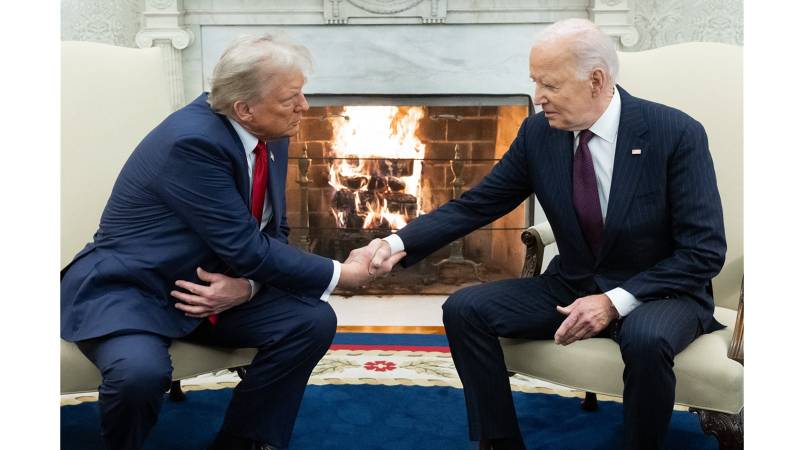
Two years ago, in November 2024, American voters handed Donald Trump a remarkable political comeback. The Republicans captured the presidency and both houses of Congress. The Democrats, led by Vice President Kamala Harris, suffered a comprehensive defeat.
On the 3rd of November 2026, the political pendulum swung dramatically in the opposite direction. Democrats recaptured both houses of Congress, winning elections in states that had appeared securely Republican. The reversal raises a fundamental question: What has changed in just two years?
The answer lies partly in economic dissatisfaction, partly in the conduct of the Trump administration, and partly in America's increasingly controversial involvement in Middle Eastern conflicts. This dramatic reversal of fortunes has been called a Blue Wave by some and a Blue Tsunami by others. It is not unique in American history. It has striking historical parallels with the Blue Wave of 1974, the Red (Republican) Revolution of 1994, and the Democratic victory of 2006.
But the most intriguing parallel may be between the elections of 2024 and 2026 themselves. In both, the governing party suffered politically from its support for Israel’s military actions in the Middle East, although the magnitude of that effect remains uncertain.
The Gaza Factor in 2024
The Democrats entered the 2024 presidential election burdened by inflation, concerns about immigration, and doubts about President Joe Biden’s leadership. Biden eventually withdrew from the race, leaving Vice President Kamala Harris with a compressed campaign that lasted only 107 days, and the difficult task of defending an unpopular administration while promising change.
One source of discontent was Biden’s support for Israel’s military operations in Gaza following the Hamas attacks of the 7th of October 2023. Days after the attack, he flew to Israel, becoming the only American president to visit that country during wartime. To top it off, he stood next to Prime Minister Netanyahu and described himself as a Christian Zionist.
The dire consequences of Biden’s unfettered support to Netanyahu as his army invaded Gaza and began to decimate it piece by piece, killing thousands of Palestinians in what was termed a war of self-defence, are examined in Akbar Shahid Ahmed’s recently published book, Crossing the Red Line: Biden, His Advisors, and Israel's War in Gaza.
Drawing on interviews with more than 150 officials and other participants, Ahmed portrays an administration that repeatedly declined to exercise its considerable leverage over Israel, despite mounting civilian casualties, with most of them being women and children, and warnings about humanitarian conditions. He argues that Biden’s decisions reflected not merely diplomatic constraints but deliberate policy choices.
In 2024, Biden’s Gaza policy contributed to dissatisfaction among Democratic voters, and in 2026, the Trump administration's relationship with Israel and its war with Iran became sources of dissatisfaction among some Republican voters
The political consequences were visible well before the presidential election. In Michigan's February 2024 Democratic primary, more than 100,000 voters selected “uncommitted” rather than support Biden. In Dearborn, with its substantial Arab American population, the uncommitted vote exceeded Biden’s.
The movement extended beyond Arab and Muslim Americans. Gaza became a contentious issue among younger voters, university students, progressives, and human rights activists, several of which were Jews.
Harris attempted to express greater sympathy for Palestinian civilians but did not substantially depart from Biden’s policy. Some voters consequently saw little difference between the candidates on an issue they considered morally fundamental.
Yet it would be an exaggeration to attribute the Democratic defeat principally to Gaza. Inflation, immigration, dissatisfaction with the administration, and Trump’s ability to mobilise his supporters were major factors. Even in Michigan, the available evidence does not establish that Gaza alone determined the result.
Nevertheless, the war exposed divisions within the Democratic coalition and weakened the party's claim to represent a broad consensus on human rights.
The Republican Reversal of 2026
Two years later, the Republicans encountered a remarkably similar predicament. Trump had promised to reduce living costs, strengthen the economy, control immigration, and avoid prolonged foreign wars. He repeatedly described himself as the No-War President and claimed to have ended numerous wars. He made no secret of wanting to be awarded the Nobel Peace Prize.
It backfired. His administration instead faced criticism over the broad spectrum of tariffs it imposed on America’s major trading partners, persistent affordability problems, controversial immigration enforcement, and an expanding military conflict with Iran.
Tariffs, which he characterised as being the most beautiful word in the English language, were particularly relevant to voters concerned about inflation. Although intended to protect domestic industries and strengthen America’s bargaining position, tariffs can increase the prices paid by American businesses and consumers. Their effects were compounded by higher energy costs associated with the Iran war.
Immigration presented another contradiction. Trump had won substantial support by promising stronger border security. But the methods employed by Immigration and Customs Enforcement in American cities generated opposition extending beyond those who favoured more permissive immigration policies.
Voters could support border enforcement while objecting to aggressive raids, questionable detentions, or perceived abuses of federal authority.
The Iran war added another dimension to the political backlash. The United States had entered a major conflict alongside Israel, raising questions about its objectives, duration, human costs, and economic consequences. Rising energy prices brought the war's effects directly into American households.
The Associated Press identified the cost of living, the Iran war, and concerns about government corruption as prominent sources of voter dissatisfaction in the 2026 elections.
Perhaps the most revealing reaction came from Vice President JD Vance. In his post-election assessment, Vance identified the Iran war as the central reason for Republican losses. He also reported that disaffected Trump supporters wanted lower living costs, an America First foreign policy, and a changed relationship between Washington and Israel.
That last observation deserves particular attention. For decades, strong American support for Israel enjoyed substantial bipartisan backing. It remains an important feature of American foreign policy. But the political debate has changed as growing numbers of Americans question the extent, conditions, and consequences of that support.
In 2024, Biden’s Gaza policy contributed to dissatisfaction among Democratic voters. In 2026, the Trump administration's relationship with Israel and its war with Iran became sources of dissatisfaction among some Republican voters.
The parallel is not exact. Gaza was primarily a question of American support for an ally's military campaign, whereas Iran involved direct American military operations and their economic consequences.
Nevertheless, both elections suggest that Middle Eastern conflicts can weaken the domestic coalitions supporting American presidents.
The Lessons of 1974
The 2026 election recalls the Democratic wave of November 1974. President Richard Nixon had resigned three months earlier amid the Watergate scandal. His successor, Vice President Gerald Ford, had pardoned him. Public confidence in the presidency had been severely damaged.
At the same time, Americans faced high inflation, recession, and the aftermath of the 1973 Arab oil embargo. The Democrats gained approximately 48 House seats, expanding an already substantial majority. A new generation of legislators, subsequently known as the Watergate Babies, entered Congress promising reform and greater accountability.
The parallel with 2026 is not that Trump’s controversies are equivalent to Watergate. Rather, both elections illustrate how dissatisfaction with presidential conduct can reinforce economic grievances.
There is also an important energy connection. The 1973 oil embargo demonstrated how international conflict could produce domestic economic distress. The Iran war has similarly highlighted America's continuing exposure to disruptions in global energy markets, notwithstanding its greatly expanded domestic oil and gas production.
A foreign-policy decision can therefore become an economic issue, and an economic issue can become an electoral liability.
The Republican Revolution of 1994
The 1994 election offers a different lesson.
Bill Clinton had won the presidency only two years earlier, promising economic renewal and major domestic reforms. His administration pursued tax increases as part of deficit reduction and an ambitious restructuring of health care.
Republicans, led by Newt Gingrich, organised their opposition around the Contract with America. They gained 54 House seats and captured the chamber for the first time in four decades. They also won control of the Senate.
Unlike 1974, the 1994 election occurred during an economic recovery. The Republican victory reflected dissatisfaction with the administration’s policies, political controversies, and an effective opposition campaign rather than a simple deterioration in economic conditions.
The lesson is that voters can withdraw support from a president even when some economic indicators are improving.
Another lesson is equally important. Clinton recovered politically and won re-election in 1996. A sweeping midterm defeat did not automatically determine the next presidential election.
The Overlooked Parallel of 2006
An even closer foreign-policy parallel with 2026 may be the Democratic victory of 2006.
George W Bush had won re-election in 2004, but the Iraq War of 2003 became increasingly unpopular as American casualties mounted and the administration struggled to demonstrate progress.
The Democrats gained control of both houses of Congress. The Iraq War was not the only issue. Political scandals, dissatisfaction with the administration, and concerns about governance also contributed. Nevertheless, Iraq demonstrated that military interventions abroad could have major electoral consequences at home.
The parallel with Iran is particularly relevant because both conflicts raised questions about the justification for military action, the prospects for success, and the costs borne by American citizens.
Are American Voters Becoming Less Loyal?
Taken together, these elections suggest that American politics is characterised by recurring dissatisfaction with the party in power.
The opposition party has frequently benefited from midterm elections, but the underlying causes vary. In 1974, Watergate and inflation dominated. In 1994, disputes over domestic policy and the direction of government were central. In 2006, Iraq became a major liability. In 2026, the combination of economic pressures, the Iran war, immigration enforcement, and concerns about governance contributed to a Democratic resurgence.
There is a temptation to interpret every electoral wave as evidence of a permanent political realignment. History counsels caution.
The Democratic victory of 1974 did not prevent Ronald Reagan’s election in 1980. The Republican Revolution of 1994 did not prevent Clinton’s re-election two years later. Moreover, an election can be a rejection of the incumbent party without constituting an endorsement of every policy advanced by the opposition. The 2026 results may therefore say more about dissatisfaction with Republican governance than about the emergence of a durable Democratic majority.
What makes the current reversal especially noteworthy is the role of foreign policy.
For much of the post-Cold War era, American presidential elections were dominated by domestic economic issues, immigration, cultural controversies, and competing views about government's role.
Those issues remain central. But Gaza and Iran demonstrate that foreign policy can become politically consequential when it divides a governing coalition, raises moral objections, or imposes tangible economic costs.
The domestic and international dimensions are no longer easily separated.
The Warning for Both Parties
The lesson from 2024 and 2026 is not that American voters have suddenly become consistently Democratic or Republican. It is that neither party can take its coalition for granted.
Economic promises must eventually be judged against household budgets. Immigration policies must be evaluated not only by their objectives but also by their implementation. Foreign military commitments must be justified in terms of American interests, costs, and consequences. And America’s relationship with Israel, long treated as an area of broad bipartisan agreement, is increasingly subject to public scrutiny.
The political significance of that change should not be exaggerated. Economic dissatisfaction remains a powerful explanation for both electoral outcomes, and more detailed research is needed to determine how many votes were actually changed by Gaza or Iran. But it would be equally mistaken to dismiss the foreign-policy dimension.
When an American president supports a war that divides his own supporters, the consequences can extend far beyond diplomacy. They can affect public trust, economic expectations, political participation, and ultimately electoral outcomes.
The voters who rejected the Democrats in 2024 and the Republicans in 2026 were not necessarily embracing opposing ideological visions. Many were expressing disappointment with unfulfilled promises, policies they opposed, and priorities they believed had been misplaced.
The enduring lesson of these elections is that electoral victories confer the authority to govern, not a guarantee of continued public consent.
That was true in 1974, 1994, and 2006. It appears equally relevant in 2026.