

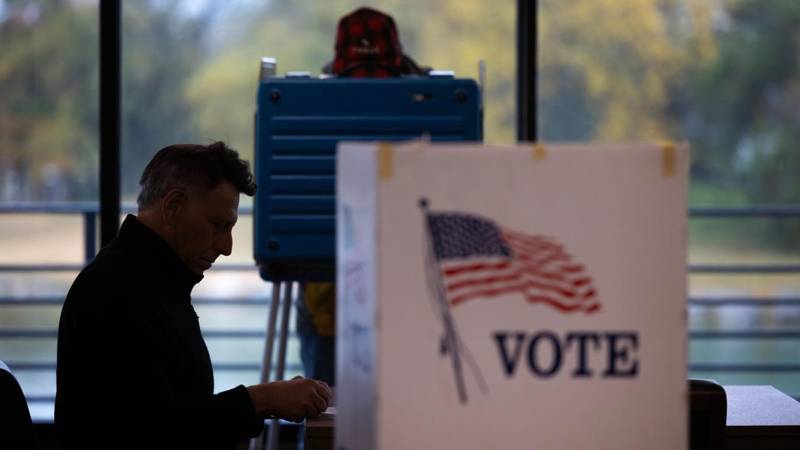
Early in his political career, Donald Trump made a chilling boast: he could stand in the middle of Fifth Avenue, shoot somebody, and not lose a single voter.
For over a decade, that dark prophecy held true. He incited riots, mocked the disabled, denigrated fallen soldiers, invited foreign interference in elections, and pardoned criminals and rioters—the list goes on—yet his followers simply shrugged.
On election night, the 3rd of November 2026, we finally learned there is a limit. Americans will not tolerate one thing: rising prices.
Inflation certainly wasn't the only reason Republicans were annihilated at the polls, but it was the biggest one. Keep that in mind as we examine the other winners and losers of this election cycle.
Global Trade Won
Trump broke the peace by attacking Iran, and Tehran struck back by closing the Strait of Hormuz, triggering a global inflation spike that hit America hard.
What Trump did to Iran's regime with bombs, Iran did to Trump’s presidency by stepping on a vital vein of global trade.
Over the decades, trade has made the world increasingly interdependent—and peaceful. It was a cornerstone of the post-WWII global peace that America helped build by championing open markets. More recently, however, free trade has come under assault—most notably from Trump himself. Republicans, once the party of free markets, disavowed their principles and went along with his sweeping tariffs. Even now, as JD Vance admits on X that the Iran war was a mistake, he fails to connect that the economic pain was caused by the curtailment of trade.
Vance and his allies have argued that reliance on global trade is a strategic vulnerability. Even if countries could wall themselves off into self-sufficient islands through across-the-board tariffs, they would end up looking like Cuba: insulated and uncompetitive. Nations that cooperate and trade freely will always outcompete those that do not.
While some of these critiques may have a kernel of truth, the prophets of doom, racial fatalism, and conspiratorial control must now eat a slice of humble pie
We are already deep into an age of interdependent capitalism. Iran's ability to disrupt commerce and Ukraine's ability to withstand Russia show that smaller powers, aided by technology, can level the playing field and use our interconnectedness to their advantage. Great powers like China and the United States need to rethink their bullying and unilateralism—not aim to become self-sufficient islands.
When it comes to trade, the old adage holds true: no risk, no reward. Trade carries inherent risks because it makes us dependent on others, but when managed well, the rewards are massive. Where diplomacy fails, targeted reshoring may be justified. But like any human relationship, trade requires strategic vulnerability and trust. It is the same reason we work, marry, and build families: relationships are essential to our economic and emotional well-being, even if they occasionally take a toll. We do not shut ourselves off simply because relationships make us vulnerable.
The lesson from America’s election is not that trade is a trap—it is that we must repair our relationships with the world and do our utmost to live in peace.
Short-Term Geopolitics Lost
A few months ago, when Pakistan was playing peace broker between Iran and the US, much was made of the military establishment's diplomatic triumph in courting Washington. Trump’s midterm defeat shows the limits of that manoeuvring.
Throughout his career, Trump has proven to be a volatile partner who harms allies—like the Europeans and Saudis—more than adversaries. He is a transactional operator with no real principles—what Pakistanis would call a lota; a dangerous lota.
Making common cause with him is only the latest in a long line of strategic errors by a the establishment. Caught between faltering civilian governance and an overbearing security state, Pakistan has too often looked to Washington for validation instead of fixing its fundamentals at home.
Pakistan’s real work is generational: building durable institutions and modern infrastructure. Nothing lasting can be built—or is even worth building—under the constant shadow of conventional or nuclear war.
The establishment's primary responsibility should be to normalise relations with India, not engage in diplomatic one-upmanship. Yes, Modi shows little appetite for peace, but there are ways to bring New Delhi around.
Meanwhile, the Pakistani public must see through pyrrhic diplomatic victories and look past the rhetoric of nationalism. It is time to stop metaphorically "eating grass"—as Zulfikar Ali Bhutto famously vowed—and start demanding what American voters demanded: economic progress.
The Doomsayers Lost
Liberal commentators in America and critics abroad have repeatedly sounded the death knell of the American republic. Writers like Masha Gessen, in the pages of The New York Times, drew parallels between Trump’s America and Vladimir Putin’s Russia, pointing to aggressive ICE raids and paramilitary tactics as proof that the United States was sliding into totalitarianism.
Then there were those who claimed that Americans had become hopelessly tribal, that politics had become a new religion, and that we were headed for an "American Partition."
Others, influenced by critical race theory, argued that America is irredeemably racist and that Kamala Harris lost because she is a Black woman.
Finally, there were those who insisted that American democracy had been irrevocably compromised by unlimited money, billionaires, and an all-powerful Jewish lobby.
While some of these critiques may have a kernel of truth, the prophets of doom, racial fatalism, and conspiratorial control must now eat a slice of humble pie.
America is nowhere near resembling Russia. A decisive share of the electorate proved to be pragmatic and open-minded, voting not by race, creed, or partisan dogma. Elon Musk’s millions proved futile in Texas. Voters punished an administration for overseas entanglements that helped Israel but compromised the domestic economy.
Democracy Won
Disillusionment with democracy is understandable. In developed countries, partisan bickering is endless while economic and social outcomes are mediocre at best. In Pakistan and other developing countries, corruption and self-dealing make people distrust not just politicians, but the entire democratic system. In contrast to authoritarian regimes like Dubai or China, democratic governance often feels paralysed and ineffectual.
But a functioning democracy offers one essential mechanism that no authoritarian system can match: it protects a nation from a man—or a regime—that would destroy it.
The midterm results demonstrate this self-correcting mechanism—perhaps democracy's single greatest feature—in real time. Trump’s incompetence and narcissism, and his unwillingness to concede elections, could have destroyed America. But democracy saved Americans. And it did so without the chaos and destruction that are usually required for dislodging dictators.
In a perverse way, Trump may be one of the greatest pro-democracy advocates ever. Every nation will, sooner or later, face a leader like him who will do almost anything to hold on to power, even though the people don’t want him.
Every nation needs to ask itself: how will it deal with its Donald Trump? The answer, as the election showed, is democracy.
What’s Next?
With the election over comes the harder task: making progress in a system that doesn’t enforce uniformity of thought.
Early signs suggest moderates outperformed ideologues. Despite wins by some left-wing candidates, if Democrats want to hold the states that just flipped blue, they will need to govern from the centre.
The fever of political tribalism may finally be breaking. We may be witnessing the slow, halting march toward “a more perfect union”—not just in America, but around the globe as the lessons of this election sink in.
To Pakistanis and the wider world, the message from America’s midterms is this: do not give up on democracy, and double down on trade that binds us in peace.