

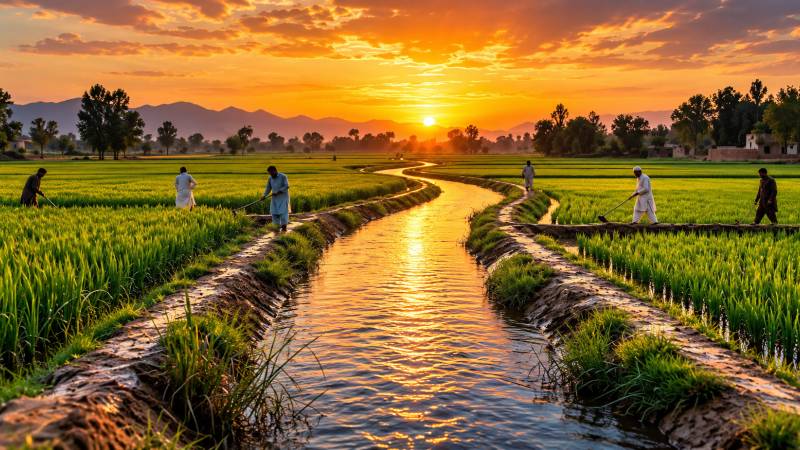
At the end of the nineteenth century, the tract that would become Lyallpur district was still sparsely populated. Within a generation of the arrival of perennial canal irrigation, it had become one of the most productive agricultural regions in South Asia and home to more than a million people. The change came with water. It is difficult now to appreciate how fundamental that change was. Before perennial irrigation, large parts of Punjab depended on rainfall, seasonal inundation, wells and the uncertain behaviour of rivers. The canals changed that. Water could be taken far from the river and delivered according to a schedule. The result was not just more cultivation. It changed settlement, land values, markets, towns and the provincial economy itself.
The British did not build this system out of generosity. Revenue mattered. So did settlement, agricultural expansion, political control and military recruitment. The canal colonies were instruments of government as much as engineering projects. But that should not prevent us from recognising the scale of what was built. The Lower Chenab Canal transformed the Sandal Bar. New chaks were laid out and populated by settlers from other parts of Punjab. Lyallpur was established as a planned town in 1896 and soon became the centre of a new agricultural economy. In Bahawalpur, the Sutlej Valley Project pushed perennial irrigation into areas that had depended on uncertain river flows and rainfall. Towns and markets followed the canals. Then came the larger works.
The Triple Canal Project connected the Jhelum, Chenab and Ravi systems and demonstrated that water could be transferred between rivers to support canal commands elsewhere. Sukkur Barrage, completed in 1932, stretched across the Indus with 66 gates and supplied seven major canals serving millions of acres. These were remarkable structures. But the more interesting part of the story is that they continued to work.
A canal dug in the 1890s did not remain useful simply because it had been well designed. It had to be inspected, closed, desilted and repaired. Gauges had to be read. Banks had to be watched. Gates had to work. Outlets had to be checked. Discharges had to be measured. Someone had to decide when a canal would close. Someone else had to make sure the work was finished before it reopened. The infrastructure was visible. The institution behind it was much less so.
Partition showed just how dependent Pakistan had become on this hydraulic network. The new border left important Pakistani canal commands dependent on headworks that were now in India. The interruption of supplies in 1948 demonstrated the vulnerability of dividing politically what had been built as an interconnected system. The response was another major period of construction.
The Indus Waters Treaty of 1960 led Pakistan to build a replacement system that transferred water from the western rivers towards canal commands that had previously depended on the eastern rivers. Mangla and Tarbela, new barrages, siphons, link canals and extensive remodelling altered the hydraulic geography of the country. So it is too simple to say that the British built Pakistan’s irrigation system and Pakistan merely inherited it.
Pakistan inherited a vast canal network and then rebuilt, connected and expanded it on a very large scale. That history matters because the system has become so familiar that we barely notice it. The water arrives. Wheat is harvested. Cotton reaches the ginning factory. Rice reaches the mill. Sugarcane reaches the mill. Cities are fed.
The real test of an irrigation system is not the size of the barrage or the length of the main canal. It is whether water reaches the farmer who is supposed to receive it, in the quantity and at the time that the system promised.
We notice irrigation when there is a shortage, a breach, a flood or a dispute between provinces. We rarely notice it when it works. Maintenance attracts even less attention. A new dam gets an inauguration. A barrage rehabilitation project gets a ceremony. A new canal attracts political interest. Desilting does not. Neither does replacing a worn regulator gate, strengthening an embankment or restoring the section of a distributary. Yet this is where irrigation systems are preserved or allowed to deteriorate.
A canal does not have to breach before it begins to fail. Suppose a channel was designed to carry 5,000 cusecs but can now carry only 4,000 because of sedimentation and deterioration of its section. The canal is still there. Water is still flowing. But one-fifth of its capacity has gone. The effect is felt further downstream. A distributary receives less. A tail gets a weaker supply. A farmer pumps groundwater to compensate. If the groundwater beneath him is saline or too deep to pump economically, he has no such protection. This kind of decline is easy to miss because the system still appears to be working.
The institutional decline can be just as gradual. Experienced engineers retire. Inspection becomes less rigorous. Preventive maintenance is postponed. Canal closures are shortened because demand makes them difficult to enforce. A repair planned this year moves to the next. A gate that should have been replaced is kept running for another season. None of these decisions looks disastrous on its own.
The damage comes from accumulation. We still tend to treat maintenance as ordinary expenditure. Much of it is really preservation of capital. Pakistan has spent enormous sums over more than a century creating this irrigation network. If a canal loses carrying capacity because its section is not maintained, part of that public investment has been consumed even though the canal still appears in government records as an asset.
The colonial irrigation administration understood this in its own way. Canals generated revenue, and assets that generated revenue had to remain functional. The motive was fiscal. The broader lesson was that irrigation infrastructure had to be maintained if it was to keep producing value. Pakistan’s justification today is different. These canals support food production, rural livelihoods, groundwater recharge, industry and an agricultural economy worth trillions of rupees. Their value cannot be measured simply by the water rate collected from farmers. That is what makes the present condition of the system worrying.
Storage has been reduced by sedimentation. Groundwater now provides the buffer that keeps much of Punjab agriculture functioning when canal supplies are inadequate, but water tables are falling in important areas and groundwater quality is poor in others. Climate change is altering the snow, glacier and rainfall regimes on which the Indus depends.
At the same time, provincial irrigation departments are being asked to operate ageing infrastructure while maintenance competes with the political appeal of new projects. Pakistan needs new storage and selected new infrastructure. That argument does not disappear. But building something new does not remove the obligation to maintain what is already there. The real test of an irrigation system is not the size of the barrage or the length of the main canal. It is whether water reaches the farmer who is supposed to receive it, in the quantity and at the time that the system promised.
A farmer there does not experience the Indus Basin in millions of acre-feet. He experiences it through his turn at the outlet. If that turn arrives late, or carries less water because the channel has lost capacity, the decline of a national asset becomes a very local problem. More than a century ago, settlers entered the new canal colonies and watched water reach land that had not previously supported settled cultivation. Their descendants may still farm those areas today. The channels may be the same. In some places even the pattern of rotation remains recognisably descended from the one their forebears knew. That continuity is impressive, but it can also mislead us.
We begin to think the system is permanent because it has always been there. It is not. Canals survive because somebody clears them. Barrages survive because somebody inspects and repairs them. Water distribution remains credible because somebody measures it. Institutions remain capable because knowledge is passed from one generation of engineers and field staff to the next. Pakistan inherited more than canals and barrages. It inherited the responsibility to keep them working. The remarkable thing is not only that this system was built. It is that, after more than a century of use, expansion, floods, droughts, war and political change, it still works. We should not have to lose parts of it before we understand what kept it alive.