

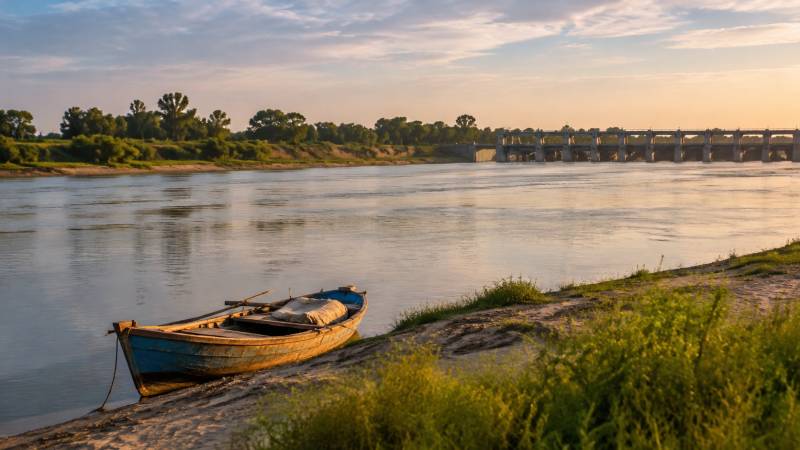
The fate of the Indus reveals what happens when engineering ambition, unchecked demands and political expediency disregard nature's limits. For millennia, the River Indus has sustained civilisations, nourished fertile plains and shaped communities from the Tibetan Plateau to the Arabian Sea. Its waters support agriculture, fisheries and wetlands; its seasonal flows carry the sediment that sustains floodplains and the delta. For Sindh, the Indus is more than a watercourse. It is life, livelihood and identity. Yet the river that shaped this landscape is increasingly denied the water needed to sustain it.
Human intervention is hardly new. Earlier societies diverted water for cultivation while adapting, imperfectly, to the river's rhythms. What distinguishes modern intervention is its scale and permanence. A living river has increasingly become a regulated delivery system. In our determination to control its waters, have we imperiled the ecological foundations of the Indus itself? Human needs create pressures; engineering supplies the means to meet them; and political expediency can override ecological safeguards. Population growth and economic development are not inherently the problem. The danger arises when legitimate human demands are pursued without regard for the ecological limits of the river.
The transformation accelerated under British rule. The Sukkur Barrage, commissioned in 1932, transformed Sindh's agriculture, bringing vast tracts under irrigation. After independence, dams, reservoirs, barrages and link canals expanded the hydraulic network; the lopsided Indus Waters Treaty of 1960 further shaped its development. These works brought undeniable benefits: food production, electricity, storage and economic opportunity. They also fostered a damaging misconception: that freshwater reaching the sea represents a loss, rather than the completion of a river's ecological journey. The issue is not whether infrastructure was necessary, but whether its benefits justified ignoring cumulative environmental costs. Project by project, diversion became the organising principle, while the river's ecological needs remained an afterthought.
A river cannot live on leftovers. Nowhere is this clearer than in the lower Indus and its delta. The Indus does not end where its last irrigation canal begins; its journey to the Arabian Sea is indispensable. Freshwater flows restrain seawater intrusion, nourish mangroves and wetlands, and sustain estuarine fisheries. Sediment replenishes a coast continually challenged by tides and erosion. Deprived of adequate freshwater and sediment, the delta faces advancing salinity, degraded farmland, threatened groundwater and increasingly precarious fishing livelihoods. Sea-level rise compounds the damage. This is not simply an environmental complaint from the end of the river: it concerns food security, human settlement and the future of coastal Sindh.
The river's ecological distress is also visible upstream, where barrages fragment aquatic habitats and embankments interrupt connections with floodplains. Here, the Bhulan—the Indus river dolphin offers a particularly poignant warning. This endangered freshwater mammal is an evolutionary marvel, adapted to the Indus's muddy waters. Functionally blind, it navigates and hunts through echolocation, feeding on fish and freshwater prawns. Once distributed across much of the basin, the Bhulan now survives in disconnected stretches of river, its movements impeded by barrages. Dolphins may stray into irrigation canals and become stranded as water levels fall; others drown in fishing nets. Pollution and reduced flows erode the habitat on which their recovery depends. The Guddu–Sukkur reach remains a crucial refuge. Across its surviving range, conservation efforts have helped numbers recover to roughly 2,000. Yet a species confined to fragments of its former habitat remains vulnerable. Rescue operations matter; restoring the conditions that make rescue unnecessary matters more.
The Bhulan is not alone. Freshwater turtles help recycle organic matter; otters depend on productive wetlands; native fish, prawns and countless smaller organisms sustain a complex food web. The celebrated palla, or hilsa, migrates from the sea into freshwater to spawn. Once able to travel far upstream, its passage has been curtailed by barrages, notably at Kotri, damaging a fishery woven into Sindh's cuisine and culture. At the delta, mangrove creeks shelter juvenile fish, shrimp and crabs before they enter coastal waters. The loss is not merely of individual species but of the intricate relationships that sustain a living river. Aquatic plants, algae and wetland vegetation provide food, shelter and breeding habitats for smaller organisms and fish. Their degradation reverberates through the entire food web, threatening the Bhulan, migratory birds and the fishing communities whose livelihoods depend upon the river.
Just as the Indus is increasingly treated as a hydraulic resource to be exploited, the coastline is viewed as real estate awaiting conversion into profit. In both cases, nature is expected to accommodate human ambition without limit.
Pollution deepens the crisis. Untreated sewage, industrial effluents, agricultural chemicals and plastic waste degrade water quality; diminished flows can concentrate contaminants. Managing the volume of water while disregarding its condition is not river management. It is an accounting exercise detached from ecology. Mounting withdrawals, expanding cultivation and poorly regulated waste can push natural systems towards thresholds from which recovery is difficult. Immediate gains are visible; ecological losses accumulate quietly, often reaching downstream communities and future generations first. Short electoral horizons and narrow interests favour new projects over maintenance, efficiency and environmental safeguards. Development can then consume the natural capital on which its own success rests.
The same disregard for ecological limits is evident along Karachi's coastline, where relentless dredging, land reclamation and speculative real estate development continue to push the city further into the sea. Natural shorelines, mangroves and coastal habitats are sacrificed to commercial ambition, often with scant regard for the ecological consequences. Just as the Indus is increasingly treated as a hydraulic resource to be exploited, the coastline is viewed as real estate awaiting conversion into profit. In both cases, nature is expected to accommodate human ambition without limit. What passes for development is too often driven less by necessity than by greed, with ecological costs transferred to future generations.
Human ingenuity cannot repeal ecological reality. Nature must define the limits; science must establish the evidence; logic must guide decisions within those limits. The three must work in tandem. For the Indus, this requires scientifically determined environmental flows not an arbitrary annual allowance, but water released in quantities and seasons that sustain fisheries, dolphin habitat, floodplains and the delta. Reservoir operations and water allocations must reflect downstream needs. Basin-wide assessments should consider the combined effects of existing and proposed infrastructure, not merely each project in isolation.
It also means treating sewage, policing industrial discharge, improving irrigation efficiency, reducing waste, protecting aquatic breeding grounds and supporting safer fishing practices. Dolphin monitoring, turtle protection, fish migration and delta salinity should inform policy as surely as crop yields and reservoir levels do. Transparent water accounting and meaningful participation by downstream communities are essential. A credible policy must measure not only water diverted and acres irrigated, but also sediment reaching the delta, water quality, biodiversity and livelihood security. These indicators reveal costs that conventional engineering accounts too readily exclude.
These safeguards are conditions for development that can endure, they are conditions for development that can endure. The Indus has sustained civilisations for thousands of years; it must not be reduced to a contest over the last available drop. Its ecological needs deserve a secure place in water governance, not whatever remains after more powerful claimants have taken their share. It is not a possession to be exhausted, but an ecological inheritance to be protected. True progress is measured not by how completely we control a river, but by whether we can meet human needs without destroying its capacity to sustain life. The Indus is not merely water to be divided. It is a test of whether human wisdom can rise to the level of human ambition.