

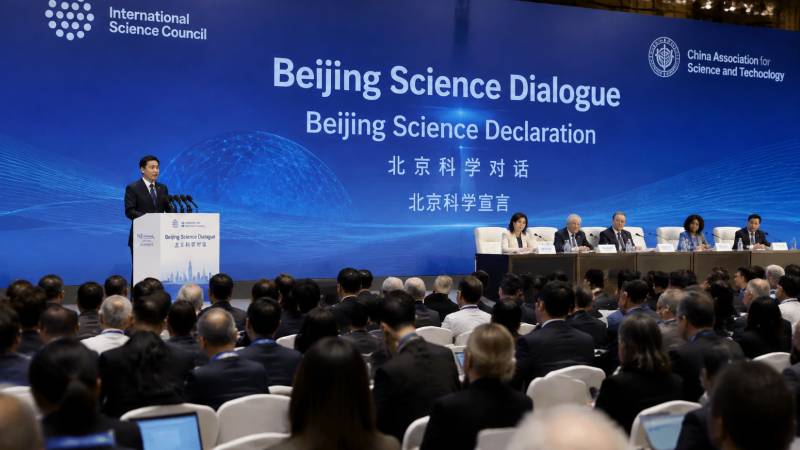
As an academic and social scientist, I find the Beijing Science Declaration, adopted on October 21, 2026, one of the most significant and forward-looking developments in international scientific cooperation this year. More than 1,000 delegates from 80 countries participated in the Beijing Science Dialogue, jointly convened by the International Science Council (ISC) and the China Association for Science and Technology (CAST). It is particularly encouraging that, alongside a large number of developing countries, major powers, including the United States, Canada, France, Germany, the United Kingdom, India, Russia and Brazil, participated in the dialogue and endorsed a collective declaration. At a time of geopolitical polarization and fragmentation, achieving such a broad consensus is an impressive accomplishment.
In my assessment, the Declaration has four important dimensions: its intentions, its substantive commitments, the relative marginalization of social sciences and humanities, and the opportunities it creates for countries like Pakistan.
Intentions: Science as a Global Public Good: The first part of the Declaration reveals a strong sense of purpose, compassion and understanding of the value and significance of science, not merely for states and societies but for humanity at large. Most importantly, it recognizes science and its benefits as a global public good. Its underlying proposition is that science must be goal-directed and to serve humanity. The language and phraseology are meaningful and purposive. They acknowledge the inequalities that characterize scientific knowledge, research infrastructure and technological progress across nations. Recognizing these disparities is an important first step towards bridging the divide between developed and developing countries. The intention to narrow these gaps represents a welcome shift towards a more equitable global scientific order.
Equally significant is the recognition that, despite geopolitical conflicts and ruptures in the international order, cooperation in multiple arenas; particularly scientific research, knowledge sharing and intellectual exchange, is not only desirable but achievable. The opening paragraphs convey considerable optimism and confidence. The Declaration brings together scientists, leaders of scientific organizations, government representatives, youth networks and other stakeholders from around the world. It recognizes that science is an integral part of society, that scientific exchange is the foundation of scientific and societal progress, and that knowledge generated across the natural, social and human sciences is essential for informed decision-making and effective policy implementation.
Its affirmation that openness, inclusiveness, cooperation and mutual respect are fundamental to scientific progress is particularly important. This reflects a degree of maturity within the international scientific community and among the civil society, business and public-sector representatives participating in the dialogue. They recognize that, in an increasingly polarized, fragmented, uncertain and unpredictable world, consensus on data sharing, scientific inquiry, research collaboration and the public good is a necessary precondition for addressing common challenges. The larger message is that science can remain a bridge between nations and societies even when political relationships are strained.
Commitments: The second part is more substantive and policy-prescriptive. It demonstrates a determination to translate broad intentions into commitments and, eventually, achievable goals. The Declaration identifies eighteen commitments, organized around four interconnected themes.
First: Safeguarding an Open, Inclusive and Cooperative Global Science System: The first set of commitments emphasizes the protection of academic freedom and the development of an inclusive and cooperative global scientific system. It goes beyond conventional appeals for international research collaboration by addressing inequalities in the production, ownership and distribution of scientific knowledge.
One particularly important commitment is that developing countries should not be treated merely as 'sites for data collection' but should become co-leaders in data analysis and intellectual property ownership. This is a significant recognition of the unequal power relationships that have historically characterized international research partnerships. The emphasis on strengthening research institutions, sharing infrastructure, promoting open science and data, facilitating mobility and ensuring a more equitable distribution of research costs is particularly relevant to developing countries. Commitment 6 deserves special attention. It explicitly identifies scientific cooperation, science diplomacy and multilateral partnerships as instruments for building mutual understanding, trust and global solidarity. This provides an important opening for countries like Pakistan to use scientific cooperation as an additional instrument of international engagement.
Second: The second component focuses on the opportunities and challenges associated with Artificial Intelligence, particularly its implications for research integrity, ethics, societal values and human well-being. The Declaration rightly emphasizes that AI must serve humanity and the public good rather than deepen existing inequalities or create new digital divides. It calls for common norms, ethical principles and governance arrangements that ensure transparency, accountability, fairness and human oversight. Equally important is its recognition that AI governance cannot be left exclusively to technology developers, computer scientists or corporate interests. Its social, economic, environmental, cultural, psychological and ethical consequences must also be considered. The commitments to international cooperation, data sharing, capacity building, talent development and mutual learning are particularly relevant to developing regions. The onus is now on countries like Pakistan to formulate their own scientific and technological agendas, strengthen institutional capacities and take advantage of the opportunities that these commitments offer.
Third: The third component addresses an increasingly important global challenge: the erosion of trust between scientific institutions, governments and society. The Declaration recognizes that misinformation and disinformation can undermine public confidence in scientific knowledge and weaken evidence-based decision-making. It therefore emphasizes science communication, public engagement, education and sustained dialogue with different segments of society. It rightly calls for scientists to communicate scientific knowledge more effectively, acknowledge uncertainty, distinguish between facts, scientific judgments and value choices, and engage responsibly in public debate. The emphasis on working with media, educators, community leaders, artists and storytellers is particularly welcome. Scientific knowledge cannot improve people's lives unless it is communicated in ways that society can understand, appreciate and use.
However, there is another dimension of trust that deserves attention. Developing countries also experience a deficit of trust in their relationships with scientifically advanced countries. Concerns about unequal research partnerships, access to technology, intellectual property ownership, data sovereignty and the distribution of scientific benefits cannot be overlooked. Building trust, therefore, must be a two-way process. Science diplomacy and equitable multilateral partnerships can help address these concerns by creating relationships based on mutual respect, shared ownership and reciprocal benefits.
Fourth: Shaping the Future Together; The fourth component looks beyond immediate scientific and technological challenges and seeks to establish a more sustained and institutionalized role for science in global agenda-setting and public policymaking. It calls for science to become an integral part of the formulation, implementation and evaluation of future global sustainability agendas. It also emphasizes the participation of young scientists, joint problem-solving involving governments, businesses and civil society, and reforming research assessment systems to reward the quality and societal relevance of research rather than merely individual academic performance.
Building trust, therefore, must be a two-way process. Science diplomacy and equitable multilateral partnerships can help address these concerns by creating relationships based on mutual respect, shared ownership and reciprocal benefits.
Commitment 18 is particularly significant because it calls for giving meaningful voice to all disciplines, knowledge systems, cultures and regions. This is an important recognition that scientific progress cannot be confined to a narrow group of disciplines or countries. Taken together, these eighteen commitments represent an ambitious effort to make international science more open, inclusive, equitable and responsive to the challenges confronting humanity.
A Missing Dimension? Social Sciences and Humanities
Despite its broad and ambitious commitments to scientific cooperation, knowledge sharing and international collaboration, the Declaration, in my assessment, does not sufficiently articulate the contribution of social sciences and humanities. To be fair, it would be inaccurate to suggest that these disciplines have been entirely overlooked. The preamble explicitly recognizes that knowledge generated across the natural, social and human sciences is essential for informed policymaking. Commitment 10 specifically requires social sciences to be involved from the outset in AI governance. Commitment 14 recognizes the contribution of artists and storytellers in communicating scientific knowledge, while Commitment 18 calls for meaningful participation by all disciplines and knowledge systems.
These are important acknowledgements. Nevertheless, the problem is that their recognition remains largely implicit or confined to particular areas of the Declaration. The commitments do not sufficiently elaborate how social sciences and humanities can contribute systematically to the broader scientific enterprise. From my perspective, this is an important omission because the major challenges confronting humanity are not exclusively scientific or technological. Climate change, demographic transformations, inequality, migration, conflict, political instability, poverty and the governance of emerging technologies are equally social, political, economic and cultural challenges.
Political science, sociology, economics, psychology, anthropology and public policy are indispensable for understanding how societies respond to change, how institutions function, how power and resources are distributed, and why policies succeed or fail. Humanities are equally important. History, philosophy, literature, languages and the arts provide insights into human behavior, civilizational experiences, cultural diversity, ethical choices and competing conceptions of justice and human well-being. Technology may offer solutions, but societies determine how these solutions are adopted, distributed and governed. Scientific progress without an understanding of human behavior, social institutions, cultural values and political realities can produce unintended consequences.
The Declaration could, therefore, have made a much stronger case for integrating social sciences and humanities into multidisciplinary research, particularly in addressing the interconnected challenges of peace, justice, social cohesion, resilience and sustainable development. My criticism is not that the Declaration has ignored these disciplines altogether, but that it has not given them the institutional recognition and operational significance they deserve. If science is to become a bridge between nations, societies and peoples, its intellectual foundations must extend beyond laboratories, technological innovation and scientific infrastructure. The social sciences and humanities must be integral to this enterprise.
What Can Pakistan Make of the Beijing Science Declaration?
For Pakistan, the Beijing Science Declaration presents an opportunity that should not be missed. Its significance goes beyond endorsing another international declaration. It offers an opportunity to reposition Pakistan's scientific institutions, research priorities and international partnerships within an emerging global framework of scientific cooperation. Pakistan should follow a two-pronged approach: first, strengthen its domestic scientific and research institutions; second, pursue international partnerships and science diplomacy by taking advantage of the commitments articulated in the Declaration. On the domestic front, Pakistan needs to identify priority areas where scientific research can directly contribute to national development and human security. These should include:
Climate change, water and cryosphere research: Strengthen research on the Hindu Kush Himalaya, glacier melt, water security, disaster preparedness and climate adaptation. International partnerships can connect Pakistan's research institutions with Arctic and Third Pole scientific networks.
Demography, public health and social development: Integrate demographic research, public health, population studies, social sciences and behavioral research into evidence-based policymaking. Pakistan's demographic challenges cannot be addressed through administrative interventions alone.
Chemical sciences, biotechnology and pharmaceuticals: Strengthen research and innovation in chemical sciences, biotechnology, medical research and pharmaceutical production, including peaceful applications of nuclear technology in healthcare, diagnostics and agriculture.
Artificial Intelligence, cyber connectivity and digital technologies: Develop indigenous research capacity in AI, data science, cybersecurity, digital infrastructure and responsible technology governance. Pakistan should also invest in the ethical, legal and social dimensions of these technologies.
Agricultural and geospatial technologies: Promote research in climate-resilient agriculture, food security, precision farming, satellite-based monitoring and geospatial applications. These technologies have direct implications for Pakistan's economic security and sustainable development. However, strengthening domestic institutions alone will not be sufficient. Pakistan must develop a more proactive science diplomacy strategy.
The Declaration offers at least four avenues for doing so.
First, Pakistan should use its existing diplomatic relationships and multilateral engagements to develop research partnerships with scientifically advanced countries as well as emerging scientific powers. China is an obvious and important partner, particularly in AI, space technology, geospatial research, biotechnology and infrastructure connectivity. However, Pakistan should also diversify its partnerships with Europe, North America, Central Asia, the Middle East and other developing countries.
Second, Pakistan should seek to move beyond conventional academic exchanges towards joint research programs, shared laboratories, research funding, technology transfer and collaborative intellectual property arrangements. The Declaration's emphasis on developing countries becoming co-leaders rather than merely data providers is particularly relevant here.
Third, Pakistan should use its geographical position and scientific interests to develop international research collaborations around shared challenges. Climate change, the Hindu Kush Himalaya, glacier melt, water security, disaster management and sustainable mountain development provide opportunities for cooperation with China, Central Asian countries, European research institutions and Arctic scientific networks. Pakistan's experience in the Third Pole can also contribute to wider global discussions on the future of the cryosphere.
Fourth, Pakistan should institutionalize science diplomacy. This requires closer coordination between the Ministry of Science and Technology, Pakistan Climate Change Authority (PCCA), the Higher Education Commission, research universities, scientific academies, relevant government departments and Pakistan's diplomatic missions abroad. Embassies should become more active in identifying research opportunities, facilitating scientific exchanges and building partnerships between Pakistani and international institutions.
An institutionalized science diplomacy initiative could also bring together scientists, social scientists, diplomats, policymakers and the private sector to identify priority research areas and develop international collaborative projects. There is one additional opportunity that Pakistan should not overlook. Science diplomacy should not be restricted to the natural sciences and emerging technologies. Pakistan's universities and research institutions have considerable potential to contribute to international discussions on governance, political economy, demography, conflict resolution, regional cooperation and sustainable development. Integrating social sciences and humanities into these partnerships would give Pakistan a more comprehensive and distinctive scientific profile.
Let me reiterate, the larger message of the Beijing Science Declaration is that science should not become another arena of geopolitical competition and technological inequality. It should remain an instrument of cooperation, shared knowledge and collective human advancement. For Pakistan, the challenge is to move beyond being a participant in international scientific dialogues and become an active contributor to shaping their agendas. Science diplomacy can help Pakistan convert its geographical position, human capital, research potential and international relationships into opportunities for knowledge, innovation and sustainable development.