

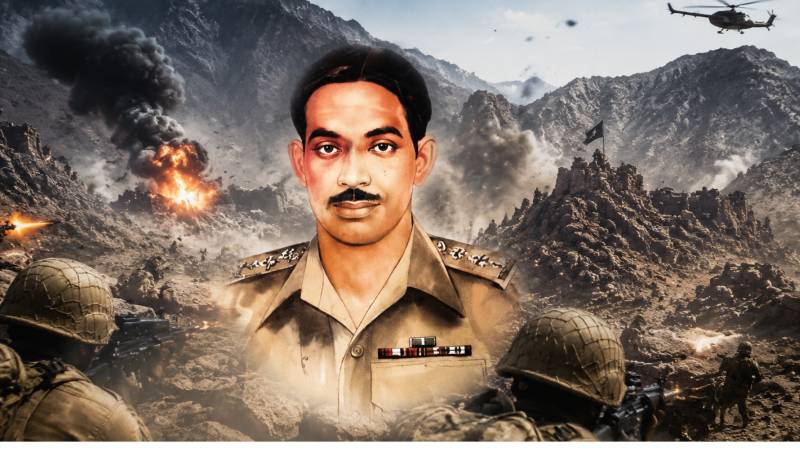
Some memories possess a beauty that remains untouched by the passage of time or the tyranny of distance. Captain Muhammad Sarwar Shaheed is one such enduring presence in Pakistan's history. Through extraordinary courage and supreme sacrifice, he wrote a new chapter of valour and became the first recipient of the Nishan-e-Haider, Pakistan's highest military honour.
Captain Sarwar belonged to Pothohar, a land that has produced countless distinguished soldiers and generals who became the pride of the nation, and whose martyrs have coloured its soil with their blood. For years, the memory of Captain Sarwar had quietly lingered in a corner of my heart. Then, one day, an irresistible desire arose within me to visit his native village. I wanted to walk through the streets where he had spent his childhood, to see the clouds, the fields, the flowers, and the skies that had once filled his young eyes.
Yet a question troubled me. Whom would I meet there? I had been told that no member of Captain Sarwar's family lived in the village anymore. But as the saying goes, when intentions are sincere, even the darkest paths find their own light.
One day, through my friend Brigadier Tahir Mahmood of ISPR, I had the privilege of meeting Major Adeel, Captain Sarwar's grandson. He generously shared with me a treasure of rare family documents and memories. Still, I longed to experience the village itself, to breathe the atmosphere in which Captain Sarwar had lived his early years.
It was an August morning, a public holiday, when I finally set out for Singhori. The sky was thick with monsoon clouds. Travelling from Islamabad, one reaches Rawat, and a little beyond it, a road branches off towards Singhori. It was at this turning that I met Javed Amjad Bhatti, a respected social figure from the area, who kindly agreed to be my guide.
Our first stop was the home of Khalid Masood. He and his family have long been devoted admirers of Captain Sarwar. He told me how Captain Sarwar had helped his father pursue an education and secure employment, offering guidance that changed the course of his life. There, I also met an elderly village woman who recalled that Captain Sarwar was affectionately known as Sakhi Sarwar because of his extraordinary generosity. He never turned away anyone in need.
She narrated an incident from one harsh winter. Captain Sarwar noticed a labourer named Ayub shivering in the cold. Without hesitation, he removed his own coat, quietly placed some money in its pocket, and gave it to him. When Ayub reached home and discovered the money, he hurried back, believing it had been left there by mistake. Captain Sarwar smiled, placed his hand gently on Ayub's head, and said, "The coat, and the money inside it, were meant for you."
As we continued our journey, I asked Mr Bhatti whether there was anyone still alive who had actually seen Captain Sarwar. He nodded and pointed towards a cluster of old houses. We wandered through narrow, winding lanes until we reached a modest home. Its weathered walls bore the marks of time. Beside the entrance stood an old blackberry tree, with ripe fruit scattered beneath it. The wooden door stood half open.
Mr Bhatti knocked gently, and after receiving a response, we stepped inside. A few charpoys were arranged in a small room where we sat down. There we met Sakina Bibi, who was well over 120 years old. She had seen Captain Sarwar with her own eyes. Her memories, though old, remained remarkably vivid.
Few people know, however, that Captain Sarwar is not buried here. His final resting place lies far away in Kashmir, on the nine thousand foot heights of Tilpatra.
"Captain Sarwar," she said, "was the pride of our village. He was kind-hearted, compassionate, and always ready to help the poor." She even remembered his wedding. It had been a remarkably simple ceremony attended by only a handful of people. His bride's name, she recalled, was Karam Jan.
Leaving the house, we followed a narrow footpath that wound through fields stretching into the distance. Depending on the season, these lands produce wheat, peanuts, maize, millet, and mustard. The colours of these changing fields must also have found their way into the young Captain Sarwar's imagination.
Our destination was the memorial built in his honour. Along the way stood the familiar trees of Pothohar: dharek, berry, phulai, kikar, mulberry, peepal, and banyan. Countless times, Captain Sarwar himself must have walked beneath their shade.
The memorial stands within a walled enclosure where visitors from across Pakistan come to pay their respects. Few people know, however, that Captain Sarwar is not buried here. His final resting place lies far away in Kashmir, on the nine-thousand-foot heights of Tilpatra.
I placed flowers at the memorial, offered a prayer, and then leaned quietly against its wall with my eyes closed. In that moment, the entire journey of Captain Sarwar, from Singhori to Tilpatra, unfolded before me. On 15 April 1929, he enlisted in the Baloch Regiment as a sepoy. After completing his training at the Baloch Regimental Centre in Karachi, he served during the Second World War. Following the creation of Pakistan, he joined the Pakistan Army as an officer and was commissioned with the rank of Captain.
In 1947, Indian forces had entered Srinagar and were preparing to advance further into Kashmir. Pakistani troops stood in their way. At that time, Captain Sarwar was attending a military course in Rawalpindi. He requested permission to leave the course and join the front. It was the month of Ramadan. His request was approved. On the morning of his departure, he went to the mosque for the Fajr prayer and asked the Imam to pray that he might be granted martyrdom. When he reached the front, he learned of a formidable mountain position known as Tilpatra. The enemy had established a heavily defended post there.
The Pakistani commander explained that if Tilpatra could be captured, the course of the battle might change. But success depended entirely on speed and surprise. It was an exceptionally dangerous mission. The commander asked for volunteers. Captain Sarwar stepped forward without hesitation. "I will do it." It was the night of 27 July, the twentieth day of Ramadan. Under the cover of darkness, Captain Sarwar and six soldiers began climbing towards the enemy post. As they approached the summit, they discovered that the route had been sealed with barbed wire.
Suddenly, the enemy detected their presence. A bullet struck Captain Sarwar in the shoulder. His comrade, Farman Ali, was martyred in the exchange of fire. Captain Sarwar picked up his fallen companion's weapon and, despite his own wounds, crawled towards the barbed wire. Ignoring the hail of bullets, he began cutting through it.
At last, the wire gave way. A safe passage had been opened. Captain Sarwar called out to his comrades that the route was clear. Pakistani troops immediately advanced through the opening and pressed forward towards their objective. By then, several more bullets had struck Captain Sarwar. He collapsed to the ground. But his mission had been accomplished. The obstacle preventing the advance of Pakistani forces had been removed. Blood flowed rapidly from his shattered body. His beautiful eyes slowly began to close.
Perhaps, in those final moments, forgotten scenes from his life returned before him. The winding lanes of Singhori. The golden mustard fields stretching to the horizon. The lilac blossoms of the dharek trees. The yellow blooms of the kikar. The cool shade of the shisham trees. The sweet-water well. The village mosque with its tall minaret. The seven-petalled flowers blooming in the courtyard. Karam Jan waiting patiently at the wooden threshold. Their two innocent little children.
Then, perhaps, his fading eyes looked up once more at the sky above Tilpatra.
"Where have I arrived?" the silent question may have stirred within him.
"From the plains of Singhori to the heights of Tilpatra," the mountain breeze itself may have replied.
"This was the destination I had always longed for," he might have thought.
And perhaps, with that thought, a gentle smile spread across his lips. A smile of quiet fulfilment. For not everyone is destined to complete such a journey to the highest summits.