

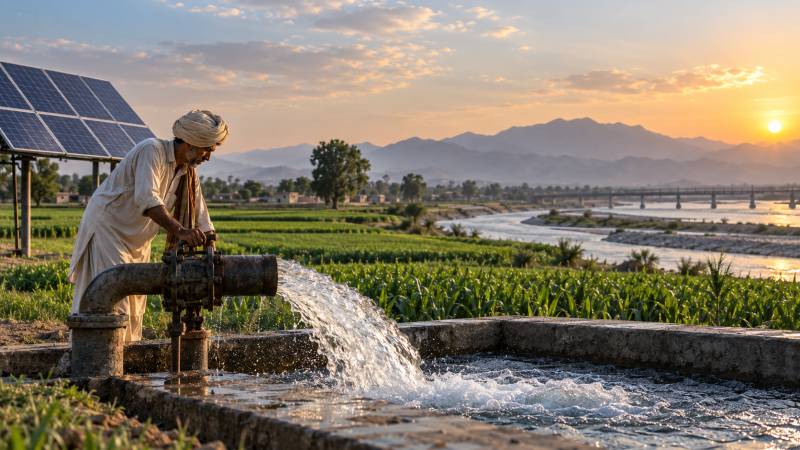
Pakistan’s water future will be decided not only by how much flows down the Indus, but by what we pump, what we grow and how efficiently we use it. The World Resources Institute’s Aqueduct projections place Pakistan among countries facing extremely high water stress in 2050. In WRI’s terminology, that means annual withdrawals exceeding 80 percent of available renewable supply. The temptation is to read 2050 as a distant warning. But for Pakistan’s groundwater, much of that future is already visible today. Pakistan already faces extreme water stress. The significance of the projection is therefore not that it identifies a crisis waiting decades ahead. It is that an imbalance we already live with risks becoming progressively harder to manage.
Pakistan’s water debate is often reduced to two propositions: we need more storage, or we need better management. Both are true. Neither is sufficient. A highly seasonal river system does need more storage. But no reservoir can decide which crop is planted, prevent excessive groundwater pumping or protect an aquifer being drawn down faster than it can replenish. Storage is necessary. It is not a substitute for water management. The harder question is how much food, economic value and resilience Pakistan obtains from every cubic metre of water it already has. Groundwater brings that question into sharp focus. It has become Pakistan’s invisible reservoir, cushioning unreliable canal supplies and giving farmers greater control over irrigation timing.
The Pakistan Bureau of Statistics, in its Agricultural Census 2024, records 1,832,232 tubewells and lift pumps combined, including 912,327 solar-powered tubewells. The census is a 2024 snapshot. With solarisation continuing rapidly since then, the present number is likely higher, but until a newer national count is available, 912,327 remains the most defensible official figure. Even as a two-year-old snapshot, the figure makes the point: solar irrigation is no longer marginal. That matters because groundwater decline is largely invisible. When a reservoir empties, everyone can see it. An aquifer can decline farm by farm and year by year without generating the same political urgency.
Where pumping exceeds recharge, part of today’s agricultural output is being financed through depletion of a stored asset. We are treating stock as if it were flow, and natural capital as if it were income. Solar power has brought obvious benefits. For farmers facing expensive diesel or unreliable grid electricity, it lowers operating costs and improves control over irrigation timing. But energy efficiency and water efficiency are not the same thing. A diesel or grid-powered pump imposes a cost every hour it operates. Once the capital cost of a solar system has been absorbed, the marginal energy cost of another hour of pumping falls sharply. One of the few economic restraints on abstraction weakens.
The problem is no longer lack of diagnosis. It is whether we are prepared to connect that diagnosis to economic policy.
The International Water Management Institute has warned that rapid solarisation can accelerate groundwater depletion where aquifers are already under stress. The problem is not solar energy. The problem is solarisation without groundwater governance. We are making groundwater progressively cheaper to extract while assigning almost no value to the groundwater itself. That is not only a rural problem. Falling water tables raise pumping costs, increase pressure on municipal supplies and eventually feed into the cost of food. The tubewell and the urban tap are part of the same water economy. There is another water decision that occurs before the pump is switched on: what the farmer plants.
Pakistan often begins the efficiency conversation after cropping patterns have already been established. We then discuss lining, laser levelling, drip irrigation and better scheduling. All matter. But one of the biggest water decisions may already have been made when the crop was selected. Rice, sugarcane, cotton, wheat and maize do not impose identical demands on the water system, nor do they generate identical returns from the water they consume. Location matters too. A crop supported mainly by renewable surface supplies is not hydrologically equivalent to the same crop sustained by repeated pumping from a declining aquifer. Yet agricultural policy rarely makes that distinction. Support prices, procurement, trade protection, processing capacity and established markets all influence what farmers grow. The scarcity and source of the water consumed often do not.
The farmer responds rationally to the incentives presented to him. If public policy makes a water-intensive crop commercially attractive while groundwater remains largely unpriced and increasingly cheap to pump, the resulting extraction cannot simply be blamed on farming practices. It is a policy outcome. Pakistan therefore needs to judge agricultural success not only by acres cultivated, tonnes harvested or export dollars earned, but by water productivity: how much economic and social value is generated from each cubic metre consumed. An export dollar earned by drawing down an aquifer is not entirely income. Part of it is an asset sale.
Every crop has an economic balance sheet. In a water-stressed country, it must also have a water balance sheet. There is also substantial scope to use existing irrigation supplies better. The Pakistan Council of Research in Water Resources says agriculture accounts for more than 93 percent of Pakistan’s water use, while its field research reports water savings of 20 to 40 percent in wheat and rice from measures such as bed-and-furrow cultivation and laser land levelling.
But not every litre that seeps from a canal or watercourse disappears from the Indus Basin. Some returns to groundwater or becomes available downstream. The objective is therefore not to eliminate every apparent loss, but to reduce wasteful use and unnecessary abstraction while increasing the value produced by the water actually consumed. That is the difference between irrigation efficiency and water productivity. Efficiency asks how effectively water is conveyed and applied. Productivity asks the more important question: what did we obtain from the water we consumed? There is one prerequisite to answering it: measurement.
Pakistan knows considerably more about flows in its rivers and canals than it does about the enormous water economy beneath its fields. As solarisation accelerates, that information gap becomes more consequential. Pakistan therefore needs water accounting that brings together surface water, groundwater, rainfall, recharge, crop consumption and changes in storage. Water must first be measured, then accounted for, and then governed. But measurement cannot become an excuse for waiting.
Stressed aquifers should be identified and groundwater conditions made central to agricultural and solar policy. Public support for solar pumping should differ between stable and rapidly declining aquifers. Crop support, procurement and trade policy should be assessed for the water they encourage us to consume. Large-capacity abstraction in critical zones should be measured more systematically. And water productivity, not simply crop output, should become a core test of agricultural policy. None of this requires blaming the farmer. It requires changing the signals to which the farmer responds.
Punjab, importantly, does not begin from a legal vacuum. The Punjab Water Act 2019 created a framework for licensing abstraction, including agricultural use. The Punjab Irrigation, Drainage and Rivers Act 2023 went further, providing for groundwater zones, measurement of water tables, annual estimates of recharge and abstraction, assessment of sustainable extraction and powers to inspect and regulate groundwater use. As Punjab’s Irrigation Minister, I helped shape both laws.
The legal architecture exists. What remains missing is implementation. That gap becomes more consequential when an official census already records more than 900,000 solar-powered tubewells. This brings us back to WRI. Its Aqueduct projection is not a prophecy. It is a warning about risk and direction.
Pakistan already possesses much of the knowledge required to understand what lies behind that risk. The census shows how rapidly the pumping economy is changing. PCRWR shows that major efficiency gains remain possible. IWMI points towards groundwater sustainability and water accounting. Punjab’s own laws show that part of the institutional response has already been written. The problem is no longer lack of diagnosis. It is whether we are prepared to connect that diagnosis to economic policy and implement the instruments we already possess.
Pakistan needs additional storage, but also sustainable groundwater management, agricultural incentives that recognise hydrological realities, better irrigation management, rehabilitation of existing infrastructure, protection of water quality and credible water accounts. These are not competing solutions. They are entries in the same national water balance.
The road to 2050 will therefore not be determined only by how much water flows down the Indus. It will also be determined by what we grow with that water, how much value we produce from it, how cheaply we pump what lies beneath our feet and whether we know when withdrawals begin exceeding what nature can replace. Pakistan does not need to wait until 2050 to discover what extreme water stress looks like. We are already living its arithmetic. 2050 begins at the tubewell.