

Recently, a woman acquaintance told me warmly that she remembered watching me on Pakistan Television during my PTV days. Then she asked whether I had ever done anything for women’s economic empowerment. She went on to describe her own forum and exhibitions. I listened, smiled, and felt an inward ouch. How does one respond without sounding self-congratulatory? How do we make earlier work visible without turning a conversation into a personal inventory of achievements?
Younger people have sometimes asked me a related question: why have so many women experts, myself included, despite decades of work, remained without a stronger public profile or wider recognition? I have written and spoken bluntly about public relations, privilege and entitlement, and about the professional adversaries and practical costs that can follow when one challenges established interests. This piece, however, is neither an elegy for the death of development dreams nor a lament about the drama of the development business. It is an attempt to document a policy argument, trace its history and ask why the institutional memory of development so often falls short of the work that helped shape it.
How does Pakistan remember the work that precedes a development initiative, a policy announcement or a fashionable new vocabulary? On 8 October 2005, the earthquake in northern Pakistan exposed not only the devastation of a natural disaster but also the inequalities that shape recovery. I was deeply disturbed by the particular hardships faced by women in mountainous communities. Among the survivors were young women and girls who sustained spinal cord injuries and became paraplegic. For some, the disaster continued long after rescue operations ended. Women’s experiences of abandonment, financial insecurity and the uncertain consequences of compensation payments raised questions that could not be answered by emergency relief alone. A one-time payment could not restore mobility, provide accessible housing, secure long-term rehabilitation or guarantee economic independence. Nor could a short official order capture the complicated realities of women whose lives no longer fitted familiar categories of marital status, disability or household dependency.
I had understood even before the earthquake that women’s economic vulnerability could not be reduced to a single legal or social category. The disaster made the consequences sorely visible. It reinforced my conviction that public policy must look beyond administrative classifications to the lives those classifications are supposed to serve. In 2008, I began developing a case for gender- and marital-status-responsive taxation. In July 2010, with the support of the Economic Freedom Network Pakistan and Friedrich-Naumann-Stiftung für die Freiheit, I published A Tax Break for Economic Freedom? The Case of Divorced Mothers, Divorced, Disabled and Never Married (Above 40 Years) Pakistani Women: A Civic Entrepreneur’s Perspective.
The argument was not about charity. It was about economic justice. Why should a woman’s vulnerability be recognised only when her husband dies? What about a divorced mother supporting children, a disabled woman earning a living, a divorced woman trying to rebuild her life, or a never-married woman over forty without a reliable financial safety net? The point was not to withdraw protections from widows, but to ask why other women’s circumstances deserved less consideration.
Women’s economic freedom requires skills, markets, capital and supportive institutions. It also requires fiscal arrangements that recognise unequal circumstances and administrative systems that translate formal entitlements into practical benefits.
This question remains relevant to Pakistan’s tax framework. Some provisions recognise particular circumstances, including those of widows and disabled persons, in relation to specified tax obligations. But relief from a filing requirement is not the same as exemption from income tax and property tax, and neither necessarily addresses a woman’s broader economic insecurity. The question is whether public policy adequately recognises the different circumstances in which women must earn, support families and try to remain financially independent. A later development illustrates the difference between announcing a policy and making it usable. The Finance Act 2021 introduced a 25 per cent reduction in tax payable on qualifying business profits for eligible women-owned enterprises established on or after 1 July 2021, subject to statutory conditions.
In October 2025, the Federal Tax Ombudsman directed the FBR to operationalise the provision through the IRIS tax-return system after a complaint about access to the relief. A concession written into law is not necessarily a concession a woman can claim. Policy design, digital infrastructure, accessible information and administrative implementation must work together. The promise of reform remains incomplete when the intended beneficiaries cannot access it. My engagement with this issue continued. In September 2023, The Friday Times published my article, “Beyond Widows: Tax Equality for All Single Women”, revisiting the unequal recognition of women’s economic circumstances. https://www.thefridaytimes.com/30-Sep-2023/beyond-widows-tax-equality-for-all-single-women
I do not suggest that later tax provisions resulted directly from my work; establishing that connection would require evidence. But the chronology deserves to be documented. Questions about marital-status bias, women’s economic autonomy and the practical accessibility of tax relief have been part of Pakistan’s public debate for years.I take some quiet satisfaction in seeing divorced women enter policy discussions and in seeing courts challenge restrictions that excluded daughters from family pensions. The legal position has moved in an important direction: under applicable civil-service pension rules, a daughter’s eligibility cannot simply be denied because her divorce occurred after her father’s death. In October 2026, a Lahore High Court ruling also struck down Punjab’s restriction on family pensions for widowed, divorced and unmarried daughters. These developments matter. They also expose how easily administrative rules can mistake marital status for financial security. But who remains outside the frame?
Consider a divorced mother raising children, a disabled woman trying to earn a living, a never-married woman over forty, or a woman abandoned by her husband. Consider women whose lives do not fit a convenient administrative category, or those who never had a government-employed father whose pension could become a safety net. Family-pension reform is important, but it cannot substitute for a wider system of economic and social protection.
There are other women whose circumstances remain largely absent from mainstream discussions of economic security: wives abandoned by husbands, and women whose lives and financial security are reshaped by polygamous relationships. Pakistan’s family law does address these matters. The Muslim Family Laws Ordinance regulates subsequent marriages and provides a mechanism for seeking maintenance when a husband fails to support his wife adequately or fails to maintain multiple wives equitably. Yet the existence of a legal provision does not mean that a woman can readily enforce it, secure the money she needs or rebuild her economic life.
What happens to a woman who is neither formally divorced nor reliably supported? What happens when another marriage changes the resources available to her and her children? These realities need sustained attention in discussions of taxation, social protection and women’s economic independence. A woman should not have to fit a recognised category of deprivation before her circumstances become visible to the state. These are the exclusions I was trying to bring into public discussion when I began developing the case for gender- and marital-status-responsive taxation in 2008. Divorced women, divorced mothers, disabled women and never-married women over forty have economic lives, obligations and ambitions that public policy must take seriously. So do women living with abandonment or the financial consequences of polygamous relationships.
Such arguments may not make headlines or qualify their authors for prestigious awards. Policy work does not always arrive with choreographed activism, institutional visibility or a carefully managed public profile. Some of us have worked persistently, often without fanfare, to question the stigma attached to women’s marital status and to keep neglected questions alive in policy conversations. I do not claim ownership of reforms whose histories are complex. But neither should the history of these arguments disappear. I take satisfaction when a previously sidelined category of women receives recognition. I also believe that the quieter work of identifying exclusions, challenging assumptions and documenting alternatives deserves a place in our collective policy memory.
For donors and development organisations, this raises a larger question. Do our systems of evaluation capture only the latest project, the number of participants trained or the immediate policy outcome? Or do they preserve the history of ideas, advocacy and research that preceded it? Institutional memory is a development resource. It helps prevent duplication, strengthens accountability and allows new initiatives to build on existing knowledge rather than presenting longstanding arguments as new discoveries. Women’s economic freedom requires skills, markets, capital and supportive institutions. It also requires fiscal arrangements that recognise unequal circumstances and administrative systems that translate formal entitlements into practical benefits. The most useful response to that uncomfortable conversation is not to recite a résumé. It is to put the record into the public domain. Ideas need not belong to one person, and policy reform should never become a contest for personal credit. But the history of those ideas matters. When we fail to document it, we diminish not only individual contributions but our collective capacity to learn.
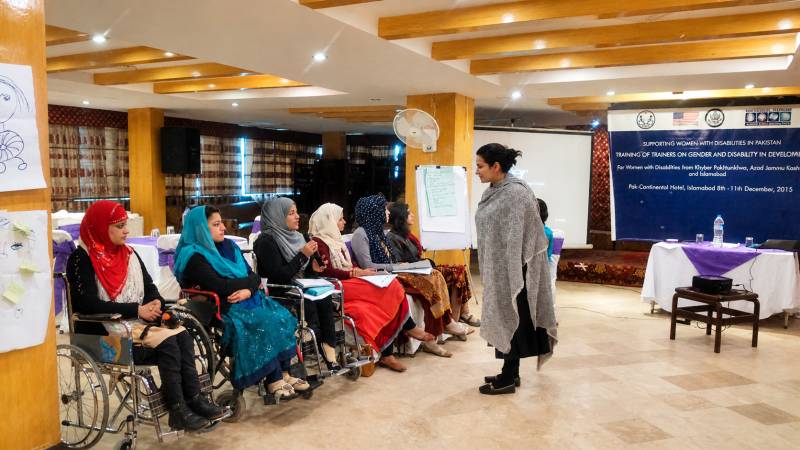
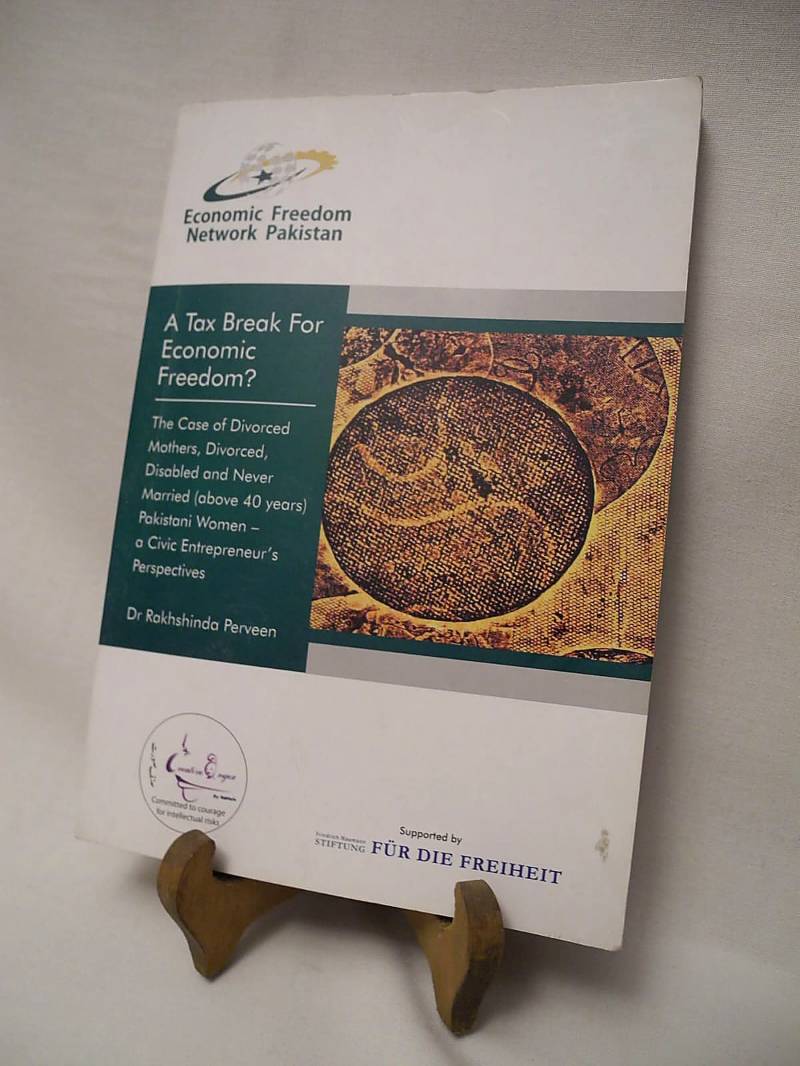
Photo caption: Dr Rakhshinda Perveen conducted a training session to promote the economic empowerment of women who use wheelchairs. Source: Author’s archives