

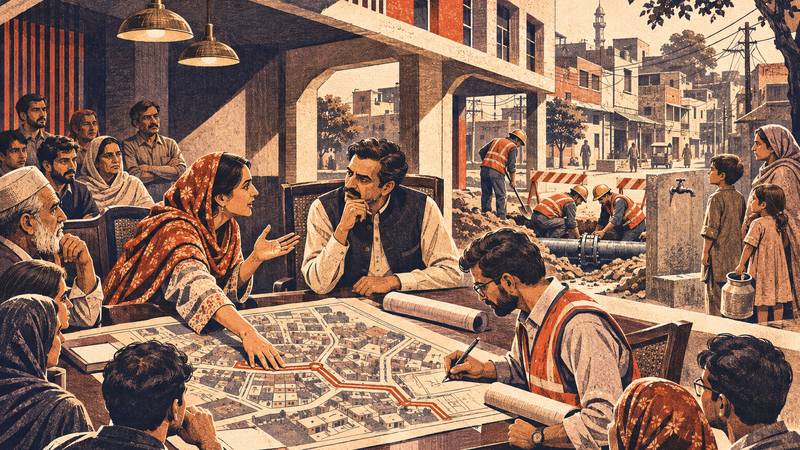
On November 22, 2026, The News reported that relevant federal offices had yet to initiate a formal proposal on a referendum for new provinces, even as ministers publicly discussed holding one. The argument that smaller provinces would bring government closer to citizens deserves to be taken seriously; particularly in parts of Pakistan that are poorly served by their provincial capitals who themselves offer a test of what proximity can achieve. Lahore, where winter smog demands concerted action across transport, industry, and agriculture, already seats the government that must coordinate much of that work. Karachi’s unreliable water and sewerage services, Peshawar’s flooding after heavy rain, and Quetta’s dwindling groundwater, all raise the same question about authority, resources, and responsibility: even though the institutions involved, and the scale at which they must act, differ from one city to the next.
The distinction matters because a citizen may have good reason to want a provincial capital closer to home, yet still bear what public administration calls administrative burden: the time, effort, and uncertainty involved in finding out which agency is responsible, complying with its procedures, and pursuing an answer when responsibility is divided among several offices. In Pakistan, it is often how citizens first discover where authority sits, if they discover it at all. So the question becomes: can Pakistan devolve enough power to improve everyday governance, while protecting provincial autonomy and making public officials more answerable to citizens? Proximity to the provincial capital could make some offices easier to reach, but those who want to preserve the existing provinces must make their case where it counts: by giving elected local governments the authority, staff, and funds to deliver everyday services and, more importantly, by giving citizens effectively enforceable remedies whenever officials fail to deliver.
Devolution without effective local government
The 2001 Devolution Plan shifted substantial responsibilities towards districts, while the Eighteenth Amendment to the Constitution of Pakistan in 2010 transferred powers from the federation to the provinces. Article 140A of the Constitution requires each province to devolve political, administrative, and financial responsibility and authority to elected local representatives; yet a provinces have kept municipal functions in agencies they control, while councils remain the visible address for complaints.
Can Pakistan devolve sufficient power to the grassroots level to improve everyday governance, while protecting provincial autonomy and making public officials more answerable to citizens?
Under the Punjab Local Government Act 2025, executive authority vests in the local head, yet the provincial secretary decides which staff and property a successor local government inherits. Where citizens must still look to the provincial capital to get local work done, Punjab has itself strengthened the administrative case for demanding a capital closer to home. In Karachi, why do services remain unreliable under the Sindh Local Government Act 2013, even with an elected PPP mayor and a PPP provincial government? Islamabad’s local government restructuring – introduced by presidential ordinance in January 2026, but lapsed since it was not enacted into law by both houses of parliament within the stipulated timeframe – raises the same question: what would elected councils control when policing and the Capital Development Authority (CDA) remain in federal hands?
The Islamabad Devolution Summit, convened on January 13-14, 2026, by Punjab Assembly speaker Malik Muhammad Ahmad Khan and Punjab Assembly Local Government Caucus convenor Ahmad Iqbal Chaudhary, produced a cross-party charter in a bitterly divided political climate. A July 2023 Senate bill seeking a constitutional amendment addressed local government elections and financing, but in October a task force report reiterated the call for constitutional guarantees. Political incentives diverge once incumbents risk losing empowered local councils to their opponents during their own term. The summit made agreement visible: delivering on it means asking parties to give up control over money and appointments that help them take credit for local works. Any party defending the existing provinces, especially while governing in one or more of them, should be pressed on what it is prepared to relinquish within them.
New Provinces: Solution or displacement of the problem?
Any argument in favour of more provinces must concede that provincial status can turn on identity, representation, administrative access, and a fairer share of limited resources. And these are serious claims. Haroon Khawaja’s proposal for converting districts to provinces does give the public something specific to examine, but a solid judgment on the issue can only be made once the federal government publishes an official blueprint explicating the boundaries, powers, finances, and transition of the proposed new provincial architecture. It must account for the expenditure burden of new secretariats and ministerial establishments, including but not limited to the salaries and privileges of ministers and secretaries. The ongoing debate could essentially be testing what the public will accept. Even a referendum would leave the constitutional requirements for changing provincial boundaries in place; and perhaps that is why there are also rumours of another constitutional amendment in the pipeline.
Any party defending the existing provinces just because it governs them should be pressed on what it is prepared to relinquish within them
While the political merits of any proposed division must await the particulars of the government’s plan, its underlying administrative premise can – and should – be examined forthwith. A district or division may seek a legislature to determine its spending priorities, yet a new capital that controls municipal staff and budgets leaves councils petitioning provincial departments for work their constituents expect them to undertake. Parties seeking to preserve the existing provinces must share if not delegate power within them – entrusting elected local governments with staff, funds, and discretion – while retaining provincial capacity to direct resources towards those with the greatest need. And citizens in every province need enforceable remedies when services fail.
What genuinely effective reform requires
The case for devolving a function depends on who has the knowledge and means to perform it. In Bolivia, devolved investment became more responsive to measured local needs. In Pakistan, policymakers became easier to reach after devolution, although spending preferences favoured visible infrastructure over education and health. Within a community, the design of an infrastructure project affects whether residents can sustain it. Proximity makes it easier to reach an official: it also makes it easier for a well-connected contractor to reach one. How far elite capture travels with power depends partly on who can inspect an award and act on an audit, as a field experiment on Indonesian village roads illustrates.
As engines of modern growth, elected district and city governments should direct day-to-day administration, with authority over functions, staff, and funding. Citizens should have a say in setting priorities before budgets are passed, and residents, service providers, and neighbouring councils should be able to work across institutional boundaries where the service demands it. Ahmad Iqbal Chaudhary’s “Districts First” white paper proposes constitutional protection for local functions and revenues, while the cascaded model developed by Haroon Khawaja and Dr. Ikramul Haq places professional administration under local democratic authority. A statutory schedule of functions and a published transfer calendar would give councils an enforceable claim. A council that must bargain for its quarterly release answers to those who release it as well as to those who elected it.
Greater proximity to a provincial capital would make it easier for the citizen to reach an official; it will also facilitate the well-connected contractor hunting for government tenders
Provincial autonomy and local self-government can reinforce each other: most public service woes persist across Pakistan because the former does not augment the latter. Provinces already coordinate – at best expediently, at worst inefficiently – services that cross districts, and provincial finance commission awards provide for equalisation grants and transfers where general transfers fall short of expenditure needs. A city should direct its drainage crews, while a water system serving several districts requires provincial coordination. Ward and village bodies can inspect local work, drawing on specialist staff, procurement, and equipment pooled by the district. Abolishing provinces would leave unresolved the question of who coordinates and redistributes resources. Devolving day-to-day administration would allow provincial assemblies to concentrate on their actual responsibility of legislation and setting service standards, and provincial governments to defend provincial interests through a stronger Council of Common Interests, whose decisions should face assembly scrutiny.
The bureaucracy that survives every reform
Earlier critiques of cadre dominance and the case for specialist career paths raise an uncomfortable question for devolution: who will run a district health service when the council acquires it? When senior appointments reward unrelated assignments, experienced practitioners may have to leave technical work to advance. Devolved administrative authorities should allow health administrators, engineers, and other specialists to advance within their professions while remaining in post long enough to see a decision through.
If the cadre structure changes, the test is who becomes eligible to exercise senior authority. Replacing the Pakistan Administrative Service (PAS) with a flagship Finance and Economy Group, for example, could reproduce the hierarchy that specialist recruitment is meant to overcome. If access to senior posts still turns on cadre membership, officers have reason to defend their group’s claim to an appointment even where another service has the better-qualified candidate. Both cadres would then spend more time and effort in turf wars, at the expense of the citizenry they are duty-bound to serve.
Most public service woes persist across Pakistan because provincial autonomy does not augment local self-government
Postings also determine the price of acting on principle. Public service motivation or PSM theory helps explain why an official might intervene when a dispensary runs out of medicines, or refuse to approve a favoured contractor’s work. In Pakistan, ethical and religious commitments to service also carry weight, as does the threat of a punitive transfer. Organisations shape motivation, as experiments on beneficiary contact suggest. In Punjab’s health monitoring experiment, even the response to evidence of staff absence varied with the disposition of the official receiving it. Merit recruitment and predictable careers offer a Weberian safeguard against arbitrary power, provided officers can report interference in confidence and seek independent protection against retaliatory transfers.
An annual confidential report (ACR) records a superior’s assessment, though the service failures citizens experience may never enter it. Punjab’s performance-based postings gave tax inspectors a reason to improve collections, yet its property tax experiment shows how a revenue incentive can also strengthen the collector’s hand against the taxpayer. Even explicit performance standards require judgment about how officers meet them, particularly when evidence from Nigeria associates professional discretion with higher project completion rates. Councils should be able to document persistent failures reported locally, and secure an officer’s transfer on substantiated grounds. The finding should follow the officer, with proportionate discipline up to dismissal resting with the competent provincial or federal appointing authority, subject to notice, hearing, and appeal. Conviction on criminal charges, if warranted, must be adjudicated by the courts.
From rulers to servants
Even within Pakistan’s existing four provinces – as well as two other federating units which, quite unfortunately, seem to be missing from this debate altogether – the civil servant’s primary duty is to the citizens the office exists to serve. Citizens should therefore help set the priorities against which councils and officials assess their joint performance. Merit protections give officers room to act on that primary duty, while the test of public value is whose services improve and how much effort citizens must still expend to secure them. When services fail, a resident should be able to file a complaint in person or online, requiring the administration to identify the responsible office and provide a satisfactory response within a statutory deadline. Provincial law should provide an independent appeal with power to order correction, judicial review where a statutory duty is breached, and publication of compliance so that residents can verify the outcome.
The citizen waiting for service delivery should be able to find out who is responsible, see when the work is due, and obtain a remedy if it never happens. When the official blueprint for new provinces is published, its political merits will deserve a fair hearing; its promises of improved governance and better administration should be judged in terms of what it would actually deliver for citizens.