

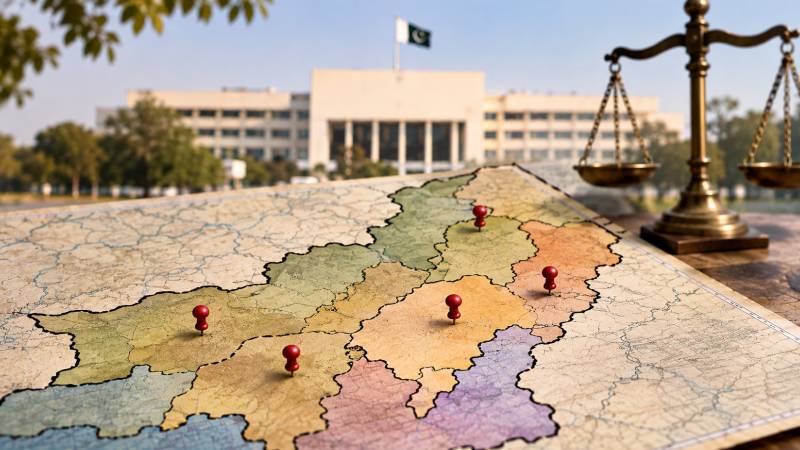
At first glance, the case for new provinces in Pakistan seems simple. Large provinces can be difficult to govern, and their least developed areas often receive too little attention. Decisions about schools, clinics, water supply and roads are made in provincial capitals, far from the communities that rely on these services. If it made sense for the 18th Amendment to shift power from Islamabad to the provinces, why should devolution stop at Lahore, Karachi, Peshawar or Quetta? Before we redraw the map, we should ask what people would actually gain.
The provinces acquired greater responsibilities, and the 7th National Finance Commission Award increased their share of federal tax revenues. They have defended their financial autonomy vigorously in Islamabad, yet have been much slower to share power with their own districts and municipalities. Article 140A already requires them to devolve political, administrative and financial authority to elected local governments. Even so, provincial governments often delay local elections or keep elected councils dependent on them for funds.
One study puts recurrent spending at more than 80 per cent of provincial expenditure in fiscal year 2023. That includes the cost of running public services as well as administration. A new province would also have to pay for an assembly, a secretariat and other institutions year after year. How much would be left to address the needs that justified its creation?
Interior Minister Mohsin Naqvi has floated a referendum, and Defence Minister Khawaja Asif has spoken of as many as twelve provinces. If the aim is to bring government closer to people, the provinces can begin by giving elected local bodies the powers and resources the Constitution envisages. Why, then, has redrawing provincial boundaries become the priority?
Pakistan’s military rulers have often shown a keen interest in local government. Ayub Khan introduced Basic Democracies, Zia-ul-Haq held non-party local elections and Pervez Musharraf built a system around district nazims. Each arrangement gave military rulers a way to cultivate local leaders while limiting the role of political parties.
Karachi needs a single elected municipal authority responsible for services across the city, with a predictable share of provincial revenues. If the PPP wants to make a convincing case for keeping Sindh united and win the support of its cities, it should start by sharing power within the province.
One Unit was a different experiment, but it too reflected a belief that political claims could be managed by redrawing the map. It merged the provinces and territories of West Pakistan into a single unit to establish parity with the more populous eastern wing. The cost of denying representative politics became clearest in 1970–71, when the refusal to transfer power after the Awami League won a parliamentary majority helped turn a constitutional crisis into the breakup of the country.
The establishment’s repeated interventions have weakened parties that once had a national reach. Many now draw most of their support from a single province or region. Dividing the provinces further could weaken their bargaining power and give Islamabad more room to cultivate local allies, especially in mineral-rich areas where control over land and resources is at stake.
There is also the question of money. The establishment has little appetite for an arrangement that gives the provinces a large share of federal tax revenues while leaving Islamabad to meet the costs of defence and debt servicing. The Constitution protects the provinces’ collective share. A wider reorganisation could give the Centre an opening to press for a different financial settlement.
Would dividing Sindh improve its governance? The most vocal opposition so far has come from Sindh, where many see the proposal as a step towards separating Karachi from the province. The PPP’s record gives its critics plenty of reason to be angry. After years in power, it has done too little to improve public services in rural Sindh.
Meanwhile, residents of Karachi, Hyderabad and Sukkur struggle with unreliable water supplies, broken roads and inadequate sanitation. In too many places, the gap between town and village has narrowed because urban services have deteriorated and rural services have improved so little.
What would dividing Sindh into three provinces change? If the PPP governed all three, why would it govern differently? The MQM and Jamaat-i-Islami have both had their turns in Karachi’s municipal government, at different times and under different arrangements. In my judgement, parts of that experience were worse. Giving either party a province of its own offers little assurance of better services.
In Karachi, responsibility for municipal services is scattered among provincial agencies, local bodies and military-administered cantonment boards. A resident who wants a drain cleared or a road repaired may first have to find out whose job it is. Even then, there is every chance of being sent to another office. Karachi needs a single elected municipal authority responsible for services across the city, with a predictable share of provincial revenues. If the PPP wants to make a convincing case for keeping Sindh united and win the support of its cities, it should start by sharing power within the province.
The mainstream parties are poorly placed to resist pressure from the establishment, partly because of choices they made themselves. The present governing arrangement emerged from a disputed election, and the governing parties supplied the votes for the 26th and 27th Amendments. The first changed how the chief justice is chosen and how constitutional cases are heard. The second transferred constitutional jurisdiction to a new Federal Constitutional Court and concentrated military authority in the office of the Chief of Defence Forces. The parties that found these changes expedient may now discover how little room they have left to defend provincial autonomy.
Article 239 requires a two-thirds majority in each house of Parliament and in the assembly of the affected province to change provincial boundaries. The constitutional decision belongs to those legislatures. The referendums held by Zia and Musharraf are reminders of how easily such a vote can be used to secure public approval for a decision already made.
Pakistan already has enough fronts open. Relations with India, Afghanistan and Iran are strained, even as China remains a dependable partner. Violence in Balochistan and Khyber Pakhtunkhwa and discontent in Azad Kashmir have different causes, but each calls for political engagement and a government willing to listen.
This is a particularly unwise moment for the establishment to open another front against the mainstream parties still supporting it. Forcing a division of Sindh along ethnic lines risks reviving the conflict that did so much damage in the 1980s and 1990s. A demand for a new province deserves a fair hearing when it comes from the people who would live in it and can give them more control over their services, revenues and resources. If we end up with more provincial capitals bargaining separately with a stronger Centre, the people promised a government closer to home will have gained very little.