

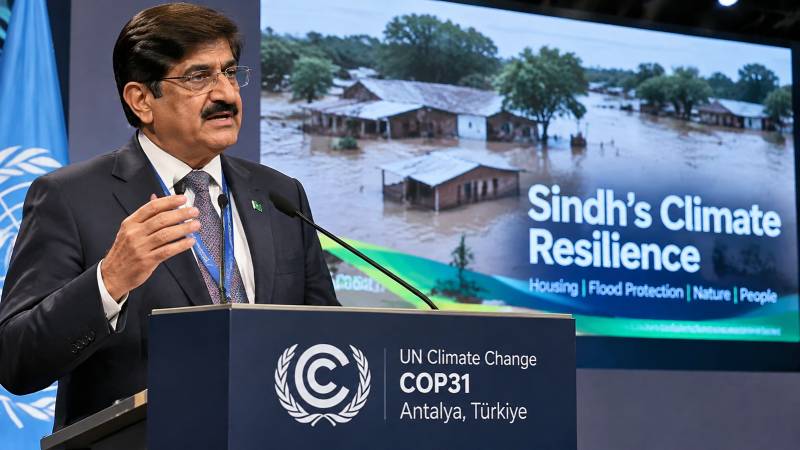
In Antalya on Monday, Sindh Chief Minister Syed Murad Ali Shah stood before COP31 and made a case his province has earned the right to make. Pakistan, he reminded the hall, emits less than one per cent of global carbon dioxide, yet the 2022 floods swept 33 million people from their homes nationwide; bearing down hardest on Sindh, with 15 million affected, nearly 70 per cent of national damages, and over two million houses damaged or destroyed. "Least to blame, most to give back," his final slide read. It is a line that should carry.
Yet climate policy must ultimately be judged by the protection ordinary people experience when waters rise. By that standard, Sindh’s compact deserves genuine credit; followed by a harder question: resilience of what, to what, for whom, over what time, and at whose cost? From Manchar Lake to the Indus Delta, and across katchi abadis, Thari villages, and hari settlements that rarely make the slides, that question remains only half-answered.
What the Chief Minister presented at Antalya was an account, not a plea. At its centre stands the two-billion-dollar Sindh People’s Housing for Flood Affectees programme to rebuild 2.1 million climate-resilient homes—over a million already complete and 700,000 under construction. Crucially, houses are owner-built rather than contractor-led, with milestone-linked tranches transferred into 1.7 million new bank accounts, many in women’s names, supported by over 42,000 village reconstruction committees where women make up 42 per cent of members.
On flood protection, the 2025 monsoon proved a severe test: two flood peaks were defended for 86 days across 2,275 kilometres of embankments without a single breach. The ninety-year-old Sukkur Barrage had all 44 gates replaced in a live river and was recommissioned in June 2026; 54 of Guddu’s 65 gates are complete; and 30 kilometres of rebuilt bunds at Manchar have more than doubled discharge capacity to 83,500 cusecs.
On carbon and nature, Sindh has moved from aspiration to transaction. Delta Blue Carbon has restored 126,000 hectares of mangroves under Verra registration, with 5.6 million tonnes of credits validated against 142 million expected over the project’s lifespan. A 20-million-dollar methane-capture deal at Karachi’s Jam Chakro landfill is being finalised under Article 6.2 of the Paris Agreement, retaining a share of credits as a public asset. Sindh also generates all of Pakistan’s wind power, produces 32 per cent of national electricity, is equipping 275,000 off-grid households with solar systems, and has launched the 540-million-dollar STAR WASH programme across 22 flood-affected districts, targeting child stunting through results-based financing. Together, this ranks among the global South’s most coherent province-level climate programmes.
Climate justice at home means ensuring every rebuilt bund is backed by a hari’s land title, every modernised barrage feeds tail-end canals, every mangrove hectare credits a fisherwoman’s account, and every rebuilt school graduates a girl.
Still, the compact must submit to a harder standard than climate summits typically demand. "Resilience" cannot remain mere budget incantation; it requires specifics across the five Ws. Sukkur and Guddu barrages protect the irrigation grid against extreme flows for downstream districts over decades, while the housing programme shields two million rural families against the next monsoon. Yet lived resilience must pass three tests: withstanding shocks without losing essential functions, restoring services equitably in speed and quality, and learning so the next crisis meets a better-prepared society. Moreover, resilience is not inherently virtuous. Patronage networks that resist reform, drainage grids that divert floodwaters into poorer settlements while sparing wealthier ones, and entrenched procurement cultures are also resilient.
That tension becomes stark along Sindh’s waterways, beginning with Manchar Lake. Pakistan’s largest freshwater lake has been degraded for nearly three decades by toxic effluent and saline agricultural runoff from the Right Bank Outfall Drain, devastating Mohana fishing communities along its shores. Rebuilt bunds hold water back, but they do not clean it; until RBOD-II carries drainage water to the sea at design scale, every flood pulse pushes toxicity back into Manchar and every dry season concentrates what remains.
Further south, the Indus Delta faces a slow emergency. Having shrunk from roughly 10,000 square kilometres to a tenth of that size, it has lost over two million acres across Thatta, Sujawal, and Badin to seawater intrusion, forcing settlements like Keti Bunder and Kharo Chan into steady retreat. Mangrove restoration cannot secure coastal livelihoods unless guaranteed freshwater flows below Kotri Barrage promised under the 1991 Water Accord are actually delivered so shrimp and mullet can spawn. The Chief Minister’s acknowledgment at COP31 that continuous freshwater flow is essential must become provincial law and budget priority, not merely a diplomatic appeal to Islamabad. Similarly, while the Asian Development Bank–Green Climate Fund coastal project promises 900 kilometres of drains and bunds protecting half a million people, its 2027–2032 construction window cannot outrun the next cyclone. Nor can Sindh sidestep its energy paradox: Thar lignite powers 4,672 megawatts—69 per cent of Pakistan’s coal capacity—saving 1.7 billion dollars annually in fuel imports, yet it is Sindh’s largest growth source of emissions and inflicts severe air, water, and health externalities on local communities. Seeking climate finance on moral grounds requires a dated, costed transition plan safeguarding Thar’s workers and host villages.
Equally urgent are the older inequalities braided through Sindh’s climate vulnerability. Tenant farmers (haris) rebuild on land they rarely own, while bonded labour persists across Hyderabad’s brick kilns, sugarcane belts, and coastal fisheries; agricultural land titles and freedom from bondage must follow housing ownership. In Tharparkar, annual drought, rising child mortality, and chronic malnutrition demand a formal drought protocol equal in urgency to flood planning, backed by timely STAR WASH delivery. In Karachi’s katchi abadis—Orangi, Lyari, Keamari—working residents enduring extreme heat and urban flooding need secure tenure, running water, and working sewers far more than electric-bus announcements. For rural girls, rebuilding 5,811 schools and hiring 31,975 women teachers is only a floor; retaining girls past grade eight through safe transport and menstrual-health facilities is the true test. Equally vital is giving Mohana, Mallah, and coastal fisherfolk—alongside marginalized Hindu farmers and Christian sanitation workers—direct governance roles and transparent shares in blue-carbon revenues.
The Chief Minister closed by invoking a five-thousand-year Indus civilisation that knows how to live with the land. The international community must answer that claim with concessional coastal finance, high-integrity Article 6 carbon access, grants for schools and sanitation, and real loss-and-damage delivery. Yet climate justice at home means ensuring every rebuilt bund is backed by a hari’s land title, every modernised barrage feeds tail-end canals, every mangrove hectare credits a fisherwoman’s account, and every rebuilt school graduates a girl. Sindh made a compelling case in Antalya; now it must ensure resilience reaches those least to blame, most exposed, and still waiting.