

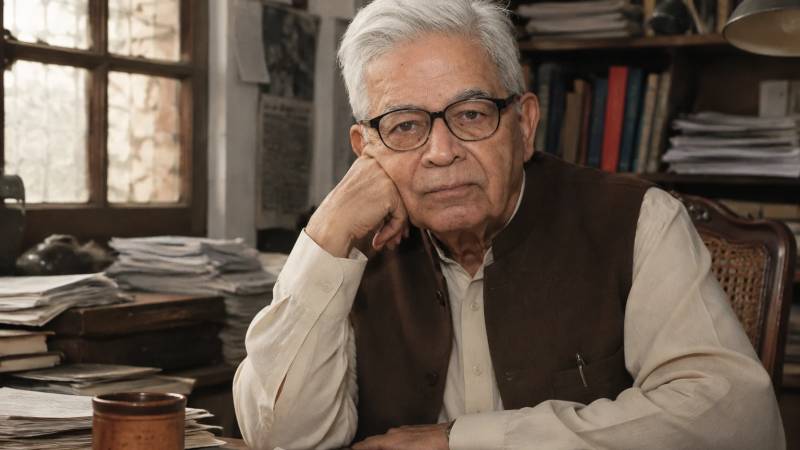
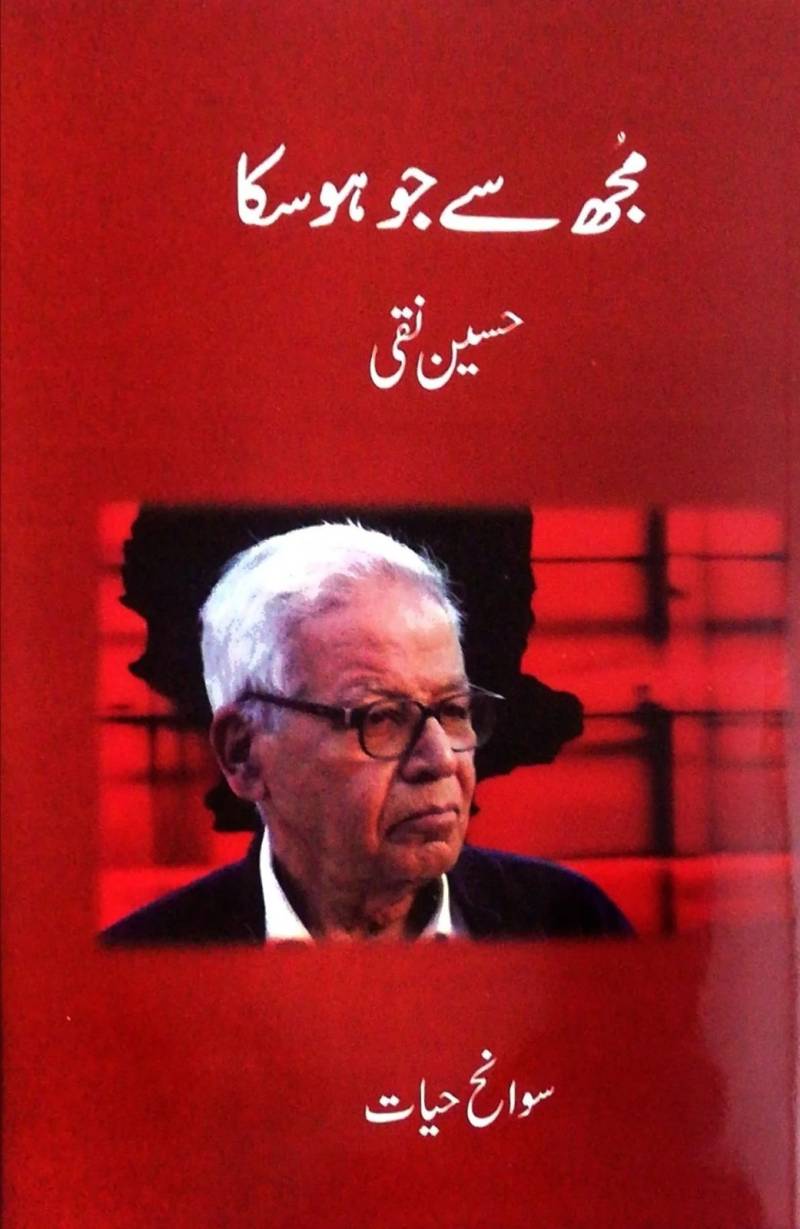
There is something profoundly moving about the title Husain Naqi chose for his autobiography, Mujh Se Jo Ho Saka (Whatever I Could Do). Here was a man who had spent nearly seven decades confronting authoritarianism, defending the dispossessed, resisting censorship, organising journalists and challenging entrenched prejudices, yet chose to describe his life’s accomplishments with such extraordinary modesty.
There was no claim to greatness, no attempt to monumentalise his sacrifices, no suggestion that history owed him recognition. It was simply an acknowledgement of having discharged, to the best of his abilities, an obligation towards fellow human beings. In an age when self-promotion has become an industry and public recognition is often mistaken for public service, the title itself constitutes a powerful philosophical statement.
With his passing in Lahore on November 22, 2026, Pakistan has lost not merely an eminent journalist or an indefatigable human rights defender but one of the custodians of its democratic conscience. His death, coming so soon after that of Professor Amin Mughal, recalls the gradual disappearance of a remarkable generation that regarded intellectual freedom, economic justice and human dignity as inseparable components of human emancipation.
In an earlier essay for these pages, Amin Mughal’s Unfinished Argument With Pakistan, an attempt was made to understand the relationship between an intellectual and a society that repeatedly frustrated his emancipatory aspirations. Husain Naqi belonged to the same historical tradition, though his principal arena was journalism, political organisation and the practical defence of human rights.
The story of Husain Naqi is also the story of another Pakistan—a Pakistan that struggled to come into existence beyond the structures inherited from colonialism, beyond communal divisions, beyond the authoritarian interpretation of nationalism and beyond the concentration of economic and political power in the hands of a privileged minority.
His intellectual formation began in Lucknow, a city whose composite cultural heritage transcended many of the boundaries that subsequently became instruments of political mobilisation in South Asia. The pluralism of its literary, educational and social life helped shape a young mind that would remain remarkably resistant to sectarian, linguistic and ethnic exclusivism. His migration to Pakistan in the early 1950s did not extinguish that sensibility. It broadened its geographical and political horizons.
The student movement in Karachi brought him into association with a generation of young activists that included Mairaj Mohammad Khan, Fatehyab Ali Khan and others who challenged the authoritarian tendencies of the newly established state.
The Democratic Students Federation and, subsequently, the National Students Federation represented an important phase in the evolution of Pakistan's progressive politics. These movements were not merely concerned with university fees, educational facilities or campus administration. They questioned the country's political direction, its international alignments, its emerging class structure and the denial of democratic participation.
Husain Naqi's resistance to the victimisation of Baloch students at Karachi University during Ayub Khan's regime remains particularly instructive. He was prepared to jeopardise his own education to defend the rights of others. His subsequent rustication and removal from Karachi demonstrated, at an early stage, the price that independent political engagement could exact in Pakistan. The episode also revealed a defining feature of his personality. Injustice did not have to affect him personally before becoming his concern.
The significance of such student activism becomes clearer when viewed against the subsequent destruction of democratic life on university campuses. The suppression of student unions has deprived successive generations of opportunities to learn collective responsibility, democratic negotiation and peaceful political organisation. Pakistan frequently laments the absence of principled political leadership without acknowledging how systematically it dismantled the institutions that once nurtured such leadership.
Husain Naqi was a product of precisely those institutions. An exceptionally revealing account of his political and journalistic personality was written by the late economist Dr. Pervez Tahir in The News on Sunday on November 25, 2018, under the deceptively simple title, Who is Husain Naqi?
Exactly eight years later, the question acquires an altogether different poignancy. Pervez Tahir recalls encountering Naqi in 1970 at Shah Hussain College, Lahore, in the company of Professor Eric Cyprian, Professor Manzur Ahmad and Amin Mughal. Naqi was then recruiting contributors for The Sun. That encounter illuminates the intellectual culture of Lahore at the time, when progressive educationists, journalists, economists, writers and political activists inhabited an interconnected world of ideas and public engagement.
Shah Hussain College itself was an expression of resistance. Established by educationists who had suffered professionally for their convictions, it represented an attempt to preserve intellectual independence through institution-building. Husain Naqi recognised the importance of such institutions. His encouragement of young writers was an extension of the same commitment. He wanted to enlarge the community of people capable of participating in public discourse.
The gravest test of his political integrity came during the crisis of 1971. At a time when censorship prevented much of West Pakistan from comprehending the magnitude of the tragedy unfolding in East Pakistan, Naqi endeavoured to communicate what official narratives concealed. Through Punjab Punch, he helped sustain an independent space for political argument. The publication brought together journalists and intellectuals, including Zafar Iqbal Mirza (ZIM), Masudullah Khan, Eric Cyprian, Khalid Hasan, Khadija Gauhar and Najm Hosain Syed.
His selection of the young Pervez Tahir as editor was particularly significant. Husain Naqi understood that the constitutional and political crisis also had deep economic roots: regional disparities, unequal distribution of resources and the concentration of economic power. This understanding distinguished much of the progressive journalism of that period. Its practitioners did not explain political crises exclusively through the personalities of rulers. They sought to comprehend the structures that produced and perpetuated those crises.
Had the warnings of Husain Naqi and other democratic intellectuals been taken seriously, Pakistan might have confronted its contradictions before they culminated in national disintegration. The tragedy of 1971 demonstrated that criticism of the state could be an expression of concern for its survival, while unquestioning loyalty to its rulers could contribute to its destruction. Pakistan has still not fully absorbed that lesson.
My own association with Husain Naqi developed through the intellectual fraternity surrounding the weekly Viewpoint, founded and edited by the legendary Mazhar Ali Khan. During my years on its editorial staff, from 1979 to 1984, Naqi was among our regular visitors and contributors. He subsequently joined the weekly on a full-time basis.
As recorded in my recently published book, Revisiting Pakistan’s Left, and in the two-part series Remembering Viewpoint & its Stalwarts, the weekly constituted much more than a publication. It brought together an extraordinary constellation of intellectuals and journalists whose conception of journalism was grounded in public responsibility.
Mazhar Ali Khan, I.A. Rehman, Zafar Iqbal Mirza, Tahir Mirza, Amin Mughal, Alys Faiz, Aziz Siddiqui, Husain Naqi and their numerous associates sustained a tradition of intellectual resistance under circumstances that younger generations may find difficult to imagine.
During the worst years of General Zia-ul-Haq's dictatorship, we had to submit pages to military censors. The blank spaces left by censorship became part of the weekly’s political vocabulary. Those of us who witnessed that period understood that censorship was not an abstract constitutional controversy. It was a daily confrontation involving livelihoods, personal liberty, institutional survival and the right of citizens to know.
Husain Naqi's column, Lahore Diary, resulted in proceedings under the Official Secrets Act, 1923, against him, Mazhar Ali Khan as editor and Ahmad Aziz Zia as printer. He recalls the episode in Mujh Se Jo Ho Saka. My own recollections include the repeated appearances of Mazhar Sahib and Zia Sahib before a special tribunal, where they were represented by Advocate Khalid Mahmud, whose office was situated on Fane Road, Lahore.
There was something extraordinarily revealing about the prosecution of a writer, an editor and a printer for their respective roles in communicating information to the public. The machinery of state repression recognised the collective character of journalism more clearly than many contemporary proprietors recognise the collective character of journalistic labour.
The appropriate tribute to Husain Naqi would be the restoration of democratic life in educational institutions, protection of journalists against intimidation, defence of constitutional freedoms, respect for linguistic diversity and recognition of the economic foundations of human dignity. Anything less risks converting resistance into nostalgia.
For Husain Naqi, the struggle for press freedom could never be separated from the struggle for the rights of journalists as workers. His association with the trade union movement, and with stalwarts like Minhaj Barna and Nisar Osmani, reflected that conviction.
Editorial independence requires material foundations. A journalist perpetually apprehensive about losing employment cannot be expected to exercise freedom with the same confidence as one protected by collective organisation and enforceable professional rights. Another remarkable dimension of Husain Naqi’s personality was his commitment to Punjabi language and literature.
That a man raised in Lucknow should become a pioneering advocate of Punjabi journalism carries a significance extending far beyond linguistic activism. His association with Sajjan, the pioneering Punjabi daily, represented a rejection of the cultural hierarchy through which the languages of ordinary people are marginalised by their own educated elites.
Husain Naqi recognised that linguistic emancipation is an integral component of democratic emancipation. A people denied the opportunity to conduct serious intellectual, political and economic discourse in their own language suffer a deprivation that cannot be measured merely by literacy statistics. For Punjab’s intelligentsia, his example remains a particularly uncomfortable reminder of its historical neglect of its own language.
The closure of Viewpoint in April 1992 marked the disappearance of an important institutional centre of progressive journalism. For Husain Naqi, however, it did not mark the conclusion of political engagement. Like I.A. Rehman and Aziz Siddiqui, he continued his work through the Human Rights Commission of Pakistan.
The emergence of HRCP as a significant institution of civil society also represented a continuity of progressive political engagement during a period when many traditional organisations of the Left were experiencing ideological and organisational disarray.
Husain Naqi’s commitment did not depend upon the fortunes of any particular political party or international ideological bloc. The collapse of the Soviet Union did not make inequality disappear, nor did it render the defence of human dignity redundant. His autobiography, published by Jamhoori Publications in 2025, and the conversations preserved by Dr. Syed Jaffar Ahmed in Jurat-e-Inkaar, are consequently invaluable additions to Pakistan’s intellectual and political history.
In his perceptive review, Lessons from an Agitator, Harris Khalique identifies the wider historical significance of Naqi's memoir. It offers an understanding of Pakistan from the position of those who resisted injustice rather than exclusively through the perspectives of those who exercised authority. Similarly, Dr. Naazir Mahmood's Those that Dare to Defy draws attention to the importance of preserving the oral histories of progressive intellectuals and activists.
These works should find a place in university curricula. Students of journalism, political science, history, sociology, law and economics need to encounter Pakistan through the experiences of those who challenged its prevailing structures of power.
The archives of Viewpoint, Punjab Punch and other progressive publications must likewise be preserved, digitised and made accessible to future generations. Their disappearance from collective memory would constitute a second defeat for the movements whose struggles they documented.
There is, however, a larger question that Husain Naqi's passing compels us to confront. Why has Pakistan produced so many intellectually distinguished, morally courageous and politically committed individuals without succeeding in building durable institutions reflecting their ideals?
The paradox runs throughout the history of Pakistan’s Left. Its intellectual achievements have often been inversely proportional to its organisational strength. Its journalists, poets, historians, lawyers, economists and political workers have produced compelling critiques of injustice, but the institutions necessary to translate those critiques into enduring democratic transformation have remained vulnerable.
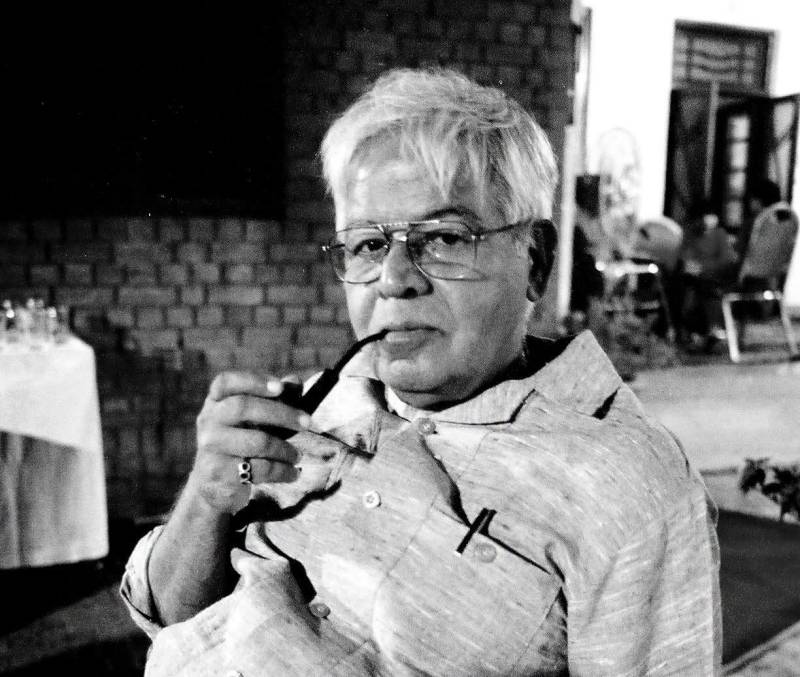
The lives of Husain Naqi, Amin Mughal, Mazhar Ali Khan, I.A. Rehman, Eric Cyprian and their contemporaries must be studied within this historical contradiction. Their achievements were immense, but their aspirations remain largely unfulfilled.
The appropriate tribute to Husain Naqi would thus be the restoration of democratic life in educational institutions, protection of journalists against arbitrary dismissal and intimidation, defence of constitutional freedoms, respect for linguistic and cultural diversity, and recognition of the economic foundations of human dignity. Anything less risks converting resistance into nostalgia.
Mujh Se Jo Ho Saka was Husain Naqi's modest summation of a life devoted to others. It was not an admission of defeat. It was the declaration of a man who understood the limitations of individual agency without allowing those limitations to become an excuse for acquiescence.
He did what he could. The question he leaves behind is what those who survive him are prepared to do.