

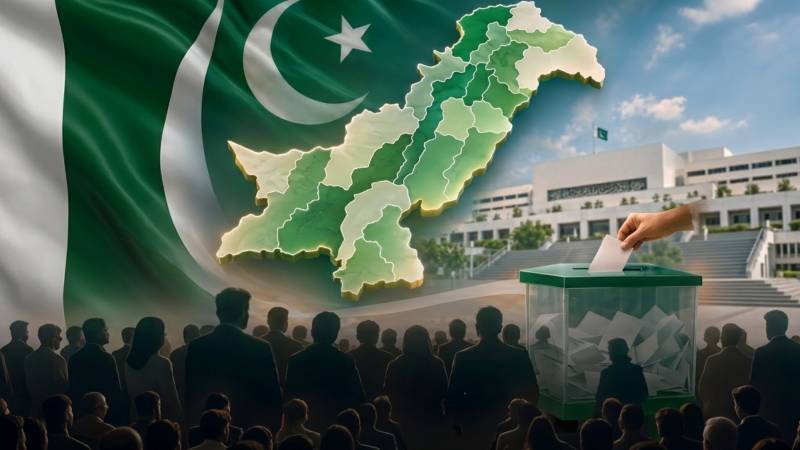
The debate surrounding the creation of new provinces in Pakistan is being widely discussed across media platforms by certain sections of the journalistic community and some quarters within the government. Proposals for dividing existing provinces through referendums are being presented as a possible solution to Pakistan's governance challenges.
In evaluating the above proposition, two basic questions must not be ignored. First, can a referendum be used as a constitutional mechanism for the creation of new provinces? Second, can population alone constitute a sufficient justification for such territorial reorganisation?
Article 48(6) of the Constitution provides that, where the President considers it desirable to obtain the opinion of the people on a matter of national importance, the matter may be referred to a referendum. The language of Article 48(6) is critical. It concerns obtaining the opinion of the people. Thus, a referendum under this provision is an instrument for ascertaining public opinion on a matter of national importance; it is not an independent constitutional mechanism for altering the territorial structure. Hence, a referendum may carry political significance or demonstrate public support; however, its outcome cannot amend the Constitution.
The Constitution has expressly prescribed the procedure for territorial reorganisation. Article 239(4) provides that a constitutional amendment having the effect of altering the limits of a province cannot be presented to the President for assent unless it has been passed by the Provincial Assembly of the affected province by a majority of not less than two-thirds of its total membership. This requirement operates alongside the parliamentary procedure prescribed for constitutional amendments. The special requirement under Article 239(4), wherever applicable, must be fulfilled. The Supreme Court of Pakistan, in the Rawalpindi District Bar Association case (2015), made it clear that the constitutional amendment procedure under Article 239 does not require a prior referendum. Therefore, a referendum may provide political legitimacy to a proposed constitutional change, but it cannot substitute for the constitutional procedure prescribed for bringing that change into effect. Likewise, the Supreme Court of Canada, in Reference re Secession of Quebec (1998), recognised that a referendum may ascertain the electorate's views on important political questions but "in itself has no direct legal effect."
Article 239(4) makes the consent of the affected Provincial Assembly through a two-thirds majority an essential constitutional requirement for altering provincial boundaries, demonstrating that territorial reorganisation cannot be achieved through a referendum alone.
The second argument concerns the assumption that Pakistan's large provincial populations necessarily require the creation of additional provinces. Undoubtedly, population figures raise questions about administrative accessibility, public service delivery and representation. Nevertheless, population cannot be treated as the sole criterion for territorial reorganisation. India provides an important comparative example. Its Constitution empowers Parliament to create new states. However, the creation of Indian states was not simply a response to population size. Linguistic identity, historical circumstances, geography, regional aspirations and political movements played significant roles. Uttar Pradesh, with a population exceeding 200 million, still remains a single state. The experience of the United States provides another perspective. California, with a population exceeding 39 million, remains a single state. Nigeria's experience also demonstrates that the creation of additional states can be influenced by minority representation, regional identity, political balance and economic development rather than population alone.
This brings us to the more fundamental question: if the principal concerns are ineffective governance, excessive centralisation and the distance between provincial governments and ordinary citizens, does Pakistan's Constitution already provide a mechanism to address these problems? In my opinion, it does. That mechanism is Article 140A, which requires every province to establish a local government system and devolve political, administrative and financial authority to elected representatives. This means that elected local representatives must possess genuine decision-making powers. Administrative devolution requires local governments to exercise meaningful control over local administration and public services. Financial devolution requires adequate fiscal autonomy to perform their constitutional functions.
India provides a useful example in this regard. Its large states operate through extensive structures of local administration and elected local bodies. The constitutional framework provides for rural and urban local self-government through Panchayats and Municipalities. These institutions bring governance closer to citizens and distribute administrative responsibilities across different levels. Uttar Pradesh administers its territory through districts, municipalities, Panchayats and other local institutions. Similarly, California relies upon counties, cities and special districts to deliver public services across its vast territory. These examples do not establish that new provinces are never necessary. Rather, they demonstrate that the challenges posed by population size and geographical expanse can be addressed through empowered local institutions.
Unfortunately, Pakistan has repeatedly failed to establish local governments as envisaged by Article 140A. Elected representatives at the grassroots level are often left without the authority or resources necessary to respond effectively to the needs of their constituencies. We must therefore ask ourselves an uncomfortable question: have we genuinely implemented Article 140A before declaring that the existing provincial structure is incapable of delivering good governance? Effective governance depends on institutional arrangements, decentralisation, representation and the distribution of authority, not merely on the number or population of constituent units. Pakistan's immediate priority should be the implementation of Article 140A.
Aristotle observed in Politics, "The rule of law is preferable to the rule of any individual." The creation of new provinces must reflect genuine regional aspirations and follow an inclusive, gradual and constitutionally prescribed democratic process rather than political expediency or the ambitions of powerful individuals and institutions in pursuit of power. The real priority should not merely be to redraw boundaries but to empower people through meaningful devolution of power.