

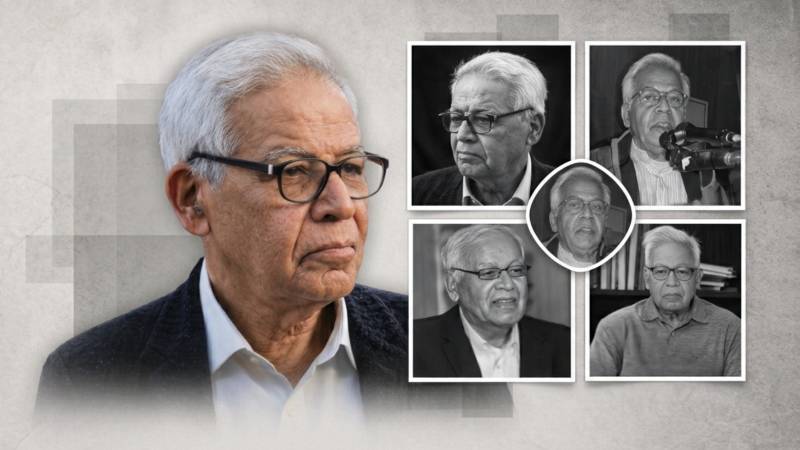
Pakistan has lost one of its most courageous, principled and respected journalists. Husain Naqi passed away in Lahore on November 22, 2026, at the age of 90. His death marks the end of a remarkable life devoted to journalism, democracy, human rights and freedom of expression. He belonged to a generation of journalists for whom speaking the truth was not only a professional responsibility but also a matter of personal honour and dignity.
Born in Lucknow, India, in 1936, Naqi grew up in a well-educated and well-heeled family. From an early age, he developed an independent mind and a strong sense of justice. He was never comfortable with the misuse of authority. These qualities shaped his personality and influenced every stage of his life.
After moving to Karachi in the 1950s, he became actively involved in progressive student politics. He emerged as a prominent student leader associated with the National Students Federation (NSF). During the 1956 Suez crisis, he took part in protests against the attack on Egypt by Britain, France and Israel. The demonstrations met with a strong police response, but this did not discourage him from continuing his political and democratic struggle.
An important chapter of his early life had unfolded in Lahore, where he was elected president of the Islamia College Students’ Union before embarking on his career in journalism. His experiences as a student leader helped shape his political outlook and strengthened his commitment to democracy, students’ rights and progressive politics.
My family knew Naqi Sahib for generations. He was a friend of my father and uncle, while my paternal grandfather and granduncles were the regular physicians to his family. He often visited my father at his offices on Shahrah-i-Iraq in Karachi and Fane Road in Lahore. He also kindly wrote the preface to my mother's memoirs. These family ties gave me a personal connection with him and an appreciation of his work and commitment to the causes he believed in.
As president of the Karachi University Students’ Union, he worked for students’ rights and better educational facilities. He supported the establishment of a new campus, better transport facilities for female students and the timely holding of examinations. He was also a strong supporter of student unions, believing that they helped young people develop political awareness, learn to tolerate differences and understand democratic values.
One incident from his student days reflected his remarkable sense of solidarity. When three Baloch students faced disciplinary action and the threat of rustication, he negotiated with the university administration and offered to accept a three-year rustication himself instead. This was typical of his character. He was always prepared to stand up for others, even when doing so involved personal sacrifice.
His involvement in student politics eventually brought him into journalism, a profession in which he would spend more than seven decades. He began his career with Pakistan Press International (PPI), where he worked under the guidance of senior journalist Javed Bokhari. He eventually became the organisation's bureau chief. However, his commitment to professional honesty was stronger than his attachment to any position. He left PPI after refusing to accept and publish a false report concerning the alleged desecration of the Holy Quran.
From defending students’ rights and challenging state authority to advocating minority rights, women's rights and civil liberties, Naqi remained committed to protecting those whose voices were often ignored by powerful institutions.
This incident reflected a principle that remained central to his journalism throughout his life. For him, facts must never be sacrificed for personal, political or professional convenience.
He worked with several newspapers and publications, including Viewpoint, Holiday, Outlook, The Frontier Post, Frontier Guardian, Daily Star, Punjab Times and The News. He also served as editor of The News. His journalism was marked by independent thinking, courage and a deep concern for ordinary people. He was never interested in pleasing those in power. Instead, he believed that journalists had a duty to question authority, expose injustice and give a voice to people who were often ignored.
His outspoken views brought him into conflict with successive governments and powerful institutions. He faced imprisonment and other forms of pressure for his political activities and professional convictions. Yet, he never allowed these difficulties to weaken his commitment to truth and justice. He understood that independent journalism often came at a personal cost, but he was unwilling to compromise his principles.
Another important aspect of his life was his commitment to the promotion of the Punjabi language. Despite being born and educated in Lucknow, he developed a deep connection with Punjab and its language and culture. He launched Sajjan, widely recognised as the first daily newspaper in Punjabi in Pakistan. Through this initiative, he sought to give the language a stronger place in the country's media and public life. His efforts reflected his belief that all languages and cultures deserved dignity and recognition.
His contribution to human rights was as significant as his work in journalism. He remained associated with the Human Rights Commission of Pakistan (HRCP) for around three decades and served in different capacities, including as its treasurer. He was also an active member of its council until his death.
At the HRCP, he continued his struggle for democracy, civil liberties, minority rights, women's rights, workers’ rights and the protection of disadvantaged communities. He believed that a society could not call itself democratic unless it protected the rights and dignity of all its citizens. He remained concerned about those who had little power or influence to defend themselves.
For younger journalists, Husain Naqi was much more than a senior colleague. He was a mentor, teacher and a source of inspiration. Many journalists learnt the basics of independent journalism through their association with him. He encouraged young reporters to develop their own opinions, question official versions of events and never allow fear or personal interests to influence their work.
Despite his strong views, he believed in tolerance and the right to disagree. He could be firm in his convictions without encouraging hatred towards those who held different opinions. His approach to public life was based on debate, dialogue and respect for democratic freedoms.
What made him remarkable was his ability to remain active and engaged even in his later years. He continued to attend meetings, participate in discussions and support causes close to his heart. On the day before his death, he presided over a book launch at the HRCP Secretariat in Lahore. He suffered a heart attack later that evening and passed away the following morning.
His passing has left a deep sense of loss among journalists, human rights activists, political workers and all those who had the privilege of knowing him. But his loss is not limited to his friends and colleagues. Pakistan has lost a public figure who spent his entire life defending principles that remain necessary for a free and democratic society.
At a time when journalism faces growing pressures and freedom of expression continues to be challenged, the life of Husain Naqi offers an important lesson. He demonstrated that a journalist's real strength does not come from holding an influential position or enjoying official recognition. It comes from honesty, professional independence and the courage to stand by the truth, even in difficult circumstances.
He did not live a life of comfort or compromise. He chose a path that mostly brought hardships, but he remained faithful to his beliefs until the very end. His contribution to journalism, the Punjabi language, democracy and human rights will continue to inspire future generations.
Husain Naqi is no longer with us, but the values he stood for will remain relevant for as long as people continue to struggle for truth, justice and freedom. His life was a testament to the power of individual courage and public service. He leaves behind a legacy that deserves to be remembered with respect and gratitude.