

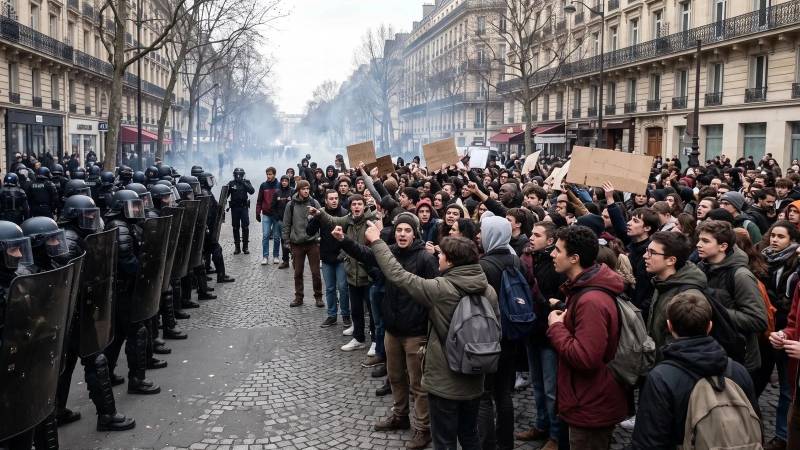
France, a nation celebrated for its revolutionary ideals, intellectual traditions and commitment to public education, is confronting an extraordinary challenge from its youngest citizens. Thousands of teenagers who should be attending lessons in mathematics, literature and science have instead taken to the streets, demanding something remarkably modest: functioning classrooms, qualified teachers and a fair opportunity to learn. What began as protests over deteriorating school facilities and staff shortages has developed into a nationwide movement, raising fundamental questions about educational inequality, democratic accountability and the relationship between the state and its younger generation. The demonstrations reached another significant moment on October 13, when more than 160,000 schoolchildren, university students and trade unionists marched across France.
The French Interior Ministry estimated participation at 161,500, following demonstrations involving more than 260,000 people on October 6 and approximately 75,000 two days later. The movement has now entered its third week, showing that the anger is neither temporary nor confined to a handful of dissatisfied schools. Perhaps the most striking development was the appearance of Swedish environmental activist Greta Thunberg outside Lycée Paul Éluard in Saint-Denis, a working-class suburb of Paris. Thunberg, whose international reputation emerged from school strikes demanding action against climate change, joined students protesting inadequate educational investment. Her presence connected two seemingly different struggles: the demand for a sustainable planet and the demand for an educational system capable of preparing young people to inhabit it. Both express a generation's frustration with decisions made by older political leaders whose consequences will be experienced most directly by the young.
Yet the French protests are not primarily about celebrity activists or political symbolism. Their origins lie in ordinary classrooms where the absence of a teacher can mean weeks of interrupted learning, where overcrowding limits individual attention and where deteriorating buildings undermine the dignity of education. The movement began gathering momentum in the Paris region during September before spreading to Lyon, Marseille, Lille, Bordeaux, Nantes and other cities. Social media helped transform local complaints into a national conversation. Students discovered that the problems affecting their schools were shared by thousands of others. Their demands are strikingly practical. They want teachers who actually appear in classrooms, sufficient desks, functioning toilets, reasonable class sizes and buildings capable of providing a suitable learning environment. These are hardly extravagant revolutionary ambitions. They are the basic conditions that a developed country should be able to provide through its public education system. A missing teacher is not simply an unfilled administrative position. It represents lessons never delivered, questions never answered and intellectual foundations that may remain permanently incomplete. Students preparing for examinations cannot necessarily recover months of interrupted instruction simply because a replacement teacher eventually arrives. The consequences are particularly severe for children from disadvantaged families. Wealthier parents can often arrange private tutoring, additional learning resources and professional guidance. Poorer households possess fewer alternatives. Thus, a shortage affecting an entire school may deepen inequalities that already exist between students from different socioeconomic backgrounds. As a physicist and lifelong teacher, I have always regarded the classroom as an environment where curiosity is gradually transformed into understanding.
The October 13 demonstrations also revealed how far the movement has expanded beyond secondary schools. University students joined protests in solidarity, and the university students' union reported widespread disruption across higher education institutions. Schools were blockaded in several cities, while some institutions shifted temporarily towards online instruction. The scale of the disruption presents a difficult paradox. Students are protesting because their education has been interrupted, yet prolonged demonstrations can themselves interrupt learning. This contradiction does not invalidate their grievances, but it demonstrates the urgency of finding solutions before another academic generation pays the price. The situation has become more disturbing because of confrontations between protesters and police. On October 13, most demonstrations were peaceful, but riot police used tear gas in Nantes and near Montparnasse in Paris. Images of police water cannon, barricades and teenagers confronting heavily equipped officers have transformed an educational dispute into a national debate about public order and the rights of minors. By that date, government figures indicated that more than 6,800 people, predominantly minors, had been detained during the protests. Approximately 1,500 faced prosecutions, while 24 allegations of police brutality were under investigation. Reported injuries included more than 200 teenagers, approximately 100 school staff members and 700 police officers. Some individual cases have been particularly disturbing. One young protester lost a hand following an incident involving a police stun grenade, prompting the government to suspend the use of such weapons during the demonstrations.
A school that teaches liberty, equality and fraternity while failing to provide equal learning opportunities exposes students to a contradiction between civic ideals and lived experience. Similarly, institutions that encourage critical thinking in textbooks but reject all criticism of their own shortcomings undermine the very values they claim to teach.
The presence of lawyers forming a protective human chain outside the Saint-Denis school on October 13 provided an extraordinary image of the crisis. When legal professionals feel compelled to stand physically between schoolchildren and police, an educational disagreement has clearly entered deeply troubling territory. Public authorities have a legitimate responsibility to protect people and property. Attacks on schools, vandalism and violence against police officers cannot be justified merely because they occur during demonstrations. Destroying educational facilities ultimately harms the very students whose interests the movement claims to defend. Nevertheless, maintaining public order must remain compatible with proportionality, accountability and the special protections owed to children. A democratic state should be capable of distinguishing peaceful dissent from criminal destruction without treating all protesters as potential offenders.
President Emmanuel Macron has called for restraint, consultation and respectful discussion. Those principles are appropriate, but their effectiveness will depend upon whether they produce visible improvements. Education Minister Édouard Geffray has announced the deployment of approximately 3,000 substitute teachers to institutions experiencing the most severe shortages. This represents an important immediate response, although the extent to which it will restore regular instruction remains to be seen. On October 13, the minister reported that 214 of France's approximately 3,700 high schools were completely closed. Other institutions experienced partial disruption or cancelled classes. The government therefore faces two simultaneous responsibilities: restoring uninterrupted education and addressing the conditions that made the demonstrations possible. Neither task can be accomplished through announcements alone.
Recruiting replacement teachers may provide temporary relief, but educational reform requires longer-term attention to staffing, professional development, infrastructure, student support and the distribution of resources. The financial challenge is substantial. France faces pressure to contain public debt and budget deficits while meeting competing demands for healthcare, pensions, defence, infrastructure and social services. Educational investment, however, should not be treated merely as another expenditure to be reduced whenever public finances become uncomfortable. The costs of educational neglect rarely appear immediately in government accounts. They emerge gradually through weaker skills, reduced productivity, diminished opportunities and declining confidence in public institutions. A qualified teacher is not an extravagance. A functional science laboratory is not a luxury. These are investments in the intellectual and economic capacity of future generations. The protests have also begun intersecting with broader economic dissatisfaction.
Further demonstrations are anticipated, with concerns about fuel prices, energy costs and living expenses potentially drawing additional participants. The presence of figures associated with France's earlier yellow-vest movement illustrates the possibility that educational grievances may become part of a wider protest against economic hardship and political unresponsiveness. Such developments could change the character of the movement. A campaign focused on school conditions may gradually become a platform for multiple grievances, making negotiations more complicated. The government must therefore distinguish between immediate educational requirements and wider political demands without allowing either to obscure the urgent need for functioning schools.
France's approaching presidential election adds another layer of political sensitivity. With Macron unable to seek another consecutive term, rival political movements are competing to shape the country's future. Jean-Luc Mélenchon has praised the protesting students and criticised police conduct, while Marine Le Pen has emphasised damage to educational institutions and argued for greater parental responsibility for repair costs. These competing responses reflect deeper disagreements about public spending, political protest, state authority and social responsibility. Yet the students' concerns should not be reduced to electoral calculations. Many of those demonstrating are too young to vote in national elections. They must nevertheless live with the consequences of decisions taken by political leaders.
This raises a fundamental democratic question: how should a society listen to citizens who are directly affected by public policy but do not yet possess full electoral representation? France has a distinguished, sometimes turbulent, tradition of student activism. The events of May 1968 transformed political and cultural debate, while the protests against the proposed First Employment Contract in 2006 demonstrated the influence young people could exercise over national policy. The circumstances of 2026 are different, and historical comparisons should not be exaggerated. Nevertheless, these episodes share an important lesson: students are not merely passive recipients of decisions made by adults. They are developing citizens capable of identifying institutional shortcomings and demanding accountability. Greta Thunberg's appearance in Saint-Denis reinforces this interpretation, connecting contemporary student mobilisation with a wider international tradition of youth activism.
These concerns deserve attention before frustration turns into confrontation. University administrators and policymakers should recognize that academic institutions cannot be judged solely by the number of buildings constructed, degrees awarded or ceremonial functions organized. Their real achievements are reflected in the quality of teaching, the availability of research opportunities, the fairness of administrative procedures and the confidence students place in their educational future. France's student movement is therefore more than a domestic political dispute. It is a reminder that educational inequality can become a crisis of democratic legitimacy when young people conclude that institutions no longer respond to their needs.
The October 13 demonstrations have made that message difficult to ignore. The participation of students, teachers, trade unionists and internationally recognized activists has expanded the movement's visibility, but its essential demands remain remarkably straightforward. Young people want to learn. They want qualified teachers, functioning schools and opportunities that do not depend overwhelmingly upon family wealth or neighbourhood. The tragedy is that such elementary expectations have become the subject of barricades, police confrontations and national political controversy. The ultimate measure of France's response will not be the number of demonstrators removed from the streets, the number of arrests recorded or even the temporary reopening of schools. It will be whether students experience meaningful improvements in the quality and fairness of their education. A nation reveals its priorities not through the eloquence of its promises to the young, but through the opportunities it actually provides them. France must now decide whether it will answer its students with lasting educational reform or allow another generation to discover that the road to a better classroom begins on the streets.