

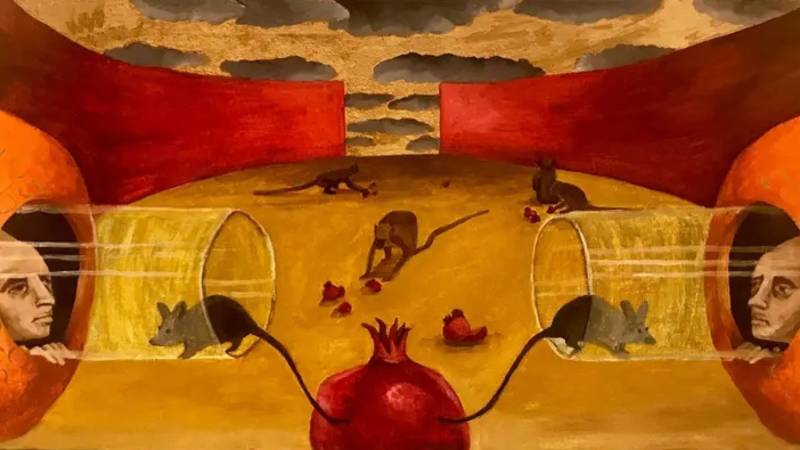
A distinct thread of menace runs through Sheherbano Husain’s work. Drawing inspiration from Francisco Goya, Hieronymus Bosch, Giorgio de Chirico and even the sublime Botticelli, she creates a world where upheaval and chaos reign—a true reflection of the world we inhabit. There is no comfort to be found in Husain’s work. By employing an overbright, almost lurid palette to lure us into this unnatural world, she presents us with half-recognised images that shimmer before our eyes. They may initially be difficult to understand because of their changed context. However, it is this very altered and reworked context that lies at the heart of Husain’s work. In decoding it, we begin to comprehend why she has referenced these particular artists. They too, with the exception of Botticelli, were masters at conveying images of corruption, power and inevitable decay.
In her approach to large areas of solid rectangular blocks of colour, we are reminded of the vibrancy of similar shapes in Anwar Saeed’s paintings. Both Saeed and Husain use these blocks of colour effectively, juxtaposing them with their particular forms and images. Husain’s scarecrows and gagged mouths lend themselves to a dystopian vision. We recognise this as our current grim reality. There is an element of restlessness, of time rushing by and of a loss of control. The frightening realisation that we are the scarecrows and that it is our mouths that are silenced with gags, rendering our voices unheard, is what lies beneath the seemingly cheerful candy-floss palette.
Factory-scapes appear to be at boiling point, threatening to erupt and polluting the air, while rows of cypress trees carry a whisper of danger. Nature is ready to exact her just and due revenge on humankind for the ravages it has inflicted upon her. Soon, the tables will be overturned. Similar to the unseen but ever-present sense of danger in de Chirico’s mysterious paintings, what we see here is something we cannot fully make sense of. Hence, we fear the unknown.
A distinct thread of menace runs through Sheherbano Husain’s work. Drawing inspiration from Francisco Goya, Hieronymus Bosch, Giorgio de Chirico and even sublime Botticelli, she creates a world where upheaval and chaos reign, a true reflection of this world we inhabit.
When communication breaks down, it underscores a disconnect in society that speaks to our current sense of foreboding, coupled with helplessness. This latter state of mind, which keeps us inert and passive, offers a glimpse of the endgame. Like the hapless victims in Bosch’s maniacal world, who were also passive players in his killing fields, we too are similar puppets in our present circumstances. The gargoyles swallowing men and women evoke images of our machine guns and bombs, while the monsters ripping off heads bring to mind our political frontmen. We are existing in a nightmare of our own devising—famine, floods and war-torn fields. This is the outcome of a lack of unity against evil.
Escher-like staircases leading nowhere and a white sacrificial lamb waiting to be slaughtered are symbols we can understand. Layered through the medium of collage, these represent confusion, sacrifice and innocence. The narrative of destruction and death persists beneath the blue skies and bright washes. Husain’s work is like the many pieces of a jigsaw: seen separately, each holds a clue to the whole; viewed together, they constitute all that has led to our current impasse.
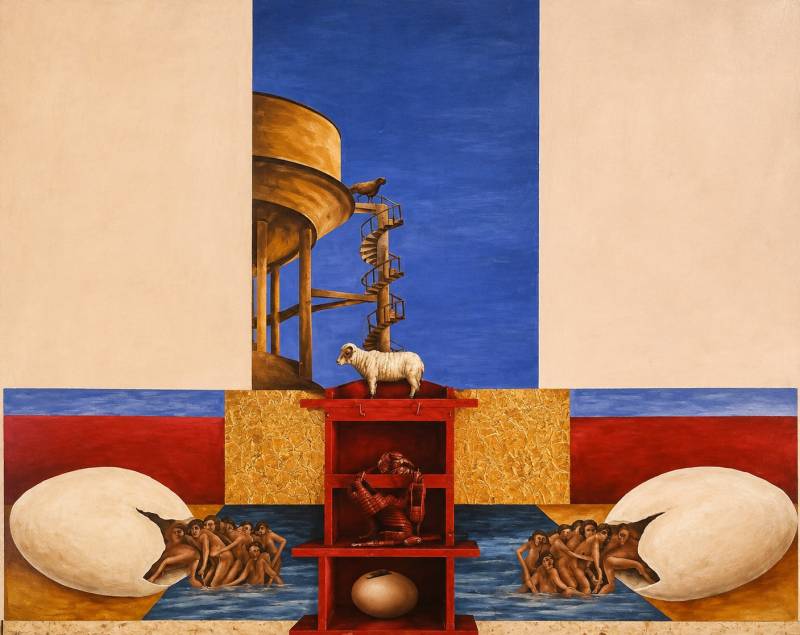
Thus, Michelangelo’s painted hands from the Sistine Chapel frescoes perhaps grant purgatory rather than life, while the Ship of Fools, carrying masked ‘mice-men’ with their inane rictus smiles and being welcomed ashore by Death, is both chilling and fatalistic in its black humour. The Tower of Babel is a labyrinth of miscommunication, where the language is that of selective and unbridled power. This dystopian world refers, of course, to Gaza, Afghanistan, Venezuela, Iran and Rwanda. The list is long and makes for depressing reading.
The division into triptychs recalls the precious, gilt-edged altarpieces in churches and chapels, where communities of the faithful knelt to pray. Husain’s triptychs beg the question of whether we are worshipping false gods of wealth and power. There is also a cyclical element to the work: the cycles of life and death persist, repeating the very mistakes that dehumanise and disconnect us. The organic images of cracked eggs, from which some form of humanity is emerging, situate us in Bosch’s Garden of Earthly Delights. The ‘delights’ on display here herald the end.
Husain’s confrontation with the physical world as experienced by humankind is an emotive portrayal of where we stand at this moment in the earth’s evolution. We look past the bright, hard pinks, cold blues and sulphurous yellows of the poisoned clouds and damaged fields. This is a place of no return. This is our Hades in “glorious technicolour” and, having created it through a false simulation of what God created, we must now dwell in it and eat of its earthly fruits. The exhibition at Gallery 8B2, Islamabad, runs from 17 October to 29 October 2026.