

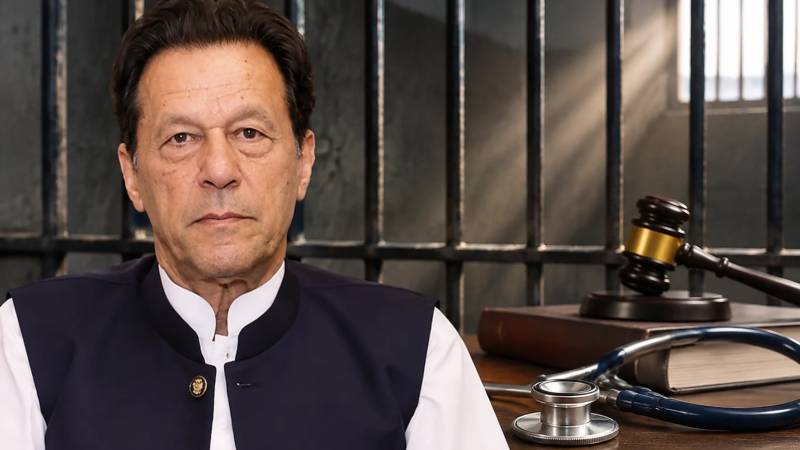
Imran Khan’s letter to the judiciary raises a question larger than his imprisonment. What becomes of fundamental rights when their enforcement depends on political convenience?
There is something profoundly diminishing about a republic in which a prisoner must remind its highest judges that he has a body: eyes that can fail, a heart that can weaken, a mind that can be injured by silence. Before a court decides what punishment the law permits, the body has already begun serving its own sentence. A letter asking to be examined by doctors should belong to the routine administration of justice. When it becomes a national political event, the republic has questions to answer.
The open letter dated November 16, attributed to Imran Khan and reportedly conveyed through his lawyer, Salman Safdar, puts those questions in painfully human terms. Addressed to the chief justices of the Supreme Court, Federal Constitutional Court and Islamabad High Court, it alleges deteriorating health, prolonged isolation, restricted access to counsel and family, and failure to implement judicial directions concerning medical care. These are allegations requiring verification. Their gravity demands a response capable of establishing what has happened behind the prison walls.
The government disputes the account. Parliamentary Affairs Minister Tariq Fazal Chaudhry has rejected allegations of neglect and isolation, saying Khan receives specialist attention and necessary facilities. That denial deserves to be recorded. It also creates an obligation to demonstrate the facts through independent examination, medical records disclosed with appropriate consent, access for counsel and a judicial account of compliance. A ministerial assurance cannot resolve a contested medical question. Nor does describing a prisoner as privileged establish that his rights have been protected.
Authenticity matters. A forged or altered letter would indict its fabricators, it would not prove mistreatment by the state. Yet the underlying questions do not disappear with uncertainty over a circulating image. They can be answered independently of its wording. The letter’s reception raises another question. Why does an account of institutional abandonment sound plausible to so many? A government concerned about that perception should welcome verification. Credibility grows when citizens can examine the evidence, rather than choose between competing declarations.
Khan’s identity gives the appeal extraordinary resonance. He was prime minister, world cup winning cricket captain and the public face of a philanthropic enterprise. Millions remain attached to his political cause. The strength of that constituency was evident when PTI backed independents won the largest number of directly elected National Assembly seats in 2024. His imprisonment cannot make that attachment disappear. For supporters who remember crowds gathering to hear him, the image of a solitary man asking judges for medical attention carries an unmistakable charge.
His stature makes the state’s obligation conspicuous, but it does not enlarge the right itself. The Constitution offers no superior grade of human dignity to former prime ministers. If fame, lawyers and public recognition cannot secure a credible account of a prisoner’s treatment, consider the detainee whose name never reaches a newsroom. The importance of this case extends beyond the man who has commanded stadiums and governments. It reaches the anonymous person whose suffering has no audience at all.
Pakistan’s Constitution is clear about the principles. Article 9 protects life and liberty subject to law. Article 10A guarantees fair trial and due process. Article 14 declares human dignity inviolable, while Article 25 establishes equality before the law and equal protection. Those provisions are addressed to the exercise of power. A state does not fulfil them by reciting their numbers at ceremonies. It fulfils them through decisions about a lawyer’s visit, a medical referral and a prisoner’s ability to challenge what is being done to him.
Imprisonment lawfully restricts freedom though it does not transfer ownership of the prisoner to his jailers. A conviction cannot settle whether appropriate medical care is being delivered. Equally, a prisoner’s popularity cannot settle the merits of a criminal appeal. Keeping those questions distinct is essential to justice. It allows a citizen to support lawful accountability while insisting on humane custody, without first joining a political party or adopting the prisoner’s account of every case against him.
A republic earns authority by placing limits on what may be done in its name. Until those limits are credible behind prison walls, a letter from a cell will continue to put the state in the dock.
The allegations about isolation deserve scrutiny against an established international standard. The United Nations’ Nelson Mandela Rules define solitary confinement as at least twenty two hours daily without meaningful human contact, and prolonged solitary confinement as more than fifteen consecutive days. They prohibit the prolonged form. Whether Khan’s treatment meets those definitions must be established through evidence. But a country cannot evade the substance of the question by giving isolation an administrative name or calling the absence of contact a security arrangement.
The judiciary’s responsibility is especially grave where non-compliance with its own directions is alleged. An order concerning a prisoner’s treatment must be followed through to implementation, with reasons examined for any departure. Otherwise, the relief exists only on paper. Franz Kafka’s novel The Trial remains disturbing because the machinery of justice is everywhere, while a meaningful answer is perpetually out of reach. It portrays the individual’s helplessness before an opaque and oppressive legal order, where accusations remain unexplained, authority evades scrutiny, and the machinery of justice offers neither answers nor redress. A prisoner seeking treatment should not have to discover which corridor, registry or jurisdiction will finally lead to an effective remedy.
International comparisons suggest that these anxieties belong to a broader institutional problem. The World Justice Project’s 2026 Rule of Law Index ranks Pakistan 131st among 143 countries and jurisdictions, with an overall score of 0.36 out of one. It stands 126th on fundamental rights, 128th on civil justice and 102nd on criminal justice. Its overall ranking has fallen one place. These figures describe more than an image problem. They point to weaknesses in the institutions through which citizens seek protection from arbitrary power.
The index measures experiences and perceptions across institutions, rather than deciding individual cases or grading every judge. It cannot establish the truth of a prison complaint. Nevertheless, its findings describe a setting in which confidence in legal protection is dangerously weak. The fundamental rights score, civil justice ranking and overall position give institutional substance to a familiar apprehension: that possessing a right and obtaining its enforcement may be very different experiences. The letter places a recognizable human figure inside that distance.
That is why indictment is the appropriate word. The letter is indeed an indictment of the state, government, establishment, courts and the society at large. Its force extends beyond reputational discomfort. An appeal of this kind asks whether the arrangements of government can deliver the minimum protection they promise. The elected administration must answer for the conduct of authorities under its responsibility. The security establishment must recognize that national strength includes restraint and respect for lawful institutions. Courts must demonstrate that their remedies reach the people who need them. None can borrow legitimacy indefinitely from the language of constitutionalism.
The establishment, in particular, should resist confusing a political opponent’s humiliation with the restoration of order. Suppressing the visible expression of a grievance leaves its cause untouched and often makes it harder to address. An institution claiming to serve the nation must accommodate the fact that the nation contains citizens whose loyalties it dislikes. Their attachment to a leader cannot confer immunity on him. Neither can it justify treating the people who hold that attachment as an inconvenience to be managed out of public life.
There is an indictment here for political society too, though responsibility is not equally distributed. Officials who exercise custody bear obligations that an ordinary citizen does not. Still, citizens, editors and political parties choose the standards they defend. A principle invoked only when one’s own leader is imprisoned remains dangerously fragile. Every party should ask whether the treatment it excuses today would remain acceptable if the prisoner belonged to its own household. The answer should shape its conduct before power changes hands.
Bushra Bibi’s reported medical needs must also be considered independently. She is a person with rights, medical circumstances and legal proceedings of her own. Her treatment cannot be assessed through approval or disapproval of her husband. The same discipline applies to every relative of a political figure. Evidence determines legal responsibility, while medical need determines care. Allowing a family relationship to colour either judgment spreads political punishment beyond the individual and makes impartial administration of justice still more difficult.
Shakespeare in The Merchant of Venice gives Portia the line, “The quality of mercy is not strain’d.” Its appeal is to power’s capacity for generosity. Yet medical care in custody should not depend on generosity. When a patient must wait for the authorities to feel magnanimous, an entitlement has become a favour. The relevant institutions should be able to protect a prisoner’s health without celebrating their own compassion, just as a court should enforce a right without expecting gratitude for doing its work.
The practical response is available. Arrange an examination by appropriately independent specialists. Give the courts and authorized representatives access to the relevant findings, with the patient’s privacy respected. Establish what judicial directions exist and whether they have been implemented. Review restrictions on counsel and family contact, explain their legal basis and correct unlawful measures. If officials have failed in their duties, determine responsibility through a credible process. Such steps would give substance to the government’s assurances and allow contested allegations to be tested.
The implications reach every prisoner, including those whose suffering will never produce an open letter. Pakistan has the opportunity to make a highly visible case the occasion for a consistent standard of custody and judicial oversight. That would require its institutions to accept scrutiny when scrutiny is uncomfortable, and its political public to demand humane treatment across partisan lines. A republic earns authority by placing limits on what may be done in its name. Until those limits are credible behind prison walls, a letter from a cell will continue to put the state in the dock.