

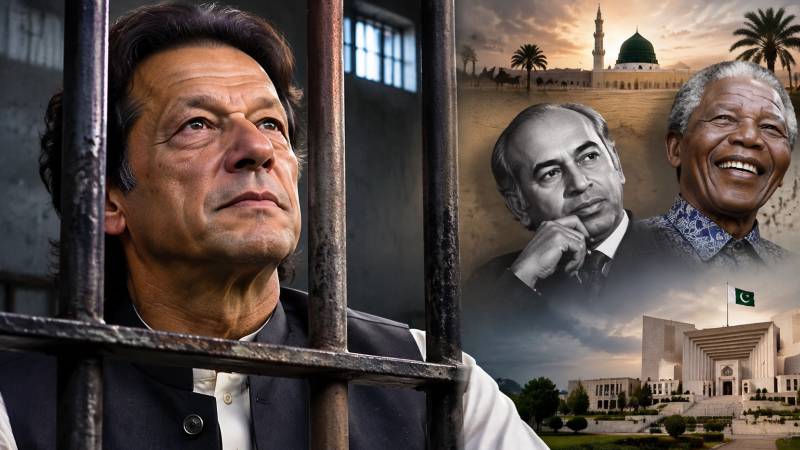
I recently met Mushahid Hussain Sayed, the former senator and chairman of the Pakistan-China Institute, whose keen eye for Pakistan’s affairs is matched by his understanding of the wider world. During our discussion the subject of generosity, kindness and justice came up in the context of Pakistan’s current political environment. Our conversation left me reflecting on a country caught in political deadlock for more than four years, while the world around it changes with unsettling speed. Pakistan cannot afford to remain consumed by its internal confrontations as wars, technological disruption, climate change and economic uncertainty reshape its neighbourhood and prospects. Those holding power, including the military establishment and the government, should recognize that generosity, restraint and kindness can achieve what another turn of the screw cannot.
The responsibility for reconciliation belongs to everyone, but the initiative should come from those with the greatest capacity to offer it. A confident state can make room for its opponents without fearing its own disappearance. Pakistan needs a credible process of truth and reconciliation, supported by a renewed charter of democracy and an economic compact that survives changes of government. These must establish constitutional boundaries, acknowledge abuses and protect political participation, while committing the country to investment, employment and prosperity beyond a privileged circle. What Pakistan needs in simple terms is stability, rule of law and wealth creation.
Our own religious tradition offers an example of the courage such leadership requires. At Sulh-e-Hudaybiyyah in 628 AD, Prophet Muhammad accepted a negotiated settlement with the Quraysh whose terms troubled some of his followers. He understood that an apparent concession could create possibilities that confrontation would foreclose. The lesson is strategic patience. Leadership sometimes requires accepting an immediate compromise to secure a greater peace. Invoking that example should encourage reflection about the purpose of power and the wisdom of restraint. It does not have to be a zero sum game.
Nelson Mandela understood this after twenty seven years in prison. He negotiated with the authorities who had incarcerated him and helped build a constitutional settlement in which former enemies could share a future. South Africa’s Truth and Reconciliation Commission sought to acknowledge victims and expose abuses. Its amnesty provisions required qualifying political offences and full disclosure. The process was imperfect, but its ambition was indispensable. To prevent yesterday’s suffering from becoming tomorrow’s governing principle. Pakistan needs that generosity of purpose, with accountability and constitutional protection giving reconciliation substance.
That brings us to Pakistan’s most famous prisoner. Imran Khan’s imprisonment poses a question that cannot be answered by counting his supporters or listing his convictions. Can institutions apply the law fairly to someone whose freedom has become deeply inconvenient to those governing the country? The answer will matter beyond this confrontation. It will establish what protection the Constitution offers when a citizen’s rights collide with powerful interests.
Khan is Pakistan’s most internationally recognizable prisoner today, a former cricket captain and prime minister whose influence has survived years behind bars. His supporters regard his incarceration as an attempt to exclude him from politics. The government describes him as a convicted prisoner serving court imposed sentences. That establishes his formal status but leaves the essential questions unanswered. Were the proceedings fair, and is his continuing detention consistent with fundamental rights?
There is substantial independent reason to scrutinize those questions. In 2024, the UN Working Group on Arbitrary Detention found the detention it examined arbitrary and recommended immediate release and reparations. In December 2025, the UN Special Rapporteur on torture raised allegations of prolonged isolation and harmful detention conditions. In 2026, the UN Committee against Torture recalled the arbitrary detention finding, urged a review of alleged politically motivated imprisonment and called for adequate medical care.
Pakistan cannot build a stable future through political exclusion and perpetual confrontation. Reconciliation must begin with those who hold the greatest power, but it must be grounded in justice, constitutional guarantees and accountability.
These interventions require precision. Independent UN mechanisms do not overturn Pakistani convictions, and the 2024 opinion cannot determine the merits of every subsequent prosecution. Nevertheless, they demand a substantive response. Repeating that someone has been convicted cannot resolve concerns about judicial independence, access to justice or conditions of confinement. Pakistan’s judicial history makes automatic deference especially difficult. Zulfikar Ali Bhutto was executed in 1979 after proceedings whose fairness remained contested for decades. In its 2024 advisory opinion, the Supreme Court acknowledged that his trial and appeal failed to meet fair trial and due process requirements. That acknowledgment could not restore his life. It demonstrated that a decision can possess judicial authority while failing the standards that give that authority legitimacy.
Khan’s case is not identical to Bhutto’s, different allegations require their own examination. The lesson is that procedural objections must receive serious attention while intervention can still matter. A legal system cannot fulfil its responsibility by correcting the historical record after the damage becomes irreversible. Recognition decades later is a poor substitute for protection when liberty, health or life is at stake.
The judiciary’s constitutional record presents a related difficulty. Courts supplied legal validation for Zia-ul-Haq’s takeover and Musharraf’s assumption of power through the doctrine of necessity. Extraordinary circumstances became grounds for accommodating departures from constitutional government. That history should not erase judges who resisted pressure. It does make institutional credibility something that must be demonstrated through conduct: fair hearings, scrutiny of executive claims and timely, reasoned judgments, especially when influential actors may dislike the outcome.
Pakistan’s weak international rule of law standing reinforces the need for scrutiny. It ranked 130th among 143 jurisdictions in the World Justice Project’s 2025 index. A national ranking cannot establish anyone’s guilt or innocence, but it challenges the assumption that formal judicial involvement settles every concern. Confidence requires meaningful access to counsel, adequate opportunity to contest evidence, transparent reasoning and appeals without unjustified delay.
For Khan, these safeguards must address overlapping proceedings. A favourable ruling in one case may leave other lawful grounds for detention intact. But accumulating cases also requires scrutiny to ensure that procedure is not being used to prolong confinement without sufficient justification. Each basis for detention should be independently and promptly assessed. Where valid grounds are absent, an effective order should restore liberty.
His treatment in custody requires the same discipline. Authorities have disputed allegations of mistreatment and medical neglect, while his family and lawyers have raised serious concerns. Credible verification, appropriate medical access and compliance with prison standards are essential. Humane treatment is an obligation, regardless of a prisoner’s popularity or political inconvenience. Generosity can help open political dialogue. Access to lawyers, medical care and lawful treatment must already be guaranteed. The principle extends beyond one cell. An unknown detainee, journalist, political worker or minority citizen deserves the same protection. Khan’s prominence makes failures more visible and should draw attention to those with fewer means of defence. A system that protects rights only when a case becomes famous offers uncertain protection to everyone else.
Political parties carry corresponding obligations. PTI must defend fair procedures for its opponents as firmly as it demands them for its leader. Governing parties must protect the rights of those seeking to remove them from office. Political allegiance changes, constitutional guarantees must remain dependable. Otherwise, each transfer of power merely reverses the direction of selective accountability. Pakistan’s experience in 1971 offers a warning about failing to resolve political disputes constitutionally. The Awami League’s national majority in the 1970 election did not produce a transfer of power. Repression, resistance and war followed, culminating in the loss of East Pakistan. Today’s circumstances differ, and predictions of another such rupture may be irresponsible. The enduring lesson is that coercive capacity cannot indefinitely compensate for the absence of a legitimate political settlement.
The answer cannot be to place Khan beyond accountability. Credible allegations if any should be investigated and tried independently. Accountability must, however, remain distinguishable from an effort to control political competition. Transparent evidence, consistent standards and effective judicial scrutiny protect the accused from abuse while strengthening the credibility of legitimate convictions. A reconciliation process must respect that distinction rather than distribute immunity among the powerful. The economic consequences also deserve attention. Courts that protect political rights help establish confidence in contracts, property and regulatory decisions. Businesses make longer commitments when rules are predictable and remedies dependable. Citizens have greater reason to invest at home when rights survive changes in power. An economic charter will achieve little if access and patronage continue to outweigh enterprise, or if constitutional uncertainty repeatedly interrupts policy.
A credible way forward therefore requires both immediate safeguards and a durable settlement. Current cases and appeals should receive prompt, independent determination, detention conditions should face credible scrutiny. An inclusive dialogue should establish commitments to constitutional government, peaceful political competition and consistent economic policy. Truth and reconciliation should acknowledge victims and institutional failures. Dialogue must support lawful processes, with rights protected throughout.
Khan’s release, electoral eligibility and any future return to office remain distinct questions, each requiring a legitimate basis for decision. Pakistan need not agree on his record, methods or suitability to govern again. It does need institutions through which those disagreements can be pursued without making fundamental rights contingent on the balance of power. Those governing today have an opportunity to replace the pursuit of political submission with the construction of constitutional trust.
I return to the reflection prompted by my conversation with Mushahid Hussain. A country facing such profound external challenges cannot indefinitely exhaust itself in an internal contest without an agreed destination. Hudaybiyyah and Mandela belong to different histories, but both illuminate the possibilities created when leadership looks beyond immediate antagonism. Pakistan’s decisive test is whether it can deliver justice while justice remains politically inconvenient. Meeting it would protect more than its most famous prisoner. It would give reconciliation credibility and the Constitution meaning in the lives of its citizens.