

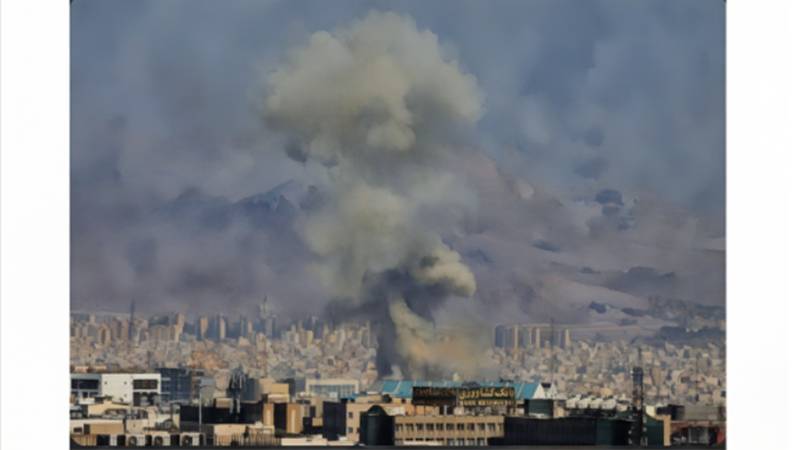
Intoxicated with the Gaza genocide, Benjamin Netanyahu has pierced his hawkish teeth into the heart of Iran. Tehran is bleeding, and Tel Aviv is bleeding from the wounds caused by a barrage of ballistic missiles.
The Western powers left no stone unturned in portraying Iran as a looming threat to Israel, and this narrative was subsequently propelled by the Western media. Recently, the UN-backed atomic watchdog passed a resolution declaring that Iran is not complying with its obligations regarding nuclear non-proliferation. The head of the International Atomic Energy Agency (IAEA) reportedly said that inspectors have been unable to determine whether Iran's nuclear program was "exclusively peaceful" as per the terms of the 2015 nuclear deal.
Apparently, this paved the way for the spoilt child of British colonialism, Israel, to expand its ongoing onslaught against Iran. The butcher of Gaza, Israel, attacked the sovereignty of Iran with an operation codenamed "Rising Lion", based on the colonial thinking of perceived threats to its very survival, citing that Iran was on the verge of developing nuclear weapons.
The IDF targeted military bases and nuclear sites, which culminated in the killing of military top brass, scientists, and civilians. The retaliatory attacks by Iran, codenamed "True Promise 3" in response to Israel’s "Rising Lion", have thrown the two countries into conflict, with both sides engaged in escalating hostilities and consequently targeting critical infrastructure—military, defence systems, and civilians—with modern weapons like missiles, drones, etc.
Reportedly, on the heels of escalation in the Middle East, the Trump White House put pressure on Iran and subsequently called for "unconditional surrender." Iran's Supreme Leader Ayatollah Ali Khamenei reiterated his resolve: "The nation will not surrender to anyone in the face of imposition." Not only this, Tehran cancelled the sixth round of nuclear talks with the US scheduled in Oman, calling it 'meaningless' in the face of Israeli attacks. In mounting pressure, Donald Trump went a step further, asking people to "immediately evacuate Tehran." Donald Trump came under fire as China accused him of "pouring oil" on the mounting conflict between Iran and Israel.
Internal Security Challenges
The way Israel has targeted strategic locations in Iran, killing military top brass, leading nuclear scientists, and civilians, demonstrates Iran's vulnerability and a chink in its armour. Iran needs introspection in terms of finding out the supposed loopholes and black holes through which Mossad might have penetrated. Reportedly, Iranian authorities claimed to have busted a drone-producing factory of Mossad in Tehran. This is a textbook case of security lapse.
This suggests that the decades-long rivalry with Israel failed to convince Iranian authorities to fix the fault lines in terms of Mossad infiltration. The busting of the factory in the capital of the country raises questions over Iran's security apparatus. Capital cities are typically extra alert when it comes to rooting out espionage agents. Individual acts of espionage are routinely reported across various states in the Global South. Running such operational infrastructure in Iran and subsequently blinding the radar system—ultimately enabling Israeli jets to hit and eliminate key military commanders, nuclear scientists, and the nuclear program negotiator—is truly mind-boggling.
Earlier, the assassination of Ismail Haniyeh, the political leader of Hamas, in a high-security zone of Tehran, should have left Iran's security apparatus on its toes to trace the Mossad moles and their facilitators—"the sons of soil."
In fact, decades-long economic sanctions slapped on Iran by the West have left wider sections of society in impoverishment. Crushing those who dare to disagree with policies pursued by the clerical leadership has created disillusionment. Those facing destitution and repression are on a slippery path, vulnerable to falling prey to predators. The damage is done; it can't be undone. Introspection is the need of the hour in prevailing circumstances.
It would not be an exaggeration to suggest that for years, the government of Iran, under Khomeini's successor, has extraordinarily suppressed dissenting voices, muzzled media platforms, and subsequently concentrated decision-making power in the hands of religious orthodoxy. This extra focus on ideological control of the population, coupled with fostering proxies abroad, might have diverted attention away from lurking security issues demanding attention and control.
Various Western countries have endorsed an unprecedented attack on the sovereign state of Iran, citing reasons that Iran was developing a nuclear program—singing from Israel's playbook. If this is the justification for the ongoing onslaught against Iran, then what will they say about various European states that not only have developed nuclear arms but have also armed Israel to its teeth with the same? Should those countries be attacked in the name of perceived threats?
The same Western countries left no stone unturned in directing their criticism against Russia when it invaded Ukraine, citing the looming threat of NATO as Ukraine had long harboured an intention of joining NATO, which Russia considered a direct threat to its country. The UK moved its warships in the name of regional security, effectively supporting Israel. Let us not forget that the UK government is already facing public backlash following its unwavering support of Israel in the Gaza genocide and potential UK 'complicity'—not to mention other European countries.
European Commission President Ursula von der Leyen told reporters that she spoke with Israeli Prime Minister Benjamin Netanyahu before the summit and agreed that Iran was to blame. "Of course, I think a negotiated solution is, in the long term, the best solution," she said, stopping short of calling for an immediate ceasefire.
American Factor
There are media reports suggesting that Donald Trump repudiated his intelligence chief Tulsi Gabbard’s assessment that Iran has not been building a nuclear weapon, publicly confronting Gabbard for the first time during his second term. It speaks volumes about the coordinated game plan.
The notion that Israel couldn't have attacked Iran without America's blessings is rooted in the strong historical and strategic ties between the two nations. Several factors contribute to this dynamic, including financial support, military cooperation, strategic alliance, the influence of the Jewish lobby, and shared strategic interests in the Middle East.
This time around, Benjamin Netanyahu has bitten off more than he can chew, as he is facing a robust retaliatory response. Culling defenceless Palestinians in a besieged enclave and confronting a sovereign state like Iran, which has been foreseeing such an onslaught, are fundamentally different. The billboards with pictures affixed to the buildings in Tel Aviv calling on the US President—"Mr President, finish the job"—tell a tale.
In an attempt to drag Washington into the ongoing onslaught against Iran, Israeli PM Benjamin Netanyahu has warned the US, pressuring Washington to be part of Israel's war: "Today it's Tel Aviv, tomorrow it's New York." Whereas Israel’s ambassador to the European Union and NATO, Haim Regev, took it one step further, suggesting that "Iran poses a threat not only to Israel but also to the region and Europe."
US Senator Bernie Sanders had already cautioned against Israel luring America into the conflict. Taking to his social media site X, Bernie Sanders placed the blame for the latest escalation with Iran squarely on Benjamin Netanyahu and subsequently warned the Trump White House against American involvement. He reportedly wrote:
"Netanyahu began this war with his attack on Iran. In the process, he sabotaged US-Iran negotiations on nuclear issues and assassinated Ali Shamkhani, Iran's lead nuclear negotiator. The US must not be dragged into another illegal Netanyahu war—either militarily or financially."
It's difficult to disagree with Senator Bernie Sanders, as Iran not only pulled out of a scheduled meeting with the US over the issue in question following the unprovoked war imposed on the country but also considered leaving the NPT due to the looming security threat from the aggressor.
Amid both growing calls by pro-Israel groups for the US to join the Israeli bombing campaign against Iran and reports of the US preparing for a possible Iran strike, the White House and New York are witnessing anti-war protests. The demonstrators carried placards reportedly reading "Hands off Iran now", "Stop funding genocide."
At the end of the day, it is the establishment that has the final say. Given the hawkish policies pursued by it, American involvement can’t be ruled out altogether. Israel is a strategic American partner when it comes to advancing its geopolitical interests and political games in the Middle East.
Experts argue that Israel's firepower reigns over Tehran, but it needs the US for deeper impact. Barbara Slavin, a distinguished fellow at the Stimson Center, a US-based think tank, reportedly told Al Jazeera that Israel would need US weapons to complete its stated mission of destroying Iran’s nuclear program.
Israel pushed for US military involvement, as only American bunker-buster bombers can strike Iran's fortified Fordow nuclear facility buried deep beneath a mountain.
However, following the conflagration of the conflict, the director of the International Atomic Energy Agency (IAEA), Rafael Grossi, chief of the United Nations’s atomic watchdog, has warned that an Israeli strike on Iran’s Bushehr nuclear power plant could trigger a nuclear disaster. The watchdog recently told the UN Security Council that a direct hit on the Russian-built Bushehr, located on the Gulf coast, could "result in a very high release of radioactivity", with "great consequences" beyond Iran’s borders.
UN Secretary-General Antonio Guterres has appealed against further internationalisation of the conflict.
G7 Supporting the Genocidal State
The leaders of the G7, a club of industrial democracies comprising Britain, Canada, France, Germany, Italy, Japan, and the United States, gathered in Canada, put their political weight behind Israel, saying it has the right to self-defence, and termed Iran as the reason for regional instability.
This is hypocrisy deeply entrenched in powerful industrial democracies, as it was Israel that attacked Iran, a sovereign state, on the laughable grounds of perceived threats. Iran only retaliated in self-defence. Giving this moral and institutional nod for the new crime scene in Iran to the Israeli war machines that caused the Gaza genocide and disfigurement of Palestine is both moral depravity and political unscrupulousness.
Such is the hegemony of industrial powers that even war crimes are neglected in their naked love for Israel, the warmonger. Even Japan, which bore the brunt of atomic bombings on Hiroshima and Nagasaki as collective punishment to its population, couldn't rise above petty global politics and aligned with the group.
Siding with the aggressor rather than its victim is not only political unscrupulousness but also akin to being in cahoots with the war criminal, Benjamin Netanyahu, and his coterie.
In an op-ed "Israel Can Have the Bomb but Not Iran: The Hypocrisy of the International Order", Sami Al-Arian convincingly concluded that:
"The hypocrisy of the international system is stark. While Israel remains outside the NPT, maintains a secret nuclear arsenal, and faces no penalties, Iran, a transparent and cooperative NPT member, is subjected to sanctions and military threats."
Crumbling Global Order
Not only is American internationalism being shredded under the Trump White House, but overall globalisation is also in utter disarray. The untreated wounds of the Middle East conflict, the Ukraine-Russia war, the Kashmir conflict, and the escalating war between Israel and Iran all speak to a broken global order, fuelled by petty political games, global greed in the form of war economy, and exploitative economic arrangements implemented through global financial governance by powerful Western countries.
The Middle East is suffering due to the petty geopolitical games of powerful Western countries and their proxy, Israel, while many third-world countries are beset by the ills of neoliberalism.
Global political order claims to be based on democratic principles, but it is rather driven by regional and geopolitical interests, as well as economic standing and technological advancement. Besides, racism runs supreme in global political spectrums, exposed by the ongoing genocide of Palestinians.
Understanding these complex dynamics is crucial for the rulers of the Middle East. If Iran sustains the pressure and ferocity of Israeli attacks and consequently drags on a war, America can’t afford to leave its main ally in the cold and risk being battered with ballistic missiles.
It is no exaggeration that Iran has used Shia Islam as a political tool to gain regional influence. After the Iranian Revolution of 1979, the pioneers of the revolution and their successors vied for broader regional influence, resulting in hostilities arising from this desire for dominance—especially from Sunni-dominated states like Saudi Arabia, which harboured similar ambitions for a dominating role.
In "Iran-Israel Standoff: Is the Mideast Nearing a Point of No Return?" by distinguished author Murat Sofuoglu, insightful input is offered on the flare-up of the conflict in question. While Iran has used its proxies, Hezbollah and other Shia groups, to expand its regional influence, many critics view Israel, as the occupying power in Palestine, as a perpetrator of war crimes and even genocide.
Those in decision-making centres in the Middle East should put their heads together to take on the aggressor by prioritising common ground. To achieve this end, siding with the one under attack—Iran—should be the beginning of the end
Iran has used its proxies, Hezbollah and other Shia groups, to expand its regional influence across the Middle East. However, Tehran has faced significant setbacks in Syria and Lebanon, where its influence has significantly diminished, and where Western sanctions continue to hit the Iranian economy hard.
Despite these setbacks, Iranian strikes deep inside Israel show that Tehran can "inflict heavy damage and expose Israeli vulnerability," according to Tazmini.
Iran’s Endgame: War of Attrition?
While analysts widely differ on forecast outcomes, many agree that Iran’s strategy will depend on domestic support and its ability to withstand economic and military pressure. In that context, the big question remains: how long can Iran retaliate against Israel?
"I’ve given up predicting outcomes," says Edward Erickson, a leading American military analyst and academic. "But it seems to me that a nation of 92 million people can wage a war of attrition and fight to exhaustion against a nation of 10 million (which is already engaged up to its eyeballs in Gaza, the West Bank, and the Lebanon frontier, as well as being fully dependent on American goodwill and support)."
Erickson warns against underestimating Iran’s resilience, adding that its large population could sustain a war of attrition against Israel and potentially exhaust its systems, with support from Russia and China likely if the conflict drags on.
He adds: "Continuous stress on Israeli systems and the Israeli people can induce exhaustion."
Dr Huma Baqai, a foreign policy and current affairs expert, is of the opinion that:
"The Iran-Israel conflict is bringing about exposures that will go a long way in identifying the scheme of things to come. The world is moving towards alliances that will determine the outcome of the conflict… Has Israel punched above its weight this time? It has never fought another state, let alone a state like Iran… Bombing defenceless, vulnerable people is one thing, and fighting a sovereign state that has prepared for this for decades is another ball game altogether."
With the rise of populist leaders like Donald Trump, Benjamin Netanyahu, Narendra Modi, Jair Bolsonaro, Giorgia Meloni, and Viktor Orbán, the foundation of the global order has become shaky beyond imagination. They thrive on paranoia, thus becoming prisoners of their own narrow narratives, warmongering, regional rivalry, and schizophrenic fits.
Populist leaders often become prisoners of paranoia by fuelling and exploiting fear, anxiety, and divisive rhetoric to consolidate power and maintain support. This can lead to authoritarian tendencies, erosion of democratic norms, and further polarisation.
The volatile nature and reckless modus operandi of Netanyahu have thrown the Middle East into flames—not to mention the Narendra Modi-led government’s recent unprovoked war on Pakistan.
Former US President Bill Clinton correctly commented that:
"Mr Netanyahu has long wanted to fight Iran because that way he can stay in office forever."
Committing war crimes against humanity just to stay in power is the psychology of fascists. Those aiding and abetting are no different from the war criminals involved. History neither forgets nor forgives. A perpetual curse will follow them to their graves.
After having highlighted the continued intensive nuclear arms race in terms of modernisation programs in 2024—upgrading existing weapons and adding new versions by nearly all nine nuclear-armed states (the United States, Russia, the United Kingdom, France, China, India, Pakistan, the Democratic People’s Republic of Korea (North Korea), and Israel)—the Stockholm International Peace Research Institute (SIPRI) conveyed concerns in no uncertain terms about the deteriorating global order stemming from divisive policies.
The 56th edition of the SIPRI Yearbook analyses the continuing deterioration of global security over the past year. The wars in Ukraine, Gaza, and elsewhere continued, exacerbating geopolitical divisions, besides their terrible human costs. Furthermore, the election of Donald Trump has created additional uncertainty—in Europe but also further afield—about the future direction of US foreign policy and the reliability of the USA as an ally, a donor, or an economic partner.
The Roots of the Muslim Dilemma
For centuries, the Muslim world neglected science and technology. As a result, they have been left behind in terms of scientific development, industrial advancement, and economic progress.
Instead of investing in industrial growth and subsequent prosperity, the majority neglected the urgent need of prioritising institution and nation-building while pursuing personal pleasures by purchasing palaces in foreign capitals and displaying extravagance and luxurious lifestyles, ultimately ensuring their own interests rather than contributing to their countries' political clout in the global order.
The result is that the industrial powers that matter in global politics and decision-making centres continue to deprive the Muslim world of its democratic space—let alone the right to self-defence. Iran’s democratic right to defend itself in the face of aggression is dubbed as a recipe for regional instability.
The Muslim world is lagging behind in science, technology, industrial revolution, and arms production; it has limited stakes in the global political order.
The Middle East states have to choose between being subjected to death and destruction and orchestrated regime changes, and a unified stand against the looming existential crisis.
Washington and its protégé Israel's agenda in the Middle East is nothing but undermining the region at all costs. This ugly agenda has its buyers in European capitals, which are instrumental in advancing this scheme.
As the war economy hinges on conflicts, enemies are created and conflicts are manufactured in political laboratories so that arms sales continue to capture capital from both the aggressor and its victims.
By supporting Israel, Washington and its Middle Eastern partners are killing two birds with one stone—undermining the Middle East in every context and keeping arms sales to Israel and those being threatened by Israel.
The Zionist state continues to commit war crimes against humanity in Gaza and Lebanon. Not only this, Israel continues to defy all international obligations, including inspection of its nuclear program sites. Despite this, it is off the radar, whereas Iran can't have nuclear power for both peaceful and civilian purposes.
This speaks volumes more than this piece of writing can portray in words.
Last but not least, there are striking similarities between the invasion of Iraq by the White House and the unprovoked attack on Tehran by Tel Aviv. The former occupied a sovereign state on the grounds of possession of weapons of mass destruction—never proved; and the latter attacked Iran on the grounds of perceived nuclear threats.
The Trump White House and industrial democracies have put their weight behind Israel in the name of self-defence. This should be an eye-opener for the Middle East monarchies.
On the heels of Israel's crime scene in Palestine in the Gaza Strip, the public in the Western world has demanded an end to arms sales to Israel, but their cries have fallen on deaf ears of those in Western power corridors as they continue to support Zionist colonialism.
The silence of the Muslim world over the invasion of Iraq, Afghanistan, orchestrated regime changes in Syria, Libya, and Egypt, etc., via violent means, emboldened the imperialist powers that they can do away with their warmongering and subsequent annihilation in various sovereign states.
A New Time magazine cover generated online outrage after netizens pointed out that the image of Iran’s Supreme Leader Ali Khamenei mirrors past covers of Libya’s Muammar Gaddafi and Iraq’s Saddam Hussein—two MENA leaders ousted by US-led intervention in the 21st century.
Time magazine accused of endorsing change in Iran with new cover. Installation of a Washington-Tel Aviv-backed, exiled Reza Pahlavi is also on the cards should Tehran fall. Reza Pahlavi is waiting in the wings.
The fall of Iran or reducing it to economic destitution—or both—has been the ultimate outcome harboured by despots. Decades-long sanctions are part and parcel of this scheme.
However, Iranians know their enemy. External aggression always helps achieve national unity.
To weather this looming storm, those in decision-making centres in the Middle East should put their heads together to take on the aggressor by prioritising common ground. To achieve this end, siding with the country subjected to aggression—Iran—should be the beginning of the end.
Narrowing down bilateral belligerence and regional rivalry needs to be discarded altogether to actualise the bigger dream of a peaceful and prosperous Middle East. Besides, science, technology, industrial growth, and a democratic society should be some of the key components of reforms.
The Middle East keeps bleeding due to colonial thinking in foreign policy, prioritised by the powerful Western world. To fight this fight, the "divide and rule" strategy needs to be discarded in the larger national and regional interests—security and stability.
This is a lofty dream. Will the Muslim world turn the corner?
On the one hand, Western powers have been tirelessly lecturing on democratic principles, such as freedom, fair play, justice, the right to life, and accountability, etc. On the other hand, they continue to support the Zionist state involved in war crimes.
The deep-rooted hypocrisy can be gauged from the fact that the Gaza genocide and Gaza being reduced to rubble have only elicited lip service from the West. This should be an eye-opener for the monarchies of the Middle East.
Some Arab states' strategic alignments with Israel and the United States reflect a complex web of interests and alliances. Historical precedents, such as the shifting perceptions and treatment of leaders like Saddam Hussein, illustrate the transient nature of these relationships.
Understanding these dynamics is crucial for navigating the geopolitical landscape of the Middle East.
What those at the highest echelons of power in the Middle East need to focus on is that in the Middle East, Israel is America, and America is Israel.
If this looming disaster is left unattended, it is only a matter of time before every country has to wait for its turn and face Israel’s "Dahiya Doctrine"—named after Dahiya, a Beirut suburb flattened by Israel in 2006—a military strategy of deliberate destruction that treats entire civilian areas as military targets, flattening everything and violating every norm of warfare.
The UN’s Historical Failure
The UN has historically failed to achieve its purpose, for which it was created after World War II. Its ineffectiveness and helplessness can be gauged from the fact that the UN and other humanitarian organisations have been sidelined in aid distribution and subsequently replaced with the controversial Gaza Humanitarian Foundation (GHF).
While media platforms have shifted focus away from the Gaza genocide and are now covering the escalating Israel-Iran standoff, Israel is advancing its annexation plan in Jerusalem and the West Bank. Meanwhile, Palestinians desperate for food continue to be killed—in breadlines—in silence, by Israeli forces.
Israel has also launched drone strikes in Southern Lebanon—not to mention Israeli troops advancing at least 1.5 km into Syria’s southern Quneitra province and the deliberate decimation of nearly 200 acres of trees from the historic Jabaatha Nature Reserve, which sits on the southern slope of Mount Hermon.
The US ambassador to the United Nations, Dorothy Shea, misspoke when she stated, "Israel's government spreads chaos, terror, and suffering in the region." She quickly corrected herself, clarifying that she had meant to refer to Iran's government.
There's no denying that the Netanyahu-led government commits crimes against humanity.
The consequences of war are multifaceted and far-reaching, impacting individuals, communities, and nations. Some key consequences include:
- Humanitarian crisis
- Infrastructure destruction
- Psychological impact
- Economic burden
- Social and cultural disruption
Turkish President Recep Tayyip Erdoğan urged global powers not to fall into "Netanyahu’s game," calling them instead to secure a cease-fire between Iran and Israel and restore peace in the region.
He said:
"Unfortunately, the genocide in Gaza and the conflict with Iran are reaching the point of no return. This madness must end as soon as possible."
Pakistan's Ministry of Foreign Affairs said in a statement:
"The international community and the United Nations bear the responsibility to uphold international law, stop aggression immediately, and hold the aggressor accountable for its actions."
Silence over crimes against humanity and aggression against sovereignty is a crime. Taking a stand against this injustice is a societal, moral, political, organisational, and institutional imperative.
A greater responsibility is placed on the shoulders of the world community to build a barrier against Zionist colonialism, which is hell-bent on changing the face of the Middle East.