

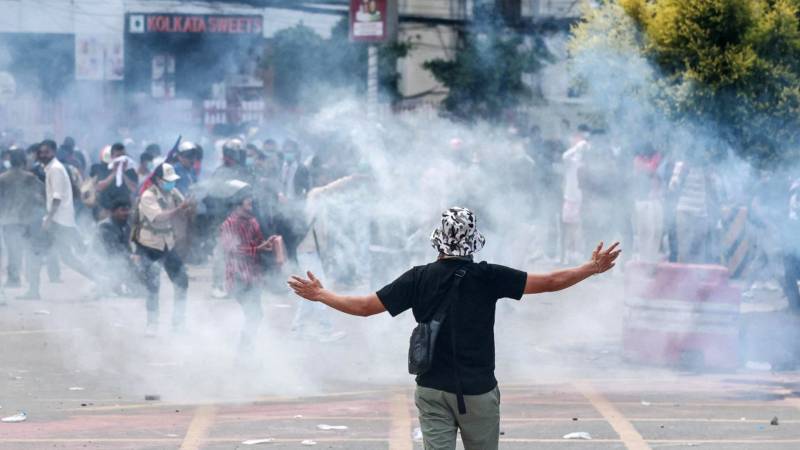
Within a span of one year, governments in Dhaka and Kathmandu were toppled by the youths. Earlier, in 2021, mob protests and violence led to regime change in Sri Lanka. All three countries of South Asia witnessed the tumbling of governments because of corruption, nepotism and bad governance. It means the power of youth is decisive in ending the cycle of oppression and corruption and there is light at the end of the tunnel amidst an environment of gloom and pessimism. The significant role of youths, called ‘Gen Z’, in toppling regimes in Colombo, Dhaka and Kathmandu reflects how the younger strata of society, if determined, can bring qualitative change.
The resignation of Nepal’s Prime Minister Sharma Oli the other day and the escape of Bangladesh’s Prime Minister Sheikh Hasina to India on 5 August 2024 was an outcome of popular uprising against them. Likewise, in 2021, demonstrations in Colombo against corruption and nepotism of President Gotabaya Rajapaksa led to his flight to Singapore, from where he sent his resignation by email. All three case studies prove that regardless of abuse of power, it is not possible to withstand popular revolt. In all three uprisings against incumbents, the participation of youth was remarkable and the military, which may have prevented their ouster, also failed to salvage the Sri Lankan President and the Prime Minister of Bangladesh and Nepal.
The downfall of monarchy in Nepal in 2006 paved the way for transforming the only Hindu kingdom into a democratic and secular state. But issues, particularly unemployment, inflation, corruption, nepotism and bad governance, deepened frustration, particularly among the youths who took law into their own hands regardless of consequences. Former Prime Minister Sharma’s use of brute force to quell the youth uprising and the killing of 30 demonstrators added fuel to the fire. Although he withdrew the ban on social media, it was too late, and the youth uprising led to an attack on the parliament, Supreme Court and the house of the prime minister. Images of demonstrators entering the house of former Bangladeshi Prime Minister Sheikh Hasina were replicated in Kathmandu.
There is an analogy between the Bangladeshi and Nepali student uprisings. In both cases, student leaders paved the way for the appointment of caretaker and interim prime ministers. In the case of Bangladesh, student leaders, after the exit of Sheikh Hasina, approached Nobel Laureate Dr Mohammad Yunus to assume power, and in the case of Nepal, students approached former Chief Justice Sushila Karki to replace Prime Minister Sharma Oli. It means the power of students matters in regime change, and they are the ones, not the military and political parties, to decide who is going to assume power.
The situation in Pakistan is certainly ripe for a popular uprising because the majority of people are hand to mouth, and curbs on media and freedom of expression tend to augment frustration and anger
Kathmandu, Dhaka and Colombo calling needs to be taken seriously by those who wield power in Islamabad under the hybrid regime. Is there a potential among the youths of Pakistan, who constitute 60% of a 250 million population, to remove incumbents by launching a popular movement and following the models of Colombo, Dhaka and Kathmandu? Or do those who wield power feel confident that a Nepal, Bangladesh or Sri Lankan type situation will not occur in Pakistan because the state is very powerful and has the capability to quell any popular uprising?
In a situation when 50% of the people of Pakistan have reached below the poverty line and the country is experiencing the worst floods, rampant corruption and nepotism, the situation is ripe for a popular uprising to be led by students. In the case of Sri Lanka, Bangladesh and Nepal, it was the failure of authoritarian regimes to understand the mood of people and their confidence that they could crush any movement which proved to be counter-productive. In all three cases, it was the power of youths which was decisive in regime change.
The situation in Pakistan is certainly ripe for a popular uprising because the majority of people are hand to mouth, and curbs on media and freedom of expression tend to augment frustration and anger. But then why do the elites, particularly the military establishment, feel confident that nothing will happen to disrupt the status quo and that any attempt to destabilise the hybrid system will not succeed? Attempts made since regime change in April 2022 to challenge the nexus between the military establishment and the coalition government of PPP, PML(N) and MQM failed to yield positive results.
Yet, for the first time in the history of Pakistan, the province of Punjab, which was not supportive of any popular uprising, is different now. Pakistan Tehreek-e-Insaf and its founder Imran Khan managed to mobilise popular support against the military-led coalition government, particularly in the populous province of Punjab. Whether it was the incident of 9 May 2023 or the killings of 26 November last year in the PTI-led long march in Islamabad, one can see resilience in PTI’s rank and file. This time, it seems Punjab will rise.
Despite the fact that Punjab is a beneficiary of power, as the bulk of the military and bureaucracy hail from that province, the mood of people of Punjab is changing. The manner in which the February 2024 elections were allegedly rigged and, with the connivance of the military establishment, PML(N)-led governments were installed in Punjab and at the Centre reflected how insecure those who control power are.
What matters is not removing incumbents from power but making sure that vested interest groups do not hijack the movement and derail the sacrifices for democracy, rule of law and good governance
Can one learn lessons from political change in Colombo, Dhaka and Kathmandu? Is the youth bulge in Pakistan capable of challenging those who control the instruments of power? Is the situation in Pakistan ripe for a popular upheaval? One can analyse the implications of popular uprising in Colombo, Dhaka and Kathmandu on Pakistan from three perspectives. First, the power of youth, particularly in Bangladesh and Nepal, contributed to the removal of incumbents. This is not the situation in Pakistan, where despite PTI’s efforts to mobilise youths, the situation is not ripe for a popular uprising. When around 60% of Pakistan’s population is composed of youths and one can witness widespread anger, antagonism and frustration in their rank and file, then why is that segment of society unable to assert its position?
Affluent and power-centric elites of Pakistan are smart enough to divert attention from real issues faced by the people and engage them on non-issues ranging from sectarian to ethnic nationalism. The policy of divide and rule is central to the elites’ success in preventing their displacement from positions of power. When Imran Khan was struggling to seek power, he used to be proud of the role of youth and pompously used to predict that once in power he would change Pakistan for the better to the extent that foreigners would come to his country to seek employment. But the reverse has happened because since the regime change in April 2022, more than half a million youths have left Pakistan for a better future.
Second, the onus is on Punjab because it controls the instruments of power and has a privileged position compared to minority provinces. Why have the youths of Punjab, despite the best efforts of Imran Khan and his PTI, failed to remove those who, according to them, usurped power through the fraudulent elections of February 2024? Critics blame the culture of Punjab for maintaining the status quo because it has no history of non-conformism, unlike the Bengalis of Bangladesh, who have a record of defiance against injustices and authoritarian governance. It is also argued by critics that it is not in the DNA of Punjab to struggle for social change and that it is comfortable with holding the status quo. Minority provinces like Balochistan, KPK and Sindh have already suffered because of endless state persecution, and their sacrifices for democracy failed to yield positive results because of what they attribute to Punjab’s opportunistic mindset.
In the popular movements of 1968–69, it was Karachi and former East Pakistan which played a vital role. During the 1977 movement against the alleged rigging during the March general elections, it was Karachi and former North-Western Frontier Province (NWFP) which were in the forefront. During the Movement for Restoration of Democracy (MRD) launched in the summer and autumn of 1983, it was rural Sindh which was leading a movement against General Zia’s Martial Law, whereas Punjab was complacent because of its privileged position.
Will Punjab and its youth rise against the exploitation and oppression of those who control the instruments of power, or, like in the past, will it remain passive and submissive? When the state is blamed for using excessive force to quell Baloch and Pashtun resistance, Punjab’s silence is noticeable. When Sindh has been neutralised by mitigating Sindhi and Mohajir nationalism, Punjab-centric military and bureaucratic elites are confident that they can easily deal with any outbreak of popular uprising.
What matters is not removing incumbents from power but making sure that vested interest groups do not hijack the movement and derail the sacrifices for democracy, rule of law and good governance. Finally, it is the leadership of youth which matters. In the case of Bangladesh, youths removed Sheikh Hasina from power after 15 years of her ruthless rule and established a political party called the National Citizens Party (NCP). The same effort is being made in Nepal, where ‘Gen Z’ is trying to organise and unite in order to prevent those from coming to power who, according to them, looted and plundered national wealth.
Pakistan is certainly at the crossroads because a country which has enormous potential to rise and deal with issues which have plagued it since its inception can certainly emerge as a democratic, egalitarian and progressive state by controlling corruption, nepotism, adhering to the rule of law and ensuring good governance. But the impediments are numerous, particularly the status quo-oriented culture of Punjab which prevents social change and development.
Kathmandu, Dhaka and Colombo calling should be a wake-up call for Islamabad before it is too late.