

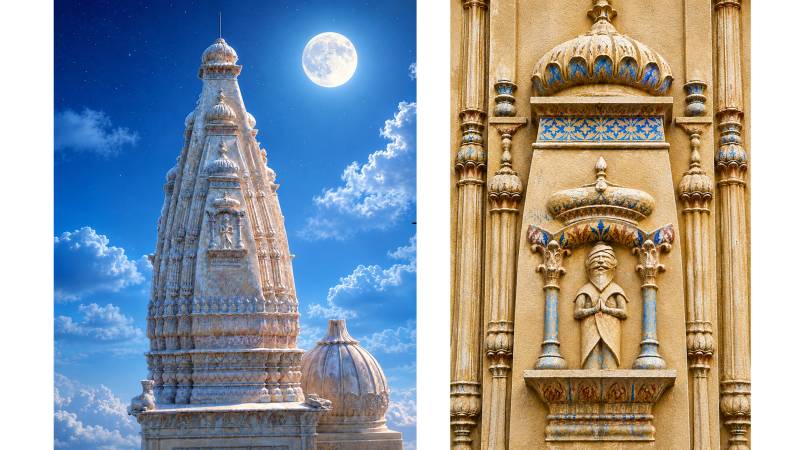
In mid-July 2026, I went to Johi, a town in Dadu District, to write about an old temple. Before I reached it, however, I encountered a question of names: what should I call a building known by different names in official records, historical accounts, and local speech?
The Evacuee Trust Property Board’s 1960 survey records it as Shivala. Hindu religious literature calls it Shivalaya, meaning an abode of Shiva, one of the principal deities of Hinduism. Some historians identify it as a Shiva temple. In Johi, however, people call it Qubi, a local term derived from Quba, meaning a tomb. Qubi refers to a small tomb, and the surrounding neighbourhood is known as Qubi Paro.
The town committee’s current records place the temple in Ward 7. That is a present administrative designation, not a permanent one. Electoral boundaries can change, and Johi is no exception. The temple may one day fall within another ward, even though the building itself will remain where it has always stood.
The Shivala was my destination, but I soon realised that the journey to it was becoming part of the story. From Dadu city, I rode a Qingqi to Johi Morr, where the road turns towards Johi town.
A coaster was waiting there, much like the minibuses once common in Karachi. Its sides were painted black, red, and green, with floral designs added to the body. I climbed aboard expecting an ordinary journey. The bus quickly changed that expectation.
The rear door would not open. The narrow aisle, which should have carried passengers from one end of the bus to the other, had become a storage space. Grain bags covered the floor. A few goats occupied another section. Stacked bakery boxes leaned against one another. They contained papa, khara biscuits, nan-katai, karak-double roti, zeera biscuits, and mixed biscuits in round, rectangular, and triangular shapes. The bus carried people, but it also carried the Kachho: its grain, animals, bread, and small trade. What looked from outside like public transport had become, inside, a moving inventory of rural necessities.
The conductor glanced at the blocked rear door and gestured towards the front. I squeezed through and found a seat behind the driver. Even there, grain bags covered the floor at my feet.
The inconvenience was not simply an accident. It reflected necessity. Where distances are long, markets are scattered, and transport is limited, a bus cannot carry only passengers. It must also carry whatever people need to move. The vehicle had become a workhorse of the local economy, carrying people and goods along the same roads.
As I settled into my seat, another journey returned to me. I had travelled towards Johi in 1982 with Abdul Rashid Junejo. More than four decades separated that journey from this one, yet the comparison came immediately.
I remember that we travelled on a bus operated by ‘Ranjhani Bus Service’. Its body was box-shaped, with a rounded front, a high roof, large side windows, and an elevated luggage rack. Above the windscreen, layers of ornamental metalwork, painted panels, floral motifs, and geometric designs decorated the front. The Kachho bus had changed, but more importantly, its passengers had changed.
Two Journeys, Two Social Landscapes
In the 1980s, as I remember, the passengers were mostly stout, middle-aged men. Sindhi topi (Sindhi cap) and patko (Sindhi turban) were common. They were not theatrical costumes; they were ordinary parts of everyday appearance. Cigarette smoke hung in the bus. Pan Ji Berri and K-2 cigarettes were common among the passengers. Smoke drifted through the narrow aisle, mingling with heat, voices, and the smell of a crowded bus. It became part of the shared atmosphere.
Some seats were reserved for women. Their dresses often combined red, dark green, and blue. Against the dusty landscape outside, those colours formed a familiar visual vocabulary of Kachho life.
The bus I entered in 2026 presented a different social landscape. This time, it belonged to ‘Jangwani Jamali’, not ‘Ranjhani’. Its body was high and box-shaped, and its seats were narrow but comfortable. The interior still carried decoration, but the colours were less sharp and vivid than those I remembered from the earlier journey.
The passengers were generally younger and physically slighter. The patko had disappeared, while the Sindhi topi had become rare. Cigarette smoke had almost vanished. In its place came another habit: playing with the mobile phone. Almost every hand seemed to hold one. Screens illuminated faces as heads bent towards them. Songs and ringtones filled the bus—Sindhi songs, Indian songs, and fragments of popular entertainment. Each phone competed with the others for attention.
Fiction and fact, drama and everyday life, seemed to occupy the same space in the tea shops of Johi – and at times, they were difficult to separate
Women’s clothing also reflected a change. Their dresses appeared more urban, with lighter colours and modern designs. Many women, however, wore black or other dark-coloured chadars. Some held mobile phones in their hands.
I found myself watching my fellow passengers' gestures and body language. Women twisted their hair, adjusted their long dupattas and chadars, played with their bangles, or handled their phones. Men stroked their chins, stretched their arms while talking, tapped their fingers against seats, or handled their phones.
I do not want to read too much into these gestures. A quick observation of posture does not reveal a person’s state of mind. A man touching his chin is not necessarily thinking deeply. A woman twisting her hair is not necessarily anxious. Bodies do not carry a dictionary in which every movement has one fixed meaning.
Streets of Johi
Tariq Imam Junejo, an officer in the Sindh Government’s Revenue Department, arranged my visit. He gave me the contact of Qurban Ali Ranjhani, a young man and aspiring civil servant, who stayed in touch throughout my journey. He asked me to get off at the van stop, where he would meet me.
He was there when I arrived. After greeting me, we walked towards Yasin Hotel, where Wafa Birhamani joined us. Johi began revealing itself before I reached the Shivala. The main road seemed narrower than I remembered. Perhaps the road itself had changed less than the things that had accumulated along its edges. Buildings, stalls, vehicles, and commercial activity had pressed closer to the street.
The old gadhah-gadhah, or donkey carts, had disappeared from the traffic. Motorbike loaders had taken their place. These small vehicles carried goods through streets that were never designed for such traffic.
The motorcycle had become almost a signature of contemporary Johi. Honda 70s and cheaper Chinese models dominated the streets. The larger 125cc motorcycles seemed less common than I remembered. The difference was mechanical, but it also revealed a social change. Motorised mobility had become cheaper, more widespread, and more individual.
The bazaar had also expanded its points of commerce. New establishments had appeared. Laboratories stood along the streets. Fruit sellers and pushcarts occupied more spaces. Tea shops seemed to have claimed almost every available corner, narrow pavement, and open space where two or three men could sit with a cup of tea and watch the town pass.
These tea shops were not merely places to drink tea. They were small public theatres where everyday life unfolded alongside television drama. Sindhi dramas played at high volume, their familiar worlds filled with dacoits, powerful waderas, revenge, violence, and fear. A gunshot from the television could mingle with the roar of a motorcycle outside, the clink of a tea glass against its saucer, and a conversation about local affairs. Fiction and fact, drama and everyday life, seemed to occupy the same space. At times, they were difficult to separate.
Shivala Temple
Rather than asking the reader to imagine the site, let me describe it as I encountered it. Standing on the street south of the temple, I faced the entrance. I entered through the gate. The temple stood to my left, on the west, while a room stood to my right, on the east. Ahead, the open courtyard extended towards the north and east.
While I was standing in the courtyard, Mukhi Gurmukhdas, the present Mukhi of the Dadu Panchayat, joined me. I asked about the compound’s size. He explained that it had shrunk over time. It once covered about 2,500 square feet, but encroachment had reduced the usable area to roughly 1,700 square feet.
As we entered the temple, Mukhi Gurmukhdas explained that, like many Hindu temples, it had three principal architectural parts: the mandap, garbhagriha, and shikhara.
Luckily, I had brought Prasanna Kumar Acharya’s A Dictionary of Hindu Architecture. Acharya was a scholar of Indian architectural history, and his dictionary helped me understand these terms. Some Sindhi terms do not correspond exactly to their original Sanskrit meanings, but the dictionary still gave me a useful sense of each concept. The first edition was published by Oxford University Press in London and New York in 1927.
With Acharya’s dictionary beside me, I could now understand the three parts of the Shivala more clearly. The mandap is the pillared hall where worshippers gather and rituals take place. The garbhagriha is the innermost and most sacred chamber, where the principal deity is enshrined. Above it rises the shikhara, the tower or superstructure that marks the sanctum.
His explanation made me look more closely at the mandap. Its dome is onion-shaped and carries an inverted-lotus design. The finial has disappeared. Triangular reliefs above the arches once held figures, but most have been damaged or lost.
Inside, the temple shifts from architecture to narrative. Its walls once carried a world of painted stories. The surviving frescoes show figures and scenes from Hindu religious traditions. Among the fragments is what appears to be a scene of Krishna, a major Hindu deity associated with devotion, love, and divine play, and the serpent Kaliya, a powerful serpent in Hindu mythology. Because the surface is badly damaged, however, I cannot identify the scene with certainty. Some frescoes have been scratched, perhaps by visitors or occupants, while others have faded, fallen away, or been covered with paint. But fragments of the original paintings remain.
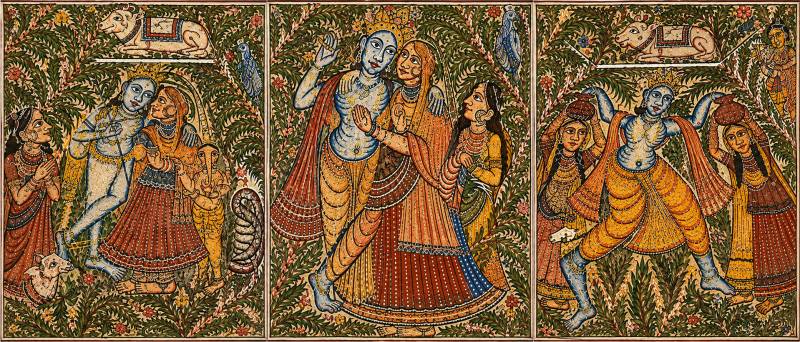
The garbhagriha presents another record of survival and damage. Its outer walls remain largely intact, although someone has cut an opening through the western wall. Triangular reliefs survive on the northern, southern, and western sides. They appear to have framed figures that are now missing. At roughly five feet five inches above the floor, the plaster bears marks of force. Someone has scratched and stripped the surface. The old colours have faded, but traces remain.
Above the garbhagriha rises the shikhara. It has four faces arranged in three layers. Each face carries a jharoka, a small ornamental frame that contains a figure. The eastern face, which looks towards the street, was in a fair condition.
On the southern face, an image is identified as Valmiki, the revered Hindu sage traditionally regarded as the author of the Ramayana and honoured as Adikavi, or the ‘first poet’. The upper structure also carries traces of the Brahmakamal, a stylised sacred-lotus motif formed by radiating petals and commonly used in Hindu temple decoration.
However, while the temple was easy to observe, its construction materials were harder to understand. To learn more, I called Ishtiaq Ansari, a well-known historian and conservationist. He explained that the walls were built with mud mortar and burnt bricks. The builders then applied layers of plaster made from chiroli, lime, jute, and hill sand, and finished the surfaces with cream-coloured lime plaster.
Ansari’s description brought the temple’s materials into focus. Ray, Kulshreshtha, and Suvrathan, in The Routledge Handbook of Hindu Temples: Materiality, Social History and Practice, describe the Hindu temple as a “lived, dynamic space” whose material form can reveal its changing social history. Shivala offers a useful example. Its burnt bricks, mud mortar, and layered plaster reflect the materials and building skills available to its makers. The use of lime, chiroli, jute, and hill sand also shows the builders’ knowledge of preparing surfaces for painting and decoration. The walls therefore preserve more than religious images. They also retain traces of local materials, building practices, and the labour that went into making the temple.
From Divine Abode to an Occupied Home
Regarding its occupancy and use after Partition, Wafa Birhamani, a veteran journalist and political activist, told me that a migrant named Syed Touqeer Alam Shah settled in Johi and initially claimed that he had obtained claims to several properties formerly owned by Hindus. According to Birhamani, Shah first occupied a well-built Hindu property located opposite the Shivala. No one in Johi, he added, asked Shah to produce official documents supporting his claim.
When I asked why no one questioned him, Birhamani offered several reasons. Shah represented the Lahore-based Urdu newspaper Daily Mashriq and had good relations with local waderas and sardars. He also maintained close ties with military and police officials. In the 1980s, Birhamani recalled, Shah’s medical store at Zulfikar Chowk, Johi, functioned almost as an informal meeting place. Government officials, influential local figures, and members of the security establishment regularly stopped there for tea. These connections, Birhamani suggested, gave Shah a position that discouraged people from challenging his claims.
Aziz Kingrani, a well-known archaeologist and historian, similarly notes that Syed Touqeer Alam Shah claimed the entire Shivala complex and presented himself as its sole legal owner. The available accounts, however, indicate that he did not obtain the entire complex. The exact extent and legal basis of his claim remain unclear.
Interestingly, the Evacuee Trust Property Board’s 1960 survey records the temple as vacant until the 1st of April 1960. In his article ‘Hindu Temple of Johi’, Kingrani notes that a house for the Hindu priest once stood immediately south of the temple. The house later became the residence of the Civil Judge of Johi, who lived there for many years. A nearby well provided water for travellers and their animals, while a sun-shed offered shade and a place to rest. The sun-shed was later demolished, and shops were built on the site.
From the late 1970s, elders of the Sikandar Chandio family began using the temple grounds. They first used the empty space, then stored their belongings there. Gradually, they stopped others from using it and treated it as their own. Finally, they fenced and occupied the area. A temporary use became permanent occupation.
Every occupant, it seems, needs a story to justify his presence. Sikandar Chandio was no exception. He claimed that a Hindu man had given the property to his grandfather. He also said that the family had never occupied the temple’s inner space. His main argument, however, was that they had protected the temple. During the Babri Masjid riots, he said, a mob tried to damage it, and his family resisted. In his account, the Chandios were protectors, not intruders.
I spoke to Akbar Lashari, a well-known social activist. He confirmed that the Chandio family had helped protect the temple from possible attacks. He also said that the family had been ready to leave if the authorities provided them with another place to live.
On the 30th of October 2019, a Revenue official met Sikandar Chandio and his family. Sikandar made his position clear: if the authorities provided alternative accommodation, he would leave the temple. He presented it as a request for shelter rather than a demand.
The authorities gave the family an official quarter. They then handed the keys of the Shivala to Mukhi Gurmukhdas, president of the Dadu Hindu Panchayat.
Damage to the Shivala
The Shivala now stands lower than the town that has grown around it. Like many towns in Sindh, Johi has altered and elevated its streets over time, changing old drainage paths and natural water flows. As a result, rainwater, wastewater, or seepage may collect around the temple’s lower walls and foundation. This matters because the temple was built with burnt bricks and mud mortar, materials that can absorb water. The water can carry salts into the plaster, weaken the mortar, and cause the surface to crack, flake, or fall away.
Rapid urban growth has added further pressure. Traffic throws dust onto the walls, smoke darkens the surfaces, rubbish can obstruct drainage, and new construction has crowded the temple. Encroachment has reduced the open space around the building and may further change the movement of water. Damp cracks and joints can also encourage weeds and other botanical growth.
The Shivala’s damage, therefore, does not come from age alone. The town has changed around it. Altered streets, drainage, traffic, construction, and encroachment now place new pressures on an old structure. Unless these pressures are addressed, the building will continue to lose parts of its fabric, slowly and often without attracting attention.
I went to see Johi’s old temple, but the Shivala took me further. Its bricks, frescoes, and broken figures still hold the material memory of a Hindu sacred space. Inside, the damaged paintings felt like fragments of a memory that refuses to fade. Outside, encroachment, altered street levels, and choked drains press against the old structure, leaving it with less space to breathe and less room to remain what it once was.
Above it, the tall shikhara still rises over the town. It has watched generations come and go, yet the people below can become so absorbed in the small demands of daily life that the larger story of their place begins to fade. When a community forgets the buildings that carry its memories, it slowly loses a part of its own sense of belonging.
Shivala is not only a monument. It is a place where architecture, memory, and belonging meet. Its walls continue to record what people built, altered, and damaged. I left Johi with one thought: a temple preserves more than the past. It remembers those who built it, worshipped in it, lived around it, and those who will one day walk beneath its shadow.