

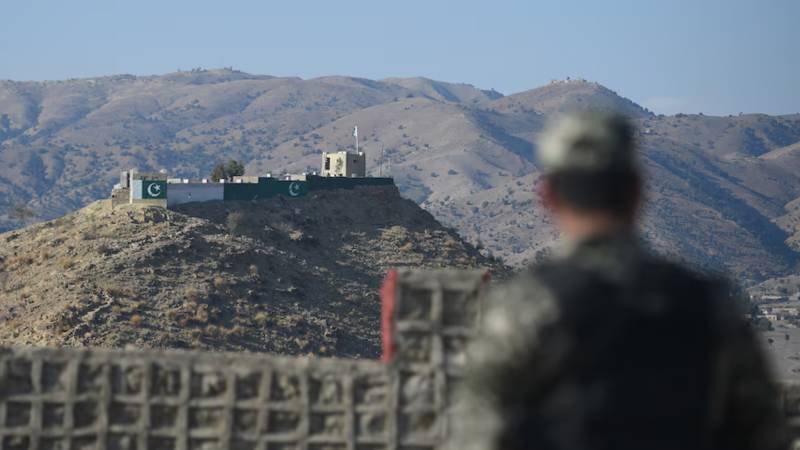
Pakistan has entered another war with a neighbour, this time with Afghanistan, and once again, the trigger is militancy. What began as border skirmishes has turned into a full-fledged conflict, leaving hundreds dead in just two days. The immediate cause was a terrorist attack. First, it was India; now, it is Afghanistan. In both cases, the fault line runs through a single theme of militancy.
The dichotomy of these conflicts is striking. Each side blames the other for using militant proxies while denying any responsibility for the forces they once nurtured. In the end, the very actors once treated as strategic assets have become the instigators of war, undermining the stability of every state in the region.
Just days before this deadly escalation, Pakistan’s military had issued a stern warning to India in response to provocative remarks by Indian officials. The statement asserted that Pakistan “shall not hold back but respond resolutely, without any qualms or restraint” if provoked again. On the other side, India’s Defence Minister Rajnath Singh declared that India could “cross any border” whenever necessary to protect its sovereignty and unity, a comment widely interpreted as an allusion to potential retaliation in the event of another major militant attack, similar to the Pahalgam incident. These fiery words from both sides added fuel to a region already simmering under mutual suspicion and the ever-present threat of terrorism.
The timing of this escalation is significant. Soon after Afghanistan’s Foreign Minister Amir Khan Muttaqi arrived in New Delhi, a deadly terrorist attack in Pakistan claimed the lives of about a dozen security personnel, including a lieutenant colonel and two majors. Pakistan responded with aerial strikes inside Afghanistan, reportedly causing multiple casualties. In a briefing to foreign diplomats, Islamabad reiterated a warning similar to the one previously issued to India: “No tolerance for any cross-border terrorist attacks from Afghanistan, and any future aggression will be met with a swift and decisive response.”
In South Asia, the borders are not just lines on a map; they are fault lines of faith, fear, and folly
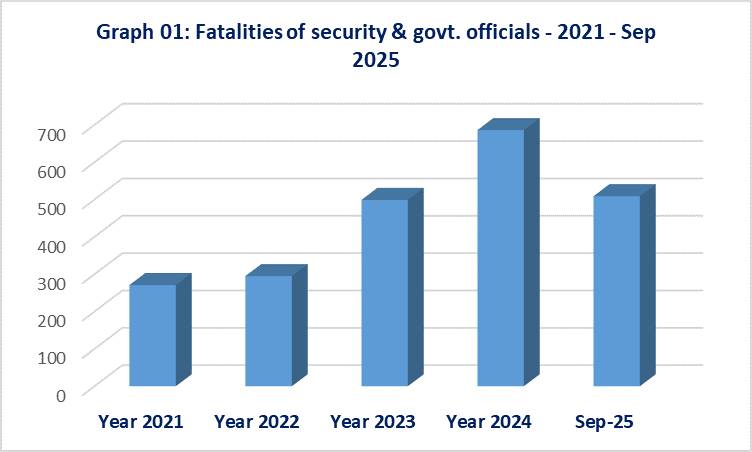
This reaction stems from an increasingly dire security landscape. Between 2021 and September 2025, Pakistan lost 8,337 lives to terrorism and counterterror operations, with 58% of the fatalities comprising civilians and security personnel (Table 01). The trend, illustrated in Graph 01, shows a steady rise in security force casualties over the same period, a troubling indicator of both operational intensity and militant reach. Particularly alarming is the surge in attacks targeting senior officers. In this year alone, five majors, one lieutenant colonel, two DSPs, three SHOs, and two SSPs have been killed, a stark reminder that even the most protected ranks are no longer shielded from an increasingly lethal conflict environment.

For India, the Taliban delegation’s visit, coinciding with the Pakistan-Afghanistan border clashes, presented an opportunity to expand its influence in a region where Islamabad’s relations with the Taliban have steadily deteriorated. The language used in the joint statement issued after the talks has been taken seriously in Islamabad, as it appears, in Pakistan’s view, to imply that Kashmir is part of India. To Pakistani policymakers, Kabul now seems to be playing a dangerous dual game: turning a blind eye to anti-Pakistan militants while seeking international legitimacy, undermining Islamabad’s position on Kashmir, and courting Indian investment at the same time.
This overlapping crisis exposes a deeper regional dilemma. A stable Afghanistan could, in theory, be Pakistan’s most crucial ally in curbing cross-border militancy. Yet the reality may prove otherwise. A consolidated Taliban regime, if left unchecked, could become a hub for multiple militant groups seeking to export their ideology across borders. As long as Pakistan and India remain locked in hostility, such groups will continue to justify their existence under the pretext of defending Islam. But once they feel secure in Afghanistan, their agenda and their targets may shift in new and unpredictable directions.
The concentration of various militant groups in Afghanistan, coupled with the emerging alignment between Kabul and New Delhi, poses a serious threat to Pakistan’s security. The Afghan Taliban, once regarded as a strategic asset, has now evolved into a strategic threat for Islamabad. This development, in Pakistan’s view, has turned its long-standing accusation of Indian support for militancy within its borders into a tangible reality.
With this shifting regional dynamic, several pressing questions arise: How might these militant groups now behave toward Pakistan? Will this alter the dynamics of the Kashmir movement, for which India accuses Pakistan of harbouring militant organisations allegedly operating in Indian-administered Kashmir with tacit links to the Afghan Taliban? How will groups such as the TTP, al-Qaeda, and ISKP, each driven by its own interpretation of Islamic Sharia, respond to this new alignment? And above all, how will India’s own religious hardliners reconcile an alliance with a regime that not only denounces idol worship as un-Islamic but also views its destruction as a religious obligation?
In this triangular equation, all three states, Pakistan, India, and Afghanistan, appear trapped in an imbroglio with no easy way out. Each faces domestic pressures that make restraint politically costly. Each accuses the other of harbouring or supporting terrorists. And each continues to ignore the uncomfortable truth that militancy, once unleashed, answers to no state.
Ultimately, militancy and hostile relations among neighbours are not mere diplomatic irritants; they are corrosive forces, like termites eating away at the very foundations of South Asia’s stability from within. Until these nations confront the ideologies and interests that sustain extremism, they will remain prisoners of their own proxies watching as the borders meant to protect them turn into the fault lines of their faith, fear, and folly.
In South Asia, the borders are not just lines on a map; they are fault lines of faith, fear, and folly. And the termites will keep eating away at the very foundations on which these nations stand until they finally realise who their real enemy is.