

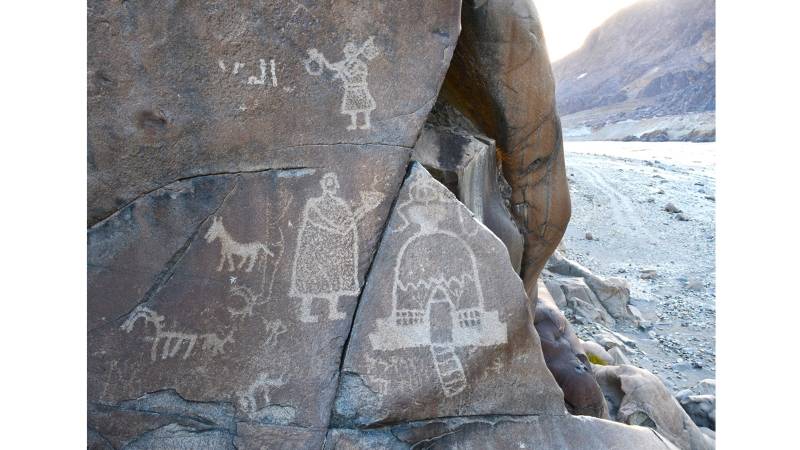
Gilgit-Baltistan is known for its rich rock art heritage. Some of its most magnificent rock carvings are found at Chilas II in Diamer district. Beyond prehistoric hunting scenes, the site features depictions of ancient rulers, soldiers, Buddhist monks, and deities. Many of these carvings are accompanied by Kharoshthi, Brahmi, and late Brahmi inscriptions. Of the six rock art sites at Chilas, Chilas II contains some of the finest specimens of Buddhist rock art. The site is located about two kilometres from Chilas Gate on the Karakoram Highway. Most of the engravings are found on rock walls and boulders close to the left bank of the Indus River.
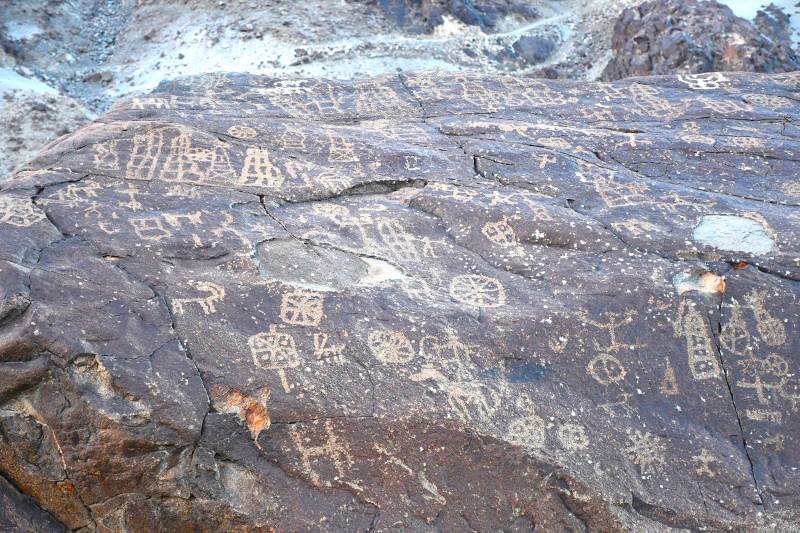
I first visited the Chilas II rock art site in 2000 and revisited it several times. On the way to the main site, one comes across a large boulder covered with petroglyphs. Among the prominent carvings on this boulder are tower-like stupas. Some of these may also represent temples. Sun discs, geometric designs, human and animal figures, and ritual scenes are also engraved on the boulder. A few human figures appear to be carrying a rafter or some other elongated object. Judging from their subject matter and style, these carvings belong to different periods.
Professor Ahmad Hasan Dani, the first Pakistani scholar to systematically study the rock carvings of Chilas, discusses several important engravings at Chilas II in his book Chilas: The City of Nanga Parvat (1983). His readings of the Kharoshthi, Brahmi, and late Brahmi inscriptions helped establish the chronology of several carvings and identify historical personalities and religious figures represented at the site. Dani also discussed these engravings in another book, Human Records on Karakorum Highway (1995). His studies remain important for understanding the political and religious history of the upper Indus Valley.
King Maues and Political Authority
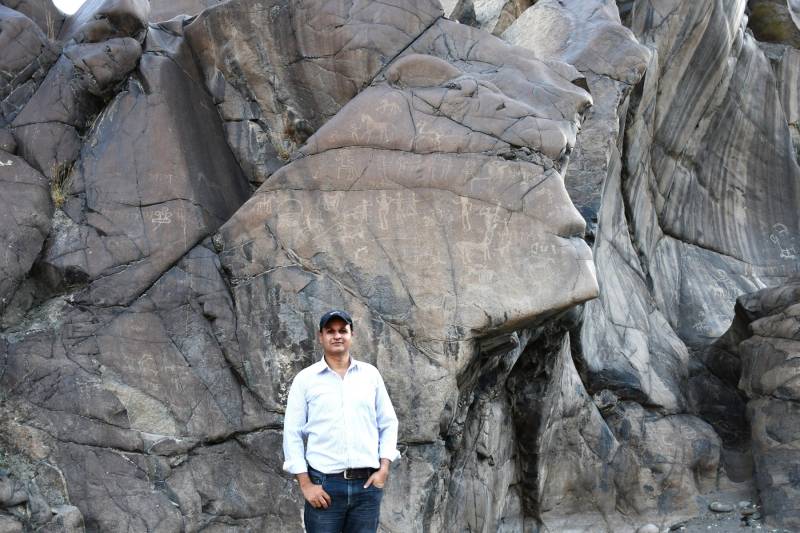
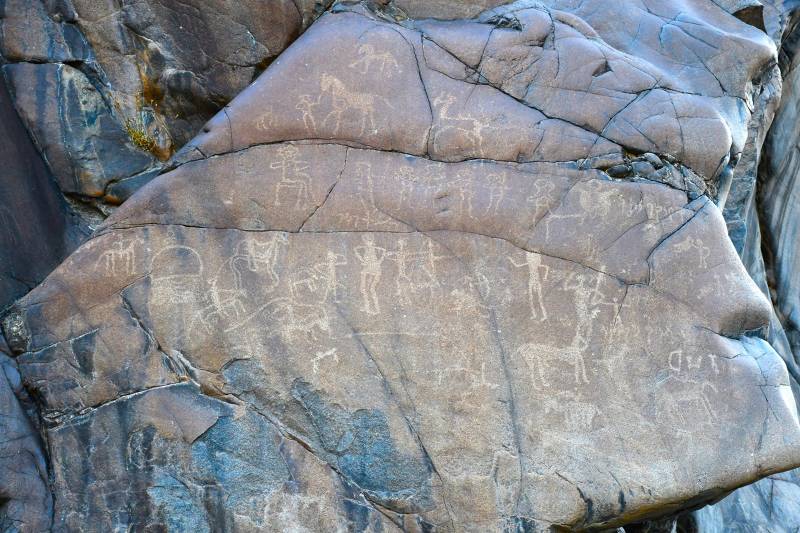
One of the most interesting scenes at Chilas II is engraved on the southern face of a rock. Scholars have interpreted this scene differently. Professor Ahmad Hasan Dani identified it as a depiction of the Scythian king Maues, his soldiers, and a captured ruler. German scholars Karl Jettmar and Volker Thewalt (1987), in their book Between Gandhara and the Silk Roads: Rock Carvings Along the Karakorum Highway, interpreted it as a scene of submission before a deity to whom a bowl is being offered. They also identified a gift bearer and dancers among the engraved figures. Among the inscriptions accompanying the scene is one in Kharoshthi that reads Moga rajasa (of King Moga). Dani identified Moga with the Scythian king Maues.
On examining the rock face, one notices three rows of carvings. Horses are depicted in the upper row, while the middle row shows a seated figure, identified by Dani as Maues, with soldiers standing nearby holding spears. Towards the right of the same row is a stout human figure tied to the leg of a soldier. Dani believed that this figure represented a defeated ruler being presented before King Maues. In the lower row, a stupa is depicted on the left, surrounded by horsemen and several standing figures, possibly representing noblemen being received by soldiers or members of the aristocracy.
When I first visited this site in 2000, there was no vandalism, but during my fieldwork in 2022 and 2024, I noticed that visitors had written their names over ancient engravings
What interests me about these rock carvings is the association of soldiers with Buddhist stupas, a recurring feature in several scenes at Chilas II. These engravings may help us understand the relationship between political authority and Buddhist religious traditions in the upper Indus Valley.
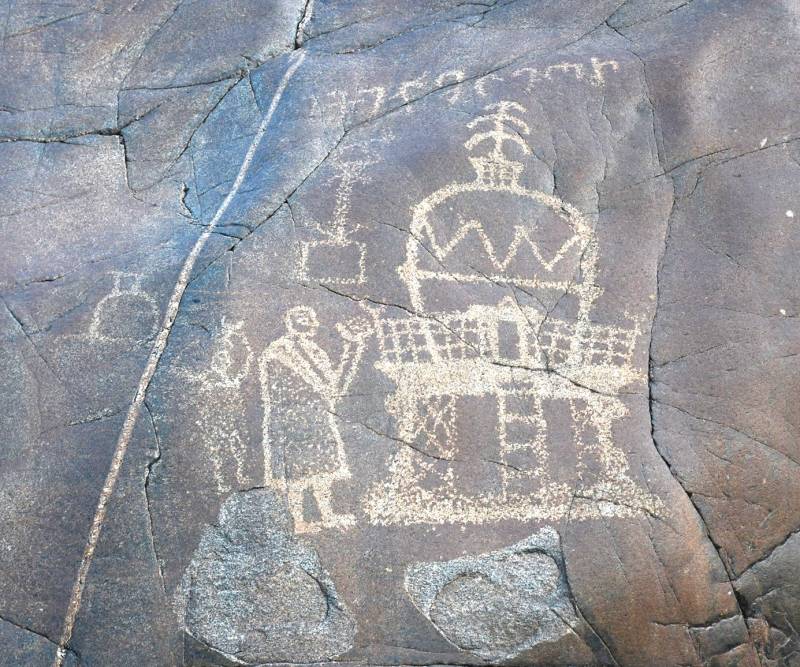
From the inscriptions on another rock wall at Chilas II, Ahmad Hasan Dani also identified the names of the governors of Maues. On a rock to the left of the scene discussed above is an engraving of a seated Buddha with a pilgrim holding a water pot. The figures are accompanied by Kharoshthi inscriptions.
Elephants, Pillared Stupas, and Deities
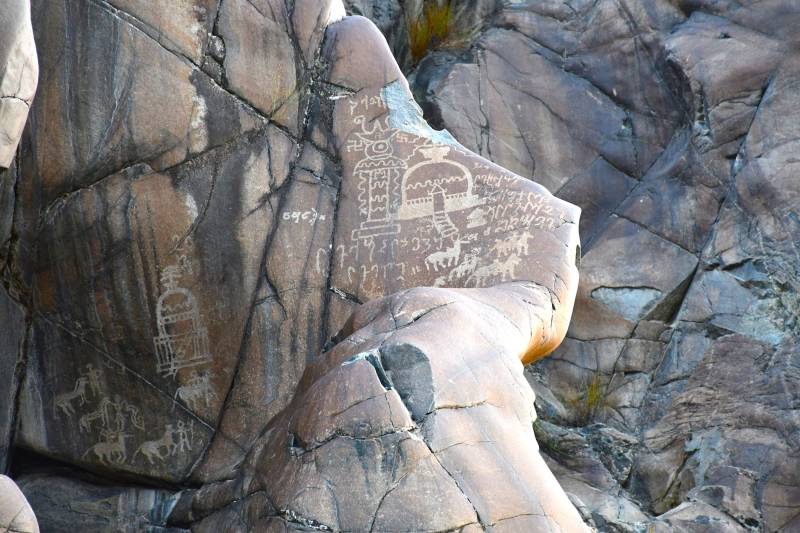
To the left of this engraved rock wall, another rock wall is fully covered with petroglyphs from different periods. This rock wall has engraved hunting and fighting scenes, human figures, animals, equestrians, stupas, tridents, deities, and geometric designs. Interestingly, three elephants are also depicted on the recessed rock wall. Such refined elephant carvings are not seen elsewhere in Chilas. Two elephant representations are engraved to the right of the 'stupa with pillars'. The stupa with pillars is one of the most magnificent carvings at Chilas II. One learns from Between Gandhara and the Silk Roads: Rock Carvings Along the Karakorum Highway by Professor Dr Karl Jettmar and Dr Volker Thewalt (1987) that this form of the stupa is dated to the first century AD. I have seen several such stupas with pillars at Thalpan and Shing Nala in the Diamer district. A few are also accompanied by inscriptions, making it much easier to date the carvings.
Below the carving of a stupa with pillars at the Chilas II rock art site, one can also see images of a lion and a bull. Bull images are rare in the upper Indus Valley, but they are a recurrent theme in the rock art of Sindh. Some bull petroglyphs can also be seen in the Middle Indus, especially at Bagh Neelab in Attock district.
The third elephant carving is found adjacent to another stupa with steps. This stupa has been vandalised, as someone has written his name over it. When I first visited this site in 2000, there was no vandalism. During my fieldwork in 2022 and 2024, I noticed that visitors had written their names over ancient engravings. There are a few remarkable engravings near the images of the stupa and elephant. One can see a warrior standing on horseback, arms outstretched, wielding a large battle axe. One can also notice an engraving of another large axe on the same rock wall. It is literally impossible to discuss every carving found on this rock wall in this article.
However, I want to discuss the carvings of Vasudeva and Baladeva, engraved on the far right of the image of a stupa with a pillar. Both figures are accompanied by inscriptions. Above the figure of Baladeva is an engraving of a simple stupa. The image of a seated Buddha is found to the left of this simpler stupa. The entire surface of the rock wall is covered with numerous carvings and inscriptions. The carvings of Krishna and Balarama are also found at the Chilas II rock art site.
Alcoves Along the Indus: Hariti and Stupa Adoration
As one descends towards the Indus River, several boulders covered with petroglyphs come into view. Among the fascinating rock carvings at Chilas II are scenes depicting Scythian soldiers. One such scene is engraved in an alcove facing the Indus River, where soldiers on horseback, carrying spears, move towards a domed stupa. The soldiers are depicted between two stupas. Near the stupa on the left is an image of Hariti, a Buddhist deity. The figure has become faint due to natural weathering and silt deposited by the Indus River. To the left of Hariti’s figure are a column and a Kharoshthi inscription. Ahmad Hasan Dani identified the deity as Hariti based on his reading of the inscription. Towards the edge of the same rock are two more representations of stupas accompanied by inscriptions. A standing human figure is depicted before one of these stupas.
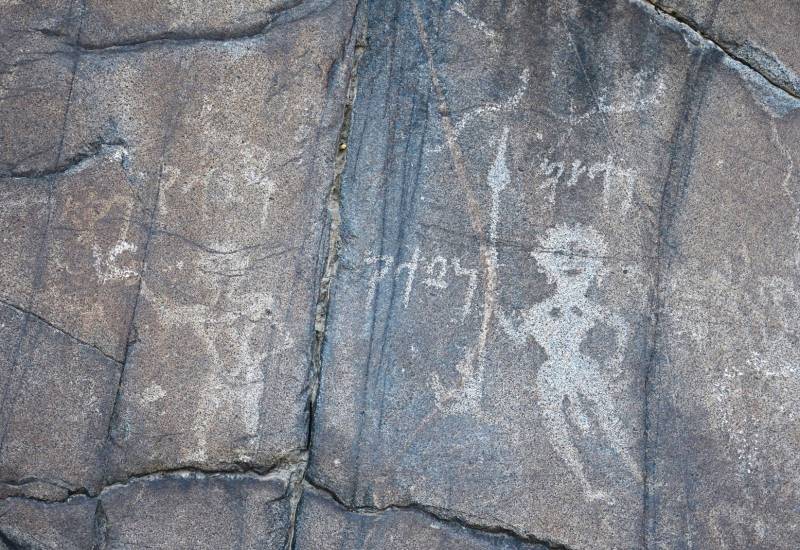
To the right of the Hariti and Scythian soldiers panel, another alcove contains two panels. The first panel shows Scythian soldiers before the stupa. Another stupa to the right of the first, on the fringe of the alcove, shows the donor’s name in Kharoshthi as Rahulasa (of Rahula). Kharoshthi and Brahmi inscriptions surround the stupa and column.
Depictions of stupa adoration, each with unique features, are found at Chilas II. A few are engraved along with monks, adding a spiritual dimension to the site. One of the best specimens is located very close to the Indus River. On the southern face of the rock, a Buddhist monk is depicted before a stupa. The stupa is built over a double square base. On the left of the steps is a Kharoshthi inscription.
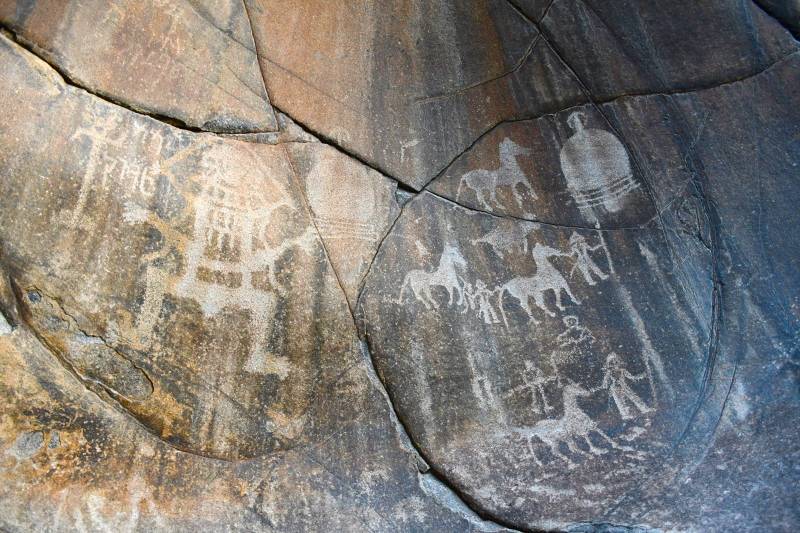
At the top is a figure of another monk, depicted holding a water pot and probably carrying a flag. Another depiction of stupa adoration is found at Chilas II. On one panel, a Buddhist monk venerates a stupa with a Kharoshthi inscription. Two votive stupas are also represented in this panel. The second monk is shown behind the first, who is holding an incense burner. Below this panel is the figure of Sakyamuni (Buddha), as believed by Professor Dr Ahmad Hasan Dani.
A little further south of these engraved rock walls and alcoves are about seven panels on a cliff, some depicting prehistoric hunting scenes. Similar scenes are found at Thalpan, Shatial, and Minar Gah, where hunters and wild animals are frequently represented in rock art. Hunting must have required considerable knowledge of animal behaviour, seasonal movements, and the mountainous terrain. The repeated depiction of hunting in the rock art of the upper Indus Valley may also reflect its social and cultural importance beyond subsistence. At Chilas II, the prehistoric hunting scenes and Buddhist religious imagery belong to different periods, reflecting changes in the subjects that people chose to engrave on rocks over the centuries.