

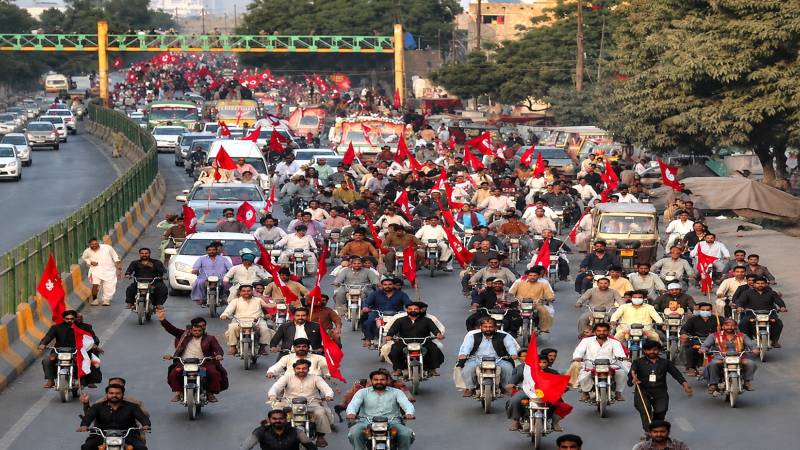
When thousands of demonstrators marched from Sachal to Fawara Chowk in Karachi on 22 November 2026 to oppose federal proposals for new provinces carved out of Sindh, they formed a civic coalition of nationalist parties, bar association leaders and citizens defending the province’s unity. On Pakistan’s prime-time television screens that evening, however, the mobilisation received little prominence. Major broadcasters gave it limited attention, while studio exchanges between cabinet ministers and ruling-coalition rivals dominated. Dawn and The Express Tribune reported the rally, its participants and demands, but gave it less prominence than its scale and political significance warranted.
This imbalance in the treatment of a significant public mobilisation reveals a deeper structural crisis in Pakistan’s information order. What once functioned as a courageous anti-colonial and pro-democratic press has hardened into “King’s media”; a system in which television networks and major newspapers amplify state narratives and the commercial interests of powerful owners while sidelining popular struggles. Far from disappearing after the end of British rule in 1947, colonial methods of executive licensing, punitive seizures, and restrictive press laws have mutated over seven decades into a durable alliance between state coercion and conglomerate capture.
The institutional lineage is continuous. British authorities policed Indian journalism through publisher declarations and punitive ordinances, even as newspapers such as Dawn, Daily Jang, and Lahore-based Progressive Papers Limited (publisher of The Pakistan Times, Imroze, and Lail-o-Nehar) forged an ethos of public accountability. Pakistan’s pluralistic promise began to unravel in its first year, when progressive periodicals faced government bans in 1948 under the pretext of national interest, beginning a decade of legal and administrative pressure on newspapers. After the 1958 martial law, the military regime dismantled independent journalism, dissolving Progressive Papers Limited’s board in 1959 to seize its titles and taking control of the Associated Press of Pakistan in 1961 to monopolise wire distribution.
These powers were codified in the Press and Publications Ordinance of 1960 and tightened through subsequent amendments, including the 1963 measure journalists denounced as a “Black Law.” The state could confiscate printing presses and replace newspaper managements. By 1964 the seized titles had been folded into the state-run National Press Trust, which subsequently absorbed other newspapers and benefited from preferential access to government advertising. During the 1970–71 political crisis, Trust-aligned dailies served as regime cheerleaders, predicting electoral defeat for the Awami League and the Pakistan Peoples Party while remaining silent during the military crackdowns that preceded East Pakistan’s separation.
When the government liberalised the airwaves through the Pakistan Electronic Media Regulatory Authority Ordinance of 2002; partly to counter Indian channels after the 1999 Kargil conflict, deregulation appeared to be a democratic breakthrough. Weak anti-monopoly enforcement instead privatised compliance. Mapping by the Media Ownership Monitor Pakistan and the Pakistan Institute of Development Economics found that eight entities (the Jang, ARY, Express, Nawa-i-Waqt, Samaa, Dawn, and Dunya groups, together with the state) accounted for 68 percent of measured audience share across television, print, radio, and online platforms in the period studied. The Jang Group commanded over one-third of the top-40 cross-media market, with ownership mapping indicating 99.9 percent effective family control through subsidiary debentures.
Far from disappearing after the end of British rule in 1947, colonial methods of executive licensing, punitive seizures, and restrictive press laws have mutated over seven decades into a durable alliance between state coercion and conglomerate capture.
Over the past decade, real-estate tycoons and active politicians; colloquially known as “Seths”, have tightened this grip, using television networks as shields for their commercial empires. A prominent housing developer and federal minister acquired Samaa TV; a private-college owner and former Lahore mayor controls Dunya News and regional city channels; Bahria Town was an early backer of Nukta Digital, before ARY Digital Network acquired a majority stake in 2026; the chairman of Blue World City is associated with SUNO TV; Al Kabir Developers acquired News One; and Lakson owns Express Media Group.
This ownership model rests on a distorted media economy that encourages deference to state authorities. After total advertising spending plunged 33.2 percent between fiscal years 2017 and 2020, with television advertising revenue falling 38.1 percent, newsrooms became heavily dependent on government advertisements, estimated to supply 22 to 23 percent of total media revenue. Successive administrations have wielded this lifeline as a weapon; press-freedom organisations reported a near-total suspension of government advertisements to the Dawn media group. Owners have shifted fiscal distress onto reporters: PIDE cited PFUJ figures of at least 7,500 media workers losing jobs during the two years before its 2021 study, while more than two dozen publications and two television channels closed. Wage arrears and further closures expose the sector’s fragility.
Where financial leverage falters, physical intimidation and institutionalised “lawfare” enforce obedience, placing Pakistan 153rd out of 180 countries in Reporters Without Borders’ 2026 World Press Freedom Index. The Prevention of Electronic Crimes (Amendment) Act of January 2025 criminalised the intentional dissemination of certain false or fake information likely to cause fear, panic, disorder or unrest, and empowered the National Cyber Crime Investigation Agency to investigate online offences. New regulatory and tribunal arrangements have raised concerns about free-expression safeguards and access to justice. Freedom Network’s 2026 impunity report documented 97 violations between October 2025 and August 2026; Punjab accounted for 51 percent. Digital-media practitioners were involved in 37 percent of violations. The report also recorded arrests, legal harassment and a police raid on Islamabad’s National Press Club.
Reclaiming Pakistan’s public sphere requires structural reform rather than moral appeals to newsroom anchors. Regulators must enforce cross-media ownership caps, mandate beneficial-ownership disclosure, and bar sitting cabinet members and real-estate conglomerates from holding broadcast licences. Public advertising budgets should be transferred to an independent steering committee; cable operators should be compelled to share subscription revenues; and Pakistan Television, funded partly through fees collected with citizens’ electricity bills, should be rechartered along the lines of Britain’s editorially autonomous BBC. Parliament must simultaneously amend the 2025 cybercrime speech offences to protect legitimate expression, reconstitute the broadcast regulator’s board with independent citizens rather than bureaucrats and retired police officials, license non-profit community radio in regional languages such as Sindhi, Punjabi, Balochi, Pashto, and Seraiki, and protect independent mobile journalism and reporters’ wages. Until newsrooms are freed from both state censors and billionaire patrons, Pakistan’s press will remain trapped in service to the king rather than its citizens.