

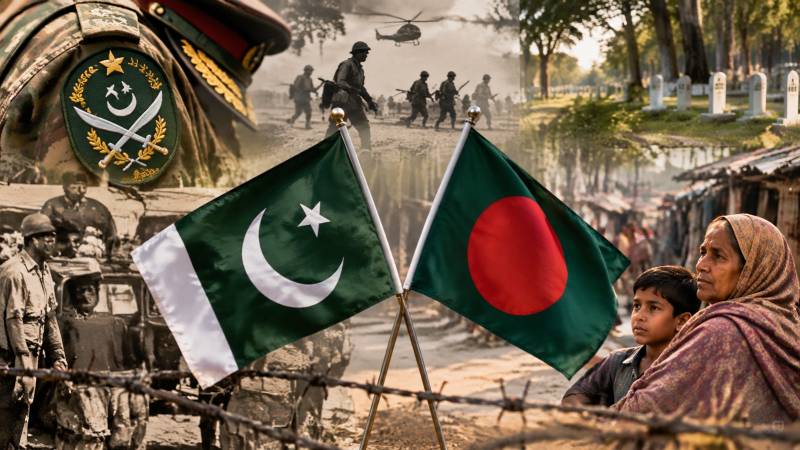
I am not a diplomat. I am not required to negotiate the language of statecraft or make every uncomfortable fact palatable. I write as a citizen, a peace advocate and a Pakistani Bihari woman whose community carries its own unresolved history of 1971. Perhaps I am still like the child in The Emperor’s New Clothes: not claiming to know everything, but unwilling to pretend that I cannot see what is in front of me.
Let me say something clearly. I love the Pakistan Army. This is not a ceremonial declaration, nor does it mean that I consider every institutional decision beyond question. My respect for the men and women who serve, for their families and for those who have laid down their lives is real.
I think of Shaheed Lieutenant Nasir Hussain Khalid Suleria, who embraced martyrdom in North Waziristan on 3 September 2020, aged just 23. He had graduated from Australia's Royal Military College, Duntroon, as its best foreign cadet. But he was also somebody's son. I remember, too, the image of Sepoy Fakhr Abbas's mother carrying her son's bier. I had written then that sons are not commodities. No medal or compensation can replace a child for a mother. These are not distant military stories to me. They are human lives.
The recent visit of Bangladesh's Speaker, Hafiz Uddin Ahmad, to Pakistan deserves attention beyond the photographs and expressions of goodwill. He was commissioned into the Pakistan Army as a Captain and trained at the Pakistan Military Academy, Kakul. On 30 March 1971, he revolted at Jessore Cantonment, fought against the Pakistan Army and joined the Bangladesh Liberation War the conflict that led to the break-up of Pakistan and the emergence of Bangladesh. For his role in that bloody struggle, he received the Bir Bikram, Bangladesh's third-highest gallantry award.
He was entitled to visit his former academy. Bangladesh's Speaker should be welcomed with dignity. Pakistan and Bangladesh need parliamentary engagement, trade, connectivity and a relationship that is not held hostage to the bitterness of the past. I want that relationship to succeed. But I have a question about how the visit was presented. The National Assembly's account spoke of shared institutional heritage and camaraderie, while leaving out the subsequent military history. The earlier announcement had referred to his wish to revisit his alma mater and meet former course mates. I have no objection to welcoming him.
My question is different: could we not have acknowledged the whole history while welcoming him? We could have recognised his formative years at Kakul, his later place in Bangladesh's national history and the possibility of a new relationship. We do not have to choose one truth and discard another.
I am not asking Pakistan to remain imprisoned in 1971. I am asking that we do not confuse reconciliation with selective memory. We can welcome Bangladesh's representatives, honour our soldiers, recognise the suffering of minorities and speak honestly about the past. These are not competing loyalties. Diplomacy may require tact. It should not require historical amnesia.
Would we present a former Indian Army officer who had fought against Pakistan in the same way, emphasising only his earlier institutional association? It is a fair question about consistency, not an accusation against the visiting Speaker. I have been writing and speaking about 1971 for over fifteen years, examining its political history, human cost and unfinished questions.
For me, 1971 is also the story of those left to live with its consequences. Urdu-speaking non-Bengalis, many of them Biharis, are too often reduced to a single label. Some openly stood with Pakistan; others were suspected or targeted as collaborators simply because they spoke Urdu. The community was never politically uniform. This does not diminish Bengali suffering. The violence and loss experienced by Biharis and others also deserve recognition. Many families remain in the overcrowded 4x4-7x7"camps", facing poor sanitation and exclusion. Citizenship on paper has yet to guarantee dignity in daily life.
There are Pakistani soldiers buried in what is now Bangladesh. Major Muhammad Akram Shaheed, recipient of the Nishan-e-Haider, was buried at Boaldar village in Dinajpur after the Battle of Hilli. His grave is a reminder that the war left human stories on both sides of the border. Remembering these soldiers and ensuring dignified access to their burial places should also be part of a mature conversation between the two countries.
I have been saddened by the silence of some people whose voices I expected to hear: friends in military and civilian circles, media colleagues and those who speak frequently of peace. I do not presume that silence means agreement or disagreement. But I have had to counsel myself not to wait for familiar voices before expressing a considered view.
I am not asking Pakistan to remain imprisoned in 1971. I am asking that we do not confuse reconciliation with selective memory. There is no weakness in acknowledging history while extending a hand to a neighbour. We can welcome Bangladesh's representatives, honour our soldiers, recognise the suffering of minorities and speak honestly about the past.
I want Pakistan and Bangladesh to move forward. I want our soldiers' sacrifices remembered. I want the patriots mostly Biharis who remain in the ghettos called camps to be seen as human beings, not as an inconvenient footnote. These are not competing loyalties. Diplomacy may require tact. It should not require historical amnesia. And love of one's country, or of its Army, should never be measured by one's willingness to remain silent.
Pakistan Hamesha Zindahbaad