


Published late last year, Nadeem Farooq Paracha’s latest book (his ninth), Of Reason, Romance and Ruin: A Conceptual History of the ‘Pakistan Ideology,’ offers a thought-provoking examination of the ideological evolution of Pakistan. Focusing on the lives and ideas of Sir Syed Ahmad Khan, Muhammad Iqbal and Abul A’la Maududi, the book explores how competing interpretations of Islam, modernity, and nationalism have shaped the country’s intellectual and political landscape.
Paracha argues that the notion of a unified ‘Pakistan Ideology’ was formalised much later, particularly in the late 1970s, and has since been used to reinforce a state narrative that often deepens sectarian, religious and ethnic divisions rather than bridging them.
I recently interviewed him, asking him about the key arguments and themes of the book.
***
RHR: While explaining the context in the early part of your book, you mention that the idea of Pakistan was actually first put forward by Hindu nationalists. Now, even if we assume that to be true, the fact remains that those Hindu nationalists were not part of the mainstream. Since their ideas didn’t become widely accepted at the time, how can you attribute the concept of Pakistan to them? Don’t you think the idea of Pakistan was actually quite organic, rather than just a response to a fringe party that wasn’t even popular back then?
NFP: First of all, it wasn’t me but Mr Jinnah who first alluded to this. He was right because as I’ve stated in the book, some Hindu nationalists in the 1920s went on record to suggest the creation of two states, one for the Hindus and one for the Muslims. Hindu nationalists by then were really not that much on the fringes anymore. When the Khilafat Movement started to crumble and violence between the Hindus and Muslims intensified, Hindu nationalists became quite active and well-known. It was in the 1920s that Hindu nationalism began to be fully formed as an ideology. And I don’t think that the idea of Pakistan was organic. It was reactive. But having said that, it was the right idea because one way or the other, Hindu nationalists were bound to become a force in India as they did from the 1990s onwards. Jinnah was right to fear such a possibility.
RHR: What, in your opinion, explains the Objectives Resolution, which was actually presented by so-called Muslim modernists in 1949? Why did Pakistan take that direction, especially considering the fact that, as you mentioned, the Muslim League was largely composed of Muslim modernists? Although one could argue that Pakistan truly began its Islamisation in the early 1970s, the subsequent Islamisation was largely based on—or at least followed the blueprint laid out in the Objectives Resolution of 1949.
NFP: I believe the Resolution would have been quite different had Mr Jinnah been alive at the time it was passed by the first constituent assembly. Nevertheless, it is an exaggeration to understand it as a document that called for an Islamic state. It didn’t. It was an attempt to undermine politics of ethnicity and bolster a nationalism and politics based on Jinnah’s so-called Two Nations Theory. The Resolution was also a way to co-opt the Islamist ideas of Pakistan which were being propagated by the Islamist parties. Yet, the so-called Islamic aspect of the Resolution is almost entirely modernist, because the Islamic modernists were not really looking to create an entirely secular nation-state but one that would be a mixture of secularism and Islamism. But this Islamism was based on the kind of Islam that the modernists had been advocating. It was different from the one understood by the Islamists. I have explained the difference between the two in detail in the book.
RHR: In the early pages of your book, you mention that after the breakup of Pakistan in 1971, one of the arguments that emerged was that it was a lack of Islam that led to the country’s disintegration. There were essentially two schools of thought—one suggested that more Islam was needed to keep the country united and maintain its integrity, while the other argued that the breakup had more to do with the mismanagement of ethno-nationalism. According to this second view, the solution should have been to grant more regional autonomy and move towards a more federal structure. So, why did Pakistan end up moving toward the first option, especially considering that it was a relatively secular Bhutto and his party in power—people who had themselves witnessed the breakup of the country? Why do you think Pakistan started shifting towards greater Islamisation rather than choosing the second path?
NFP: Paranoia. Imagine the uncertainty that must’ve gripped the state and polity in West Pakistan after the country’s eastern wing broke away. There was an intense debate between the government, state and the intelligentsia about what the country was about, now that the Two Nations Theory had been shattered by East Pakistan’s departure. The more myopic and conservative view won the day because the other view, to most, seemed too loose to keep the country from fracturing any further.
"It is an exaggeration to understand the Objectives Resolution as a document that called for an Islamic state. It didn’t. It was an attempt to undermine politics of ethnicity and bolster a nationalism and politics based on Jinnah’s so-called Two Nations Theory"
So, the idea of Islam binding together an ethnically diverse polity came into effect more forcefully after 1971. This idea had been around for years, but it really came into its own after the so-called East Pakistan debacle. But, of course, as one saw, this idea, when adopted and applied in a more concentrated manner, created its own problems, especially from the 1980s. Pakistan is not only ethnically diverse, it also has multiple Islamic sects and subsects with their own nuanced understanding of Islam. To this day, many sects and subsects refuse to pray in an opposing sect’s or sub-sect’s mosque. Nevertheless, the nationalist idea that emerged after 1971, became a prominent part of what eventually emerged as the Pakistan Ideology in 1978.
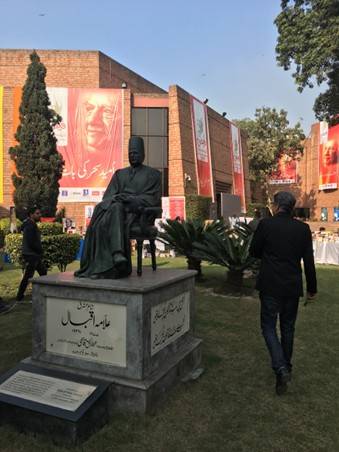
RHR: Why have you chosen Sir Syed Ahmad Khan, Muhammad Iqbal, and Abul A'la Maududi as the central figures of this book? Why these three in particular? What is the underlying connection between them, and what makes their contributions especially significant in the context of Pakistan’s ideological development? In other words, what is the common thread that links these individuals, and what is the rationale behind selecting them as the focal point of your analysis?
NFP: The first two were directly referenced by those who formulated the Pakistan Ideology. Iqbal more than Sir Syed. Maududi Sahib’s ideas on Islamic state were referenced as well, even though, ironically, he is not mentioned in textbooks. But the fact is, a lot of aspects of the Pakistan Ideology were drawn from Maududi’s thesis. His thesis on the Islamic state, or hukumat-e-ilahi, as he called it, was largely undermined by the state till the 1960s. But after 1971, the thesis began gaining increasing traction among the urban middle-classes and within state institutions such as the military. So, I explored the works of Sir Syed, Iqbal and Maududi to see what was reworked by the state to build a national ideology and what was ignored. And why.
RHR: In the chapter about Sir Syed Ahmed Khan, you pointed out that he tried to reinterpret religious teachings, insisting that many of them were metaphorical and shouldn't be taken literally. He also attempted to show that the Islamic scriptures were fully in line with science, and that there was no contradiction between the two. You discuss this in detail, but then also mention that this kind of approach was later taken up by some others including some charlatans. Now, you do make it clear that Sir Syed was different. But are you suggesting that he also served as an inspiration for sects like the Parvezi group? Because, as far as I know, the Parvezis also try to offer a highly scientific interpretation of the Quran and other religious texts.
NFP: Muslim modernism, or the idea and argument that Islam was inherently a modern, progressive and rational faith, first began to emerge among certain Muslim scholars in the 19th Century. It was a reaction to European colonialism which, initially, understood the colonised people as stuck in premodern, irrational modes of thinking and customs.
Muslim modernists challenged this. They referenced the works of early Muslim scholars and scientists, and rationalists such as the muʿtazilī, to exhibit that most post-16th Century European rationalists and empiricists were inspired by these Muslim thinkers. The Muslim modernists, however, agreed that from the 12th century onwards, Muslim societies became fearful of rationalism and speculative thinking, believing that these may undermine their beliefs.
The modernists, thus, saw themselves as revivers of rational, empirical and scientific thought in Muslim cultures as a way to not only survive colonialism’s political and cultural onslaught, but to reinvigorate and modernise Muslim societies which, they believed, had become myopic.
It was this intellectual current which branched out in various shapes and sizes across much of the 20th Century. The so-called Parvezis were one such branch. But there were many others as well, until this modernist current began to lose steam from the 1970s onwards. By the way, I don’t consider the followers of Ghulam Ahmad Parvez as a sect.
RHR: In your chapter about Iqbal, you've mentioned that he was a kind of modernist—different from Sir Syed—someone who was trying to find a middle ground. Given that you see Iqbal as a modernist of some sort, why do you think he ended up becoming a favorite of reactionary elements? Because most of the time, it's the more reactionary voices that seem to champion Iqbal. Why?
NFP: My exploration of Iqbal’s intellectual evolution in the book actually sees him landing on a rather reactionary space. He started off as a modernist and an Indian nationalist, then rather creatively attempted to build a middle path between modernity and traditionalism, secularism and Islamism. But during his later years, he began to reject rational speculation and even philosophy. To him intuition was more powerful than rationalism and passion was more important than intellectual deliberation. The most interesting thing is, after his demise, he was
first embraced by the leftists and the modernists, before he was turned into an Islamist ideologue by the Pakistan Ideology.
There was always more than one Iqbal. Leftist poets such as Faiz Ahmad Faiz admired him, pro-Ayub modernists and rationalists such as Dr Fazalur Rahman Malik liked him, the ZA Bhutto regime turned him into a Sufi saint of sorts, and the right-wing Zia dictatorship portrayed him as an Islamist.
In 2020, even the chief of the radical Barelvi Islamist party the TLP, late Khadim Hussain Rizvi, was quoting him. As I mention and try to demonstrate in my book, Iqbal wrote for impact and often jumped from taking one position to then suddenly taking another which opposed or contradicted the position he had taken earlier. He seemed to be a rather excitable character. But what a powerful writer he was. However, I tend to agree with Dr Parvez Hoodbhoy when he says that Iqbal was more of a poet than a philosopher.
RHR: Is this your overall assessment of Iqbal?
NFP: In a nutshell, yes.
RHR: Throughout the chapter, you keep mentioning that Iqbal evolved a lot — and as you mention, he took various positions over time. In the book you explain that at one point he was even supportive of Marx and of the Ahmadis, he was then influenced by Nietzsche, and at the same time, he wasn’t exactly a secular figure. Yet, can one really call him a Muslim modernist in the same way you describe Sir Syed Ahmed Khan?
NFP: Iqbal was part of the Muslim modernist current that I spoke about earlier. He was yet another branch of that current. But eventually, he tried to break away from this current and land on something which he believed was more powerful and emotional. Well, he did. It worked wonders in bolstering his poetry, but complicated his so-called philosophical prose. The prose is all over the place, taking various contradictory positions within the same space. No wonder he ended up hating philosophy. I think he got bored of it. Writing poetry about intuitive and passionate shaheens was certainly more appealing to him.
RHR: So, if you were to give a final, overall assessment of Iqbal — after taking into account all his evolution and ideological shifts — how would you define his legacy? In just a few words, how would you sum up Iqbal and his ideological contribution?
NFP: One can say that his contribution to Urdu and Persian poetry was immense. Sometimes unmatched. But in no way was he ever an ideologue. He was turned into one by the state years after his demise in 1938.
RHR: Now let’s talk about Maulana Maududi, who we know is the founder of Jamaat-e-Islami. You’ve mentioned that he was strongly opposed to the creation of Pakistan. But the state of Pakistan —at least at the time of its conception — was meant to be a country where Muslims would form the dominant majority. Considering that Maududi believed a state should be completely subservient to God, why was he against Pakistan? Because if Pakistan had not come into existence, there’s no way Muslims in India would have had the opportunity to create a state in the name of God. So whatever chance there was—whether one argues that Pakistan was meant to be a country for Muslims rather than for Islam—we can debate that. But from a realistic point of view, Muslims had a far better chance of creating a state subservient to God in Pakistan than they ever would have had in India.
NFP: Unlike Iqbal, Maududi sahib was an ideologue and a much more concrete thinker. But after reading through dozens of his books and essays in past many years, I am of the view that he often ended up overthinking about Mr Jinnah and Pakistan. For example, he firmly believed that Jinnah and his party would behave like the secular Turkish nationalist, Kamal Atatürk. Maududi feared that Jinnah would sideline the ulema and the clerics and create a secular Muslim-majority nation state.
But nothing of the sort happened. By 1950, Maududi made his peace with the idea of Pakistan and accepted it. It is however true that he detested Jinnah. Maududi wanted to lead the Muslims of India, but was distraught when he realised that the secular, Westernised, and liberal Jinnah was to become the prime Muslim leader in the region.
Of course, there was also the matter of how, according to Maududi, Islam was universalist and there was no place in it for a nation state because a nation state is inherently secular. Nevertheless, as Pakistan inched closer to becoming — if not a theocracy then certainly a theodemocracy — Maududi sahib’s apprehensions began to wither away, even though it took another twenty-five years at least for this to happen. Maududi sahib’s scholarship and activism played a major role in making this happen.
Over the years I’ve developed this curious relationship with Maududi. I tremendously admire him as a prolific political and Islamist theorist, yet I always end up disagreeing with most of his ideas. But the respect for him remains. Same is the case with Iqbal. Out of three scholars whose works that I deconstruct in the book, I feel more agreeable with Sir Syed. He’s such an underrated intellectual giant. Ironically, more so in Pakistan. And this is because the methodology that he used to explore Islamic texts and his conclusions in this regard cannot be discussed in textbooks anymore. So his place in such books is simply that of an educationist.
RHR: A question arises regarding Jamaat-e-Islami, a party that predates many of the major political players in Pakistan today, including the Pakistan Muslim League-Nawaz (PML-N), the Pakistan People's Party (PPP), and Pakistan Tehreek-e-Insaf (PTI). Despite its longstanding presence, its highly organised structure — often resembling a vanguard party—and its consistent emphasis on Islamic ideology, Jamaat-e-Islami has failed to make significant electoral inroads. Given that Islamic rhetoric continues to hold considerable appeal in Pakistan’s political landscape and is employed by nearly all major parties, what, in your view, explains Jamaat-e-Islami’s inability to capture the imagination of a broader electorate? Why has its support remained limited over the decades? Like why, unlike Muslim Brotherhood, JI has not been successful. Mind you, it is also heavily involved in charity ( Al-Khidmat organisation) and relief operations during calamities.
NFP: The simple answer is within the way you have framed this question. The mainstream non-Islamist parties have almost entirely usurped JI’s narrative. So has the state. This narrative has been usurped and watered-down. This is why one can now see JI trying to do more constituency politics. Ideologically, it has nothing new to say because the same is often said by the state, PML-N and PTI. The major parties, especially PML-N and the PPP, have become well-oiled electoral machines due to their emphasis on doing constituency politics.
Talk of Islam in them is more rhetorical than ideological. So, JI is now attempting to explore constituency politics — something the PTI still struggles with. I would thus suggest that JI should try to attract disappointed PTI voters, and which, recently, JI actually did in Karachi. JI too has a history of being an urban middle-class party.
RHR: With respect to Jamaat-e-Islami, what I’m particularly curious about is why the Muhajir community supported the party up until the formation of the MQM. As you’ve noted, the people who migrated from India were generally more educated and, relatively speaking, more progressive. Even the MQM, after its formation, positioned itself as a more progressive party. So how do we explain the Muhajir community’s support for Jamaat-e-Islami, particularly during the 1970 and 1977 elections, despite its more conservative and religiously driven platform?
NFP: Till the creation of the MQM, the Mohajir were socially liberal but politically conservative. This was because they saw every other party having ready-made constituencies consisting of ethnic groups who had deep roots in regions that became Pakistan. Mohajirs were outsiders, arriving from areas which became Hindustan. This is why they voted for the Islamist parties which eschewed regionalism. The creation of Mohajir nationalism and the MQM in the 1980s, changed that.
RHR: In your book, you have argued that Maududi was opposed to the idea of a nation-state, yet he advocated for an Islamic state. For the benefit of the readers, how exactly is an Islamic state different from a nation-state? If I wanted to draw a clear qualitative distinction between the two, how should I do it?
NFP: To Maududi, the idea of a nation state was a Western construct. This is true. He believed that nation states were inherently secular. True again, but to a certain extent. So he began to speak of an Islamic state which can be geographically confined but can evolve into becoming something larger and more expansive. So, basically, an Islamic state is a nation state but with an Islamised state, government, laws and polity. This is what Zia was reaching for and somewhat succeeded. Zia was a thorough Maududist.
RHR: In the case of countries like Tunisia, Turkey, and even some other Arab nations before their independence, we observe overt secular trends, with public figures and intellectuals openly identifying as secular. Why is this not the case in the Indian subcontinent? Here, we see the emergence of something called Muslim modernism, and while one could argue that many Muslim modernists were, in effect, secularists, it’s still not quite the same as what we observe in Turkey or Tunisia. What explains this difference?
NFP: India had a Hindu majority. So the Muslim modernists had to use Islam as an identity marker if not as a theocratic idea. Indeed, most of Pakistan’s founders were secular, but they couldn’t have called themselves this and then demand a Muslim-majority state. They were comfortable with the idea of Islam being a progressive and adaptable tool which, to them, was inherently opposed to a theocracy. Or something of the sort.
RHR: In the concluding chapter you explain how Pakistan Ideology is a reflection of Islamism as a postmodernist critique of modernity. You rather brutally dissect postmodernism in that chapter …
NFP: Indeed. Actually, postmodernism has been attacked by various scholars, especially in the last decade or so. My problem with it is that it romanticised some rather reactionary and violent tendencies of Islamism. I have studied postmodernism very closely because one can say that at least 15 years ago I too was a champion of postmodernism … until I finally began to realise its destructive nature, its utter pretentiousness, and juvenile take on complex ideas. If you ask me now, I’ll tell it’s mostly a load of crap, good only for pop musicians.