


The work of archaeologists suggests that a port was located on the banks of the River Indus in the west of Mohenjo-Daro. Most probably, this port was situated on the present site of the village of Dhandh. This settlement was founded on the old channel of the River Indus, locally known as the Lanyaro. The port served the river traffic coming from various parts of the valley. Mr EJH Mackay mentions an Indus boat seal (Steatite Seal MM 489/ DK 10355) that was excavated from the DK Area of Mohenjo-Daro during 1927 to 1931. This unfired gray steatite seal depicts a high-prowed, flat-bottomed boat with a central cabin and a large double rudder. The back or reverse side of the seal is cracked and chipped off and has a grid design on the remaining surface. Perhaps this seal went to the USA for an exhibition.
The boat is also found on a sherd at Mohenjo-Daro. Mr Mackay writes in his book Further Excavations at Mohenjo-Daro (1938), “No. 4 is of great value, in that it is the first representation of a boat that has been found at Mohenjo-Daro. Though only roughly sketched, it confirms with the typical archaic representation of a boat in other countries; it has a sharply upturned prow and stern and is apparently controlled by a single oar. The mast may possibly be a tripod, and one or two yards are shown, or, conceivably, one only, the second line representing a furled sail.” (p. 183) A toy boat was also excavated from Mohenjo-Daro.
Such types of boats were commonly used in Mesopotamia and Egypt for seafaring. Another seal, called the "Boat with direction finding birds", was discovered by Dr George F Dales from the HR Area of Mohenjo-Daro in 1964. This small, triangular-shaped, terracotta moulded tablet depicts a rare representation of a Harappan boat; a Gharial, or fish-eating crocodile common in South Asia; and Harappan writing with 8 Indus script signs. This unique tablet (MD 602) is now displayed as NMP 1384 in the National Museum, Islamabad, Pakistan. A model of this Mohenjo-Daro seal is also displayed in the National Museum, New Delhi, India.
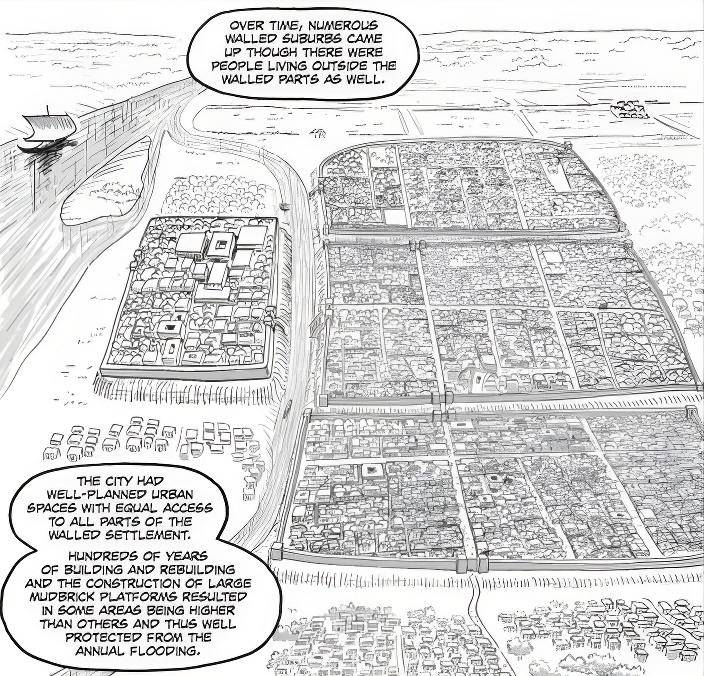
The terracotta boat models discovered at Lothal, Gujarat, India, also provide critical evidence of ancient maritime activity and shipbuilding technology. No solid evidence of wooden boats has been discovered so far from the neighbourhood of Mohenjo-Daro. If explorations are carried out, such remains of wooden boats could be found on the banks of the western course of the River Indus, the Western Nara, and the Lanyaro riverbed flowing close to Mohenjo-Daro.
In the past, the large archaeological sites of Jhukar (Larkana) and Dhamraho Jo Daro (Badeh Nasirabad) were also connected with Mohenjo-Daro through waterways and ferries. Describing the admiral and fishing fleet of Dhamraho (400 AD), Mr RD Banerji writes in the Annual Report of the Archaeological Survey of India 1919 that, “It is said a bell used to hang, from one of the mounds which the admiral of the village fishing fleet (Mirbahar or Amir ul Bahar) used to ring to inform the villagers that he had brought fish for sale.” (p. 78) The above description actually relates to the bell of the Buddhist stupa and monastery of Dhamraho, as well as the riverine port of that area with its socio-religious and economic conditions.
Evidence suggests that the fine cotton known as Sindon, used in the ancient Near East and referenced in biblical texts, originated in the Indus Valley
The Western Nara was the irrigational channel which discharged its surplus water into the Manchhar Lake, Sehwan. Mr JL Rieu, ICS Commissioner in Sindh, helped the Archaeological Survey of India immensely by conducting extensive inquiries about Dhands, or ancient riverbeds, in the area between the Western Nara and the present bed of the Indus in the 1920s.
Agricultural Lands, Grassy Fields and Gardens
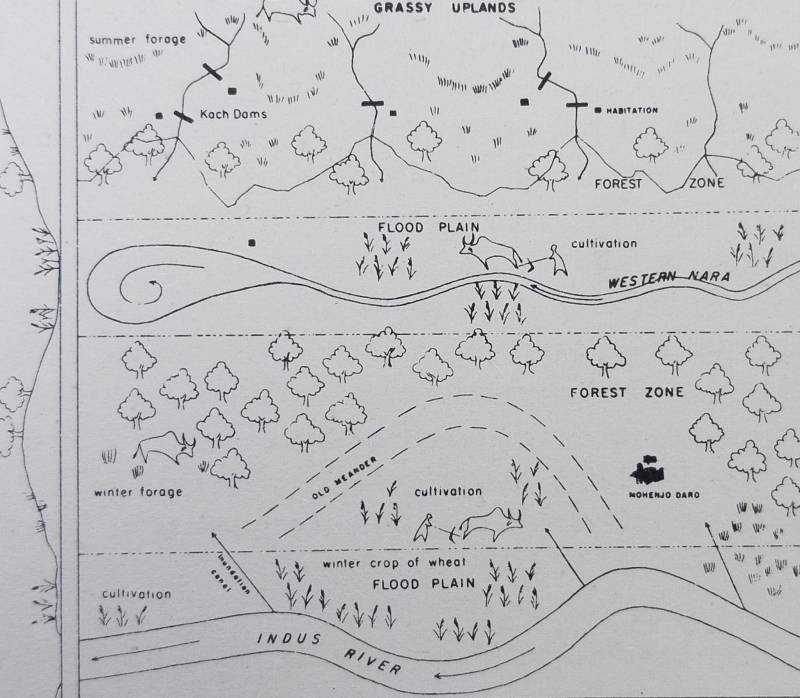
Agricultural lands and fields were situated in the flood or alluvial plains of the River Indus to the north, west, and south of Mohenjo-Daro city. There must have been some other forest zones or green belts on the eastern side of the city as well. These fertile lands were irrigated by the River Indus's canals and waters. The grassy uplands were located on the western side and were irrigated with hill torrents, dams, and bunds. The inhabitants of this city had mastered irrigation-based farming to manage seasonal floods, providing grains, vegetables, and fruits—including bananas and berries—to the populations living in the citadel and the lower city. The food surplus was stored in massive, centrally managed granaries. They easily cultivated summer and winter forages. There must have also been fruit gardens which yielded bananas, dates, and berries. The people of Mohenjo-Daro used saddle querns to grind cereals of various kinds, i.e., wheat, rice, or barley. Mr Vats described vestiges of seeds of the melon species, as well as chaff and straw, from the burial urns of Harappa.

The people of Mohenjo-Daro managed a double-cropping system with Rabi or winter crops, which yielded wheat and barley as the main staples. The Kharif or summer crops included rice, millet, sesame, and various pulses. Other produce included cotton, dates, peas, lentils, and mustard. Charred wheat grains (L 855), approximately 4,000 to 5,000 years old, were excavated from the L Area at Mohenjo-Daro. The wheat has been identified as Triticum compactum or Triticum sphaerococcum, both of which are grown in the Punjab today. Some of these carbonized wheat grains are also displayed in the Archaeological Museum of Mohenjo-Daro. The banks of the River Indus had a rich ecosystem with diverse flora and fauna. The Pipal, Banyan, and Neem trees held sacred significance, which is why they were carved on Indus seals with goddess images and human rituals. Acacia (Nilotika) or Babul grew on the banks of the River Indus, as well as near lakes and ponds.
Highlighting the discovery of a few minute scraps found adhering to the side of a silver vase from the DK Area of Mohenjo-Daro, Sir John Marshall writes that, “This discovery, which is one of the most interesting of the minor discoveries made at Mohenjo-Daro disposes finally of the idea that the fine Indian Cotton known as Sindhu and to the Greeks as Sindon was product of the Cotton tree and not a true cotton.” (p. 33) These samples of cotton were examined by AN Gulati, MSc, and AJ Tuner, MA, BSc, of the Indian Central Cotton Committee (ICCC) Technological Laboratory, established at Bombay in 1924. The ICCC itself was renamed as the Directorate of Cotton Development in 1966 by the Government of India. Recently, archaeologists have discovered 7,000-year-old cotton fibres from Tel Tsaf, a prehistoric village in the Central Jordan Valley in Israel. This is the earliest evidence of the use of cotton in the ancient Near East. The microscopic remains date back to the Middle Chalcolithic period (5200–4700 BC). Cotton did not grow in the region at the time. That is why it is believed to have been imported from the Indus Valley (modern-day Pakistan).
The definition of the word Sindon is "Linen cloth esp. that which was fine and costly, in which the bodies of the dead were wrapped or thing made of fine cloth". References to Sindon are found in both the Bible and ancient Greek literature. This name has been used five times in the King James Version (KJV) in the Gospels of Matthew, Mark, and Luke. The word Sindon is used in the Gospel of Mark (circa 70 AD) to describe the fine, costly, and high-quality linen cloth used as the burial cloth of Jesus. The Sindon was purchased by a rich disciple called Joseph of Arimathea (Judea) to wrap Jesus's body after taking it down from the cross, placing him in a rock-hewn tomb: "So Joseph bought some linen cloth, took down the body, wrapped it in the linen, and placed it in a tomb cut out of rock. Then he rolled a stone against the entrance of the tomb." (Mark 15:46)
According to Christian tradition, it was Sindon cloth in which the body of Jesus of Nazareth was shrouded. The term Sindon was used by ancient Greeks to describe Indian cotton, derived from the Sind region. Perhaps the original name of Sindon appears to derive from Sindia or Sindien, a fabric coming from Sind, a geographical part of the ancient Indus Valley Civilization. The historic name of Sindon is also used in Old English poetry, also known as Anglo-Saxon poetry, that spans from 450 to 1066 AD. Beowulf is the longest and most famous epic poem of this period.
According to the Collins Dictionary (2026 edition): “Sindonology is the scientific and interdisciplinary study of the Shroud of Turin a linen cloth believed by many to be the burial shroud of Jesus Christ. The field examines the cloth's history, image formation, and physical properties, often using forensic, historical, and scientific analysis to investigate its authenticity”. An expert in this study is called a Sindonologist. The Persian, Sanskrit, or Arabic name Sindbad or Sinbad, which translates to "Lord of the Sindh River", "Wind of the Indus River", or "Man of Sindh", is connected to the Sindh region of modern-day Pakistan. This name is found in the 9th-century Arabian Nights tales. The noun Sindon dates from c. 1450, Sindhi (noun and adjective) from c. 1815, and Sindonology from c. 1964. Sindhi means a native or inhabitant of Sind, now a province in Pakistan. The earliest known use of the word Sindhi is from 1815, in the writings of Mountstuart Elphinstone, an administrator in India.
Italian scientists from the University of Padova, Italy, conducted an analysis of the Shroud of Turin in 2015. The study suggests the linen may have originated in India. Researchers identified DNA from plant pollen and human mitochondrial DNA (mtDNA) haplogroups linked to the Indian subcontinent, in addition to regions like the Middle East and Europe. The Holy Shroud travelled within Jerusalem, Palestine (500 AD); Sanliurfa, Turkey (944 AD); Constantinople, Turkey (1204 AD); Lirey and Chambery, France (1353 AD); and finally was kept in 1578 in the Cathedral of Saint John the Baptist in Turin, Italy. According to modern research, the Shroud of Turin (Italian: La Sindone di Torino) dates back to the 1st century AD. The size of the shroud is 4.4 m x 1.1 m, or 14 ft 5 in x 3 ft 7 in. The shroud has been exhibited to the public five times since the 1900s. The last major public exhibition was held in 2015.
Mr KN Dikshit (Director General of Archaeology in India) writes in Prehistoric Civilization of the Indus Valley (1939) that, “Besides wheat and barley, it appears probable that rice, which is now the staple crop of the Larkana district was also cultivated and included in the dietary of the people”. (p. 41) The people utilized a complex system of canals and wells to manage water from the Indus River for irrigation. Even today, such lush farmlands lie to the west of the Citadel Mound and are irrigated by modern irrigation channels like the Kher Wah, Dadu Canal, and Western Nara. It is confirmed that Mohenjo-Daro farmers used ploughs to till the land. A stone plough was unearthed at Mohenjo-Daro during the excavations. A terracotta model of a plough was also discovered at Mohenjo-Daro. This type of plough was traditionally drawn by animals like bulls, designed to cut, lift, and turn over soil to prepare seedbeds, bury weeds, and manage residue.
Some furrow marks found at the related site of Kalibangan suggest a grid-based, mixed-cropping pattern. The farmers produced cereals, vegetables, fruits, oil seeds, fats, sugar, meat, fish, and dairy products, which were the main elements of the Indus people's daily diet 5,000 years ago. Sadardin Solangi (d. 2021), a retired site attendant of the SD Area of Mohenjo-Daro, stated that one day he found a copper plough while working on the mound. He handed over this ancient plough to one of the officials at Mohenjo-Daro. According to his statement, this copper plough was 3 feet long with a weight of 7 to 8 kilograms. Besides cultivators, there must have been herders, fishermen, priests, scribes or seal cutters, engineers, potters, weavers, brickmakers, masons, carpenters, metallurgists, traders, musicians, and dancers in the society of Mohenjo-Daro.
Animal Husbandry in the Mohenjo-Daro Area
A brief report on the zoological remains found at Mohenjo-Daro was compiled by Colonel RB Seymour Sewell and Dr BS Guha. Sir John Marshall used this 23-page report in his book Mohenjo-Daro and the Indus Valley Civilization (1931) between pages 649 and 672. He divides it into various categories like: 1) animals in a state of domestication, 2) animals that may be termed semi-domesticated, in that they frequent the vicinity of human habitations, 3) animals caught and probably utilized as food, 4) animal remains, such as shells, imported for ornament or use, 5) animal remains imported possibly for medicinal purposes, and 6) animal remains occurring fortuitously.
Regarding domesticated or semi-domesticated animals, the people of Mohenjo-Daro domesticated the following animals for milk, butter, flesh, and transport: 1) humped bull (zebu), 2) buffalo, 3) goat, 4) sheep/ram, 5) horse, 6) camel, 7) elephant, 8) pig/boar, and 9) dog. Describing goats, Mr KN Dikshit writes in Prehistoric Civilization of the Indus Valley (1939) that “The sacrifice of animals, particularly goats, is the most characteristic feature of the worship of Sakti, and this appears to have been one of the most significant survivals from the Indus Religion.” (p. 51)
The unicorn is another important animal of Mohenjo-Daro. Over 1,000 unicorn seals have been discovered from the Indus Valley Civilization. These are the most common motif, making up 60% to 90% of the seal corpus at some sites like Mohenjo-Daro and Harappa. These square steatite seals were first carved and then fired. Their common size is 2x2 inches, depicting a single-horned, mythical animal with an elongated neck, often facing a ritual offering stand. According to Mahadevan (1977), out of 1,524 Indus seals, 1,159 feature the representation of a unicorn. The remaining 365 seals bear the images of elephants, bison, bulls, rhinoceroses, tigers, crocodiles, and others. No archaeological evidence of these sacred animals has been found except on the Indus seals and terracotta figurines. That is why most archaeologists and experts believe that this was a mythical animal. These seals were mostly used for 700 years, from 2600 to 1900 BC.
Many terracotta figurines of elephants (Mohenjo-Daro), rhinoceroses (Mohenjo-Daro), tigers or leopards (Harappa), onagers or wild asses (Nausharo), horses (Pirak), camels (Pirak), unicorns (Chanhudaro), and rabbits (Nausharo) have also been excavated from various early, mature, and late Indus sites in Sindh and Balochistan. Some remains of donkeys have been identified at Harappan sites in India and Pakistan, while the remains of horses and wolves are reported from Surkotada. A remarkable piece of Harappan pottery was discovered in Lothal (India), which features a fox-like animal, a tree, and birds with fish in their beaks. Elephants were killed for their ivory, which was a trading item. Some scholars believe that porcupine quills could be used to make piercing instruments such as needles and awls. Antlers made a useful raw material for manufacturing tools in the Indus Valley Civilization.
Dr Jonathan Mark Kenoyer writes in his book entitled Ancient Cities of the Indus Valley Civilization (1998) that, “In addition to domestic livestock, various species of wild animals may have been kept as pets or raised for food. Chubby little ‘bunny rabbit’ figurines are quite common at both Mohenjo-Daro and Harappa, and these may have been children’s pets as is still the practice in rural regions though the hunting of hare with dogs and nets is also a common pastime. Peacocks, pheasants, pigeons, ducks and the wild jungle fowl are all represented by terracotta figurines or painted pottery; they would have been common in specific geographical zones during the Harappan Phase.” He further writes about jackals, hyenas, and wolves that, “Jackal, hyena, and wolf like figurines have also been found at the larger sites, but these species are usually not kept as pets due to their unreliable nature.” (p. 165) A curious terracotta toy model of a jackal was excavated by Mr Mackay at Mohenjo-Daro.
When it comes to wild and savage beasts and reptiles, the wild animals found in the shape of terracotta models and painted pottery included the 1) lion, 2) panther, 3) antelope, 4) blackbuck, 5) ibex, 6) jackal, 7) pelican, 8) snakes, and 9) ordinary lizard, etc. Describing these wild animals, Sir John Marshall writes, “Apart from the wild animals, alluded to above, which were caught and killed for food, the only wild or half wild ones whose remains have been found at Mohenjo-Daro are the house frequenting mongoose (Herpestes auropunctatus), the shrew (Crocidura bidiana), the black rat (Mus rattus), and four kinds of deer, viz. the Kashmir stag (Cervus Cashmerianus), the Sambhar (Cervus Unicolor), Spotted deer (Cervus Axis), and Hog deer (Cervus Porcinus). Other wild animals, however, which are figured on the seals and copper tablets or modeled in the round in terracotta, faience, bronze, etc. and which must have been familiar at this time in the Sind Valley, are the Gaur or Indian Bison, the rhinoceros, tiger, monkey, bear and hare”. (p. 29) Monkey and ape figures were found on seals and amulets, which indicates that the people of India probably worshipped this animal. The monkey was kept like a pet animal at Mohenjo-Daro.
Mentioning stag’s horn and other medicines, Sir John Marshall again writes that, “Of the four stags referred to above, nothing but the horns were found, and in as much as stag’s horn has been used from time immemorial for medicinal purposes, Colonel Swell infers that this was the use to which these horns were put at Mohenjo-Daro, particularly as most of them must have been imported from very long distances. In this connection he points out that the Kashmir stag is now found only in Kashmir and neighbouring Himalayan tracts at an altitude in summer time of between 9,000and 12, ooo feet; that the spotted deer is not at present found in Sind or the Punjab; and the Sambhar neither in Sind, the Punjab, nor Rajputana; so that, of these four deer, the only one that is now native to Sind is the hog-deer.” (p. 29)
He again writes that, “Another substance with medicinal properties that has been found in small quantities at Mohenjo-Daro is Silajit. It is curious black substance found exuding from rocks in the Himalayas, and is said to be valuable in diseases of the liver, spleen, etc.” (p. 29)
As for miscellaneous and aquatic animals and creatures, among the aquatic animals are the crocodiles or Gharials, which are found on Indus seals, art, and terracotta pottery. There is significant evidence which suggests that the people of the Indus Valley Civilization worshipped the crocodile for a fertility and recreation cult. The crocodile cult gives their firstborn child as a sacrifice to this animal in India.
Indus script and Dravidian interpretations link the crocodile sign to words with divine, watery, or fertility-related meanings. In Islamic shrines like Manghopir in Karachi, Sindh, Pakistan, Muslim pilgrims pay respect to crocodiles alongside Hindu devotees. A population of roughly 100 to 116 crocodiles exists in a small pond there. Meanwhile, in the Indus Basin System and the Nara Canal Khairpur Region, there is a population of over 300 crocodiles. Crocodile skins might also have been valued in the past, as they are today. A terracotta mousetrap (9.7 x 4.23 x 4.55 inches) with a door was excavated from the DK Area at Mohenjo-Daro. Some miniature terracotta insect cages for pets and white ants are also found at Mohenjo-Daro.
Regarding birds, shells, and fish, we also have archaeological evidence from the annual reports of the Archaeological Survey of India and the writings of Sir John Marshall and Mr Mackay. This evidence is proven by the terracotta and faience animal models, shells, and bones from Mohenjo-Daro. The known animals and birds at Mohenjo-Daro were as follows: 1) Urial, 2) peacock, 3) tortoise, 4) cat, 5) cock and hen, 6) duck/swan, 7) hawk, 8) owl, 9) parrot, 10) dove, 11) bulbul, 12) hoopoe, 13) squirrel, 14) frog, 15) fish, 16) rat, 17) scorpion, 18) mother of pearl, 19) Sank shell, 20) Lamarck, and 21) Linn. Mr MS Vats (1940) adds the following animals and birds from Harappa: armadillo, goose, kite, pigeon, sparrow, and grasshopper. In Sindh, the Sank was used in temple rituals, Lamarch to feed children, and Linn for playing games on the ground. Ivory fish objects and bones were discovered at Mohenjo-Daro. Currently, many of the above-mentioned animal and bird species, like elephants, rhinoceroses, wolves, and parrots, have become extinct in the neighbourhood of Mohenjo-Daro due to deforestation.
Kilns and the Brick-Making Work
The people of Mohenjo-Daro used baked bricks during the mature phase for the construction of their houses, shops, wells, gutters, and game boards. Sir John Marshall has given 15 various sizes of the moulded and sawn bricks that were found at Mohenjo-Daro during the excavations of 1922–1927. According to him, the smallest brick was 9.5 x 4.35 x 2 inches, which was found in the Stupa Area. Meanwhile, the largest brick, measuring 20.25 x 10.50 x 3.50 inches, came from the SD Area. On the other hand, Mr Mackay (1938) describes an unusual size of brick (DK 12636) that was 22.6 x 11.6 x 3 inches in size. It seems that these large-sized bricks were used to cover the drains in the city. These clay-moulded bricks were fired at high temperatures of 900–1100 °C. The bricks used during the mature phase of the Indus Valley Civilization were highly standardized with a consistent ratio of 4:2:1 (length, width, and thickness). Clay, gypsum, and bitumen were used for the bonding of the Mohenjo-Daro buildings. It has been suggested that the bitumen came from the wells of Hit on the Euphrates River in Babylonia, Mesopotamia.
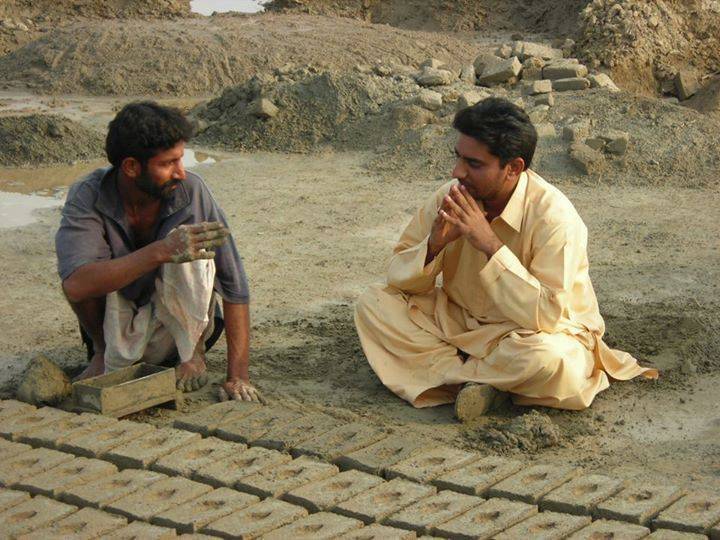
Other possible sources were the Bolan Pass, Khaltan (Sibi), and the Khirthar Range. Describing brick manufacture, Sir John Marshall writes in Mohenjo-Daro and the Indus Valley Civilization (1931) that, “The bricks of Mohenjo-Daro are all exceptionally well made, yet have no straw or other binding material. They are always rectangular in shape with the exception of those that were made for special purposes, such as the wedge-shaped bricks almost invariably employed in the construction of wells. The bricks were made in an open mould and struck along the top with a piece of wood, as proved by their striated upper surfaces”. (p. 267)
Where were these bricks made? What were the requirements for brickwork? Sir John Marshall further mentions that, “The bricks are exceptionally well baked and range from straw-colour to bright red. No attempt was made to grade them by their colour. We do not yet know the type of kiln in which these bricks were baked, but then, as now, there was evidently no difficulty about fuel. Wood must always have been far more plentiful than in Babylonia, where reeds were the only available fuel.” (p. 267) He again writes that, “As in all brickyards of the modern East, the bricks were laid over large areas for the preliminary drying. The result is that we have found the footprints upon them of cattle, crows, dogs (very common), and in one case of a large cat-like animal which may have been a leopard.” (p. 267)
Some of the Mohenjo-Daro bricks have footprints of a human child and big and small goats going in different directions. Discussing the brick kilns of Mohenjodaro, Sir John Marshall writes, “We have not yet succeeded in finding any brick-kilns, but these were probably situated well outside the city area and near an ample supply of wood. It cannot be imagined that forests were available close to the doors of the people who occupied these sites, for as time went on the supplies near at hand must have failed and the populace would have had to go further afield to procure fuel for bricks and for kitchen purposes.” (p. 268)
It probably seems that the kilns and the brick fields were situated on the north, west, and south sides of the old course of the River Indus. This river also provided open space for drying bricks and cattle grazing. There must have been hundreds of thousands of brick-making families engaged in the brick-making work around Mohenjo-Daro. Various kinds of animals, including bullocks and cows, must have been used for carrying heavy loads of bricks at this ancient city. Today, owners of brick kilns mostly use donkeys, mules, and camels for such brick transport.