

When Habib Jalib asked, “Zulm rahe aur aman bhi ho, kya mumkin hai tum hi kaho?” in the 1971 film Yeh Aman, he confronted the lie that peace can coexist with oppression. In the song, Jalib describes a bright, singing valley plunged into darkness and challenges those who have sewn their own lips shut not to stop him from speaking the truth. Released in November 1971, as the Pakistani state waged war against Bengali self-determination in the name of national unity, the film appeared at a moment of escalating state violence. In this context, Jalib’s question exposes how appeals to stability and loyalty can be used to shield organised violence.
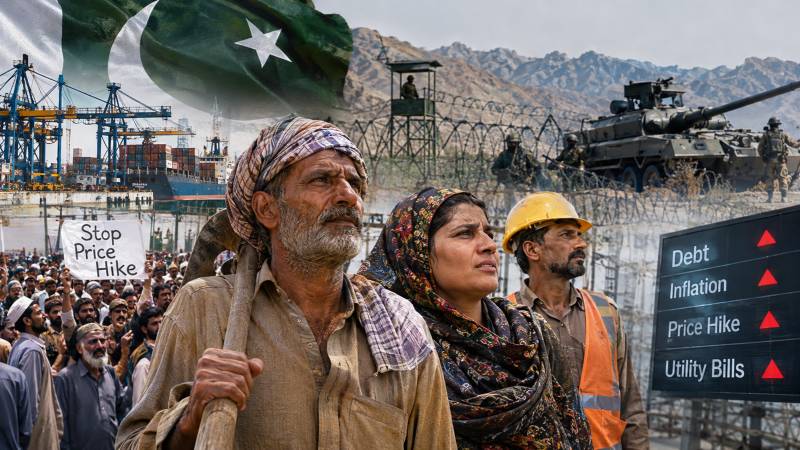
More than half a century later, mounting debt and falling living standards across Pakistan sharpen that challenge, revealing a political order in which military confrontation, economic crisis, and entrenched power reinforce one another across public spending, investment, border controls, and daily survival. In Pakistan, extractivism, militarisation, and indebtedness have become deeply intertwined, reorganising territory, finance, and circulation while concentrating control over resources and livelihoods. Calls for peace are routinely dismissed as naive or destabilising by those who treat permanent security crisis as the outer limit of the possible. Pakistan cannot emerge from this crisis without an anti-war politics grounded in the everyday struggles of working people and capable of addressing the interconnected economic, political, and coercive relations sustaining it.
When war expanded across the Middle East in February 2026, rising energy and transport costs intensified Pakistan’s economic crisis, driving up prices for food, agricultural inputs, and freight across production and household consumption. For workers and small producers, this imported inflation hit an economy already strained by falling real wages and deteriorating public services. In this context, extractivism operates not only through the removal of minerals and agricultural surpluses, but through financial claims and restricted circulation that squeeze working households. These pressures operate through distinct channels: debt servicing absorbs a massive share of public revenue and constrains spending on social provision, regressive indirect taxes erode purchasing power, and repeated utility tariff hikes pass fiscal adjustment directly onto household bills. At the same time, a development strategy backed by the military-linked Special Investment Facilitation Council promotes corporate agriculture, mineral extraction, and infrastructure corridors as answers to stagnation, transferring land, water, and commons into corporate hands.
Militarisation and security-driven border regimes compound these pressures by turning transit routes and frontiers into chokepoints that disrupt regional trade and raise the cost of survival. Although financial extraction, resource enclosure, and border closures operate through distinct mechanisms, their effects converge on working households. State-led recovery plans and appeals to national sovereignty cannot resolve this crisis while the security and property priorities tied to militarisation remain intact. They leave the underlying power relations untouched while shifting the cost of adjustment onto workers through lower real incomes, insecure employment, and heavier household burdens. An anti-war politics is therefore necessary to address the crisis, because struggles over wages, public provision, land, and resources must transform the economic, political, and coercive arrangements that govern investment and restrict regional economic life. The economic costs of militarisation are particularly visible along Pakistan’s borders, where military confrontation and movement curbs have severed longstanding ties of trade, labour, and production.
Along the Punjab border, farmers on both sides of the Radcliffe Line remain cut off from agricultural markets that once linked cultivators across the region. Direct trade through Attari and Wagah remains suspended and the Hussainiwala route stays closed, despite repeated demands from Indian Punjab’s Kirti Kisan Union to reopen both crossings, lower transport costs, and restore exchange. Pakistani cultivators face falling crop prices, costly inputs, and expanding corporate farming schemes, while restrictions on cross-border trade divert commerce onto longer routes controlled by intermediaries who profit from the bottleneck. Farther north, the suspension of cross-Line of Control trade along the Srinagar–Muzaffarabad and Poonch–Rawalakot routes has severed commercial ties across Kashmir. At Torkham and Chaman, border closures disrupt trade with Afghanistan, depriving transport workers of wages and blocking producers from regional markets, prompting farmers' organisations such as Sindh Abadgar Ittehad to demand the reopening of trade with Afghanistan so cultivators can export their crops.
In Pakistan, extractivism, militarisation, and indebtedness have become deeply intertwined, reorganising territory, finance, and circulation while concentrating control over resources and livelihoods.
In November 2026, Commerce Secretary Jawad Paul estimated that the suspension of trade with Afghanistan had reduced Pakistan’s exports by roughly $1 billion. Along the southwestern frontier, sanctions and banking restrictions constrain trade with Iran and complicate cross-border payments, while port projects and security checkpoints at Gwadar restrict local fishing communities’ access to traditional fishing grounds. These restrictions arise from different political and economic pressures, and their effects extend beyond lost trade. They weaken regional production, increase dependence on commercial intermediaries, and concentrate control over movement and resources in institutions and interests that benefit from closure. Reopening these borders and regional markets can change material conditions directly by lowering input and transport costs, loosening the grip of commercial intermediaries, and restoring cross-border livelihoods that militarised security regimes suppress.
The concentration of economic power is reinforced by policing those who contest it, as demands over livelihoods, resources, and political representation are increasingly treated as threats to internal stability. The curbs on protests and the criminalisation of dissent accompany the policing of labour movements, counterinsurgency operations, and enforced disappearances, while legal categories such as “terrorist” and “criminal” serve to justify coercion despite formal constitutional protections. Military confrontation restricts political opposition further by making national security a pretext to suppress criticism and collective organising. During the May 2025 fighting with India, warnings that war would deepen domestic repression were dismissed by regime loyalists and sections of the pro-China campist left that treated anti-war criticism as liberalism or foreign interference. By reducing political differences to competing geopolitical allegiances, these positions reinforce the consensus that allows military confrontation to justify repression at home.
In February 2026, Defence Minister Khawaja Asif declared an “open war” with Afghanistan’s Taliban government, while the United Nations recorded at least 146 civilian casualties in Afghanistan between February 26 and March 2. Within Pakistan, amendments to the Prevention of Electronic Crimes Act and constitutional changes restructuring judicial authority have further concentrated coercive power. The imposition of emergency measures and governor’s rule in Khyber Pakhtunkhwa in October 2026 extended this process, narrowing space for political opposition and collective organisation. By curbing political organisation and criminalising dissent, the state weakens the capacity of working people to challenge the economic dispossession and militarised policies shaping their lives.
Across Pakistan, struggles over livelihoods and freedom of movement have increasingly confronted restrictions imposed in the name of security. In January 2026, thousands rallied in Mir Ali to demand peace, an end to curfews, and the reopening of the Ghulam Khan crossing with Afghanistan. The Chaman sit-in brought together laghri porters resisting passport rules that threatened generations of cross-border work, while protests in Gwadar challenged deep-sea trawling, trade restrictions, and pervasive checkpoints. In Punjab and major urban centres, farmers have mobilised against wheat procurement policies and corporate agriculture, while railway and electricity workers have resisted unpaid wages, privatisation, and worsening working conditions.
During the 2026–27 budget proceedings, public-sector employees protested in Islamabad against pension changes and declining real incomes, challenging fiscal policies that place the burden of adjustment on working households. These struggles arise from different histories and political conditions and do not automatically form a common anti-war movement. Building such a politics requires overcoming the divisions that separate struggles against economic dispossession, militarised borders, and domestic repression, while addressing the interconnected economic, political, and coercive relations that sustain these conditions. At the same time, an anti-war politics refuses the cynical politics of fear that treats perpetual crisis as the only horizon, opening space instead for a collective politics that breaks with the limits of the present order. The possibility of peace rests on developing forms of collective organisation and solidarity through which working people can transform the concentration of economic and coercive power and determine the conditions of their own lives.