

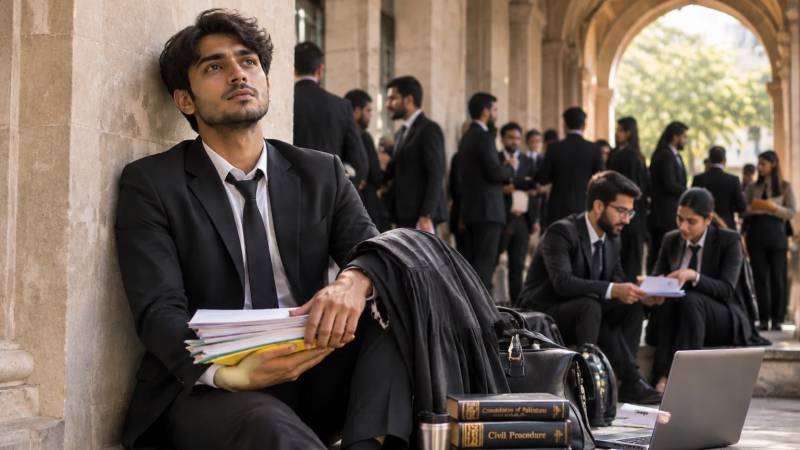
In Punjab, a law graduate can spend approximately three years researching, drafting, and running errands for a senior Advocate without a rupee in salary. He is told exposure is payment enough. It is not. It is an exploitative arrangement wrapped in the respectable veneer of an apprenticeship. Every year, thousands of eager graduates enter a profession they believe will let them defend the Constitution and earn respect. Instead, a vast majority discover a rigid hierarchy that treats them as disposable, unpaid labor. Three distinct failures demand immediate reform: unpaid work, politicised bar associations, and the blatant misuse of Government Chambers. If left ignored, these practices will not merely harm young lawyers; they will further corrode the independence of Pakistan’s courts and accelerate the structural degradation of the judicial system.
In functioning democracies, unpaid professional labor is strictly regulated or prohibited. UK pupils receive a minimum stipend; US associates are salaried from day one. Punjab offers neither. Fresh Juniors routinely spend three to five years without stipend, structured training, or income. A junior lawyer without income cannot afford essential law books, legal databases, transport, or Court attire. Crucially, financial deprivation creates dependency, in turn, makes young lawyers vulnerable to political manipulation. Many enter the volatile arena of bar politics not out of ideological conviction, but because they desperately require the institutional protection, case referrals, and sense of belonging controlled by senior factions.
The Pakistan Bar Council should mandate baseline minimum wage as a monthly stipend for every junior. Seniors will object that many cannot afford this. Then they should not hire juniors. A profession that cannot pay its apprentices cannot legitimately claim to train them. The Punjab Bar Council should establish a dedicated junior Welfare Fund and an independent complaint cell empowered to investigate non-payment, retaliation, and exclusion. A finding of non-payment after due inquiry should lead to licence suspension. A paid junior is a dignified junior, and personal dignity is the bedrock of professional independence.
Unpaid internships also sustain political clientelism. Senior Bar leaders act as patrons, exercising absolute control over the juniors who depend on them. These juniors are transformed into political foot soldiers, canvassing votes and sometimes joining physical confrontations during bar elections. In exchange for a desk and occasional brief referrals, the junior effectively surrenders their political independence. Refusal risks exclusion. This arrangement has corrupted the concept of mentorship. Fearing future competition, many seniors deliberately withhold substantive training, confining juniors to menial clerical work. The result is a self-perpetuating status quo; less competence, more rowdyism.
This is not a meritocracy; it is a hereditary oligarchy wearing the robes of a noble profession. Those born into established legal families inherit robust client lists, influential networks, and systemic protection from exploitation. In contrast, first-generation lawyers are left to beg for a desk, forced to choose daily between their dignity and their economic survival.
Government chambers were originally intended to provide Advocates with a dignified, public workspace. Instead, across Punjab’s District Courts, chambers allotted decades ago to seniors, many of whom now operate exclusively from lavish private offices, are treated as hereditary estates. A strict “Use It or Lose It” rule is urgently required: any Advocate with a private office must surrender their government allocated chamber within 30 days. Failure should be professional misconduct and disqualify them from Bar office. To ensure transparency, bar councils must publish and maintain a live, digital registry of all public chambers.
Even more corrosive still is the sale of government chambers under the euphemism of “goodwill". Juniors pay exorbitant amounts for what is ultimately public property. Consequently, young lawyers begin their careers mired in debt while seniors profit handsomely from an asset never theirs to sell. A government chamber is not real estate; it cannot be sold, inherited, or gifted. The policy must be zero-sale. Surrendered chambers should go to the next applicant on a public waiting list and anyone found buying or selling a chamber should face immediate license revocation.
Ultimately, the legal profession in Pakistan continues to run on hereditary advantage. Those born into established legal families inherit robust client lists, influential networks, and systemic protection from exploitation. In contrast, first-generation lawyers are left to beg for a desk, forced to choose daily between their dignity and their economic survival. This is not a meritocracy; it is a hereditary oligarchy wearing the robes of a noble profession. To level the playing field, reclaimed chambers should be repurposed into Junior Lawyer Incubation Centres; shared desks, Wi-Fi, and law libraries, managed by a non-political committee under the District Judge. If juniors remain unpaid, they will remain dependent. Dependent lawyers become dependent judges, prosecutors, and defenders. A profession that eats its young cannot credibly defend the rule of law. The robe is black. The profession’s conscience need not be.