

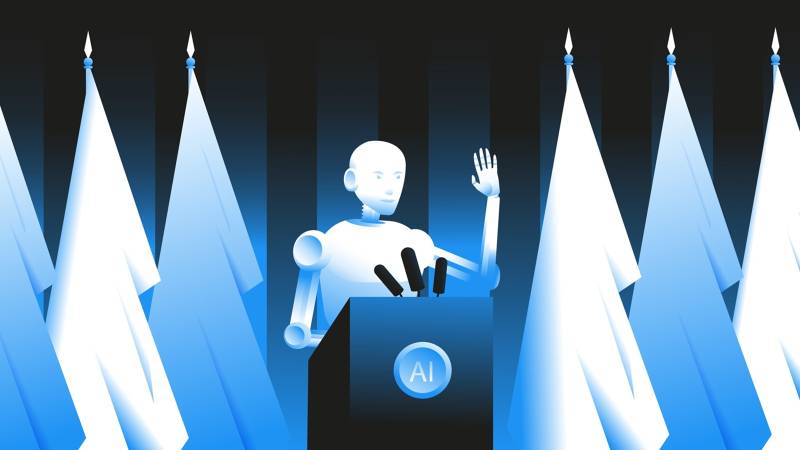
Artificial Intelligence (AI) is one of the major scientific and technological developments of the modern age. It has begun to profoundly affect the productive forces of human society, economic relations, political systems, knowledge, culture, and various aspects of human life. On the one hand, its development has created new possibilities for transforming the nature of human labour, increasing productive capacity, and expanding access to knowledge.
On the other hand, it has also raised new questions concerning job security, the exploitation of workers, personal freedom, state surveillance, environmental destruction, and the concentration of wealth. Therefore, it is not sufficient to view artificial intelligence merely as a technology; rather, it is essential to understand it within the broader context of the existing mode of production, property relations, and class society. Recently, the Fourth International has announced plans to launch a global campaign against data centres used for artificial intelligence in October 2026.
If, while criticising the present capitalist use of artificial intelligence, we also reject its scientific and productive potential, we risk unknowingly distancing ourselves from the development of modern productive forces
The Fourth International argues that the capitalist system is using modern technology not to meet the needs of the people, but to generate profits, exploit workers, and serve the interests of the ruling classes. This criticism raises several important and serious questions that cannot be ignored. However, a fundamental theoretical question also arises in this debate: is artificial intelligence inherently a technology that works against the interests of the people, or does its social role depend on who controls it, the purposes for which it is used, and which class benefits from the wealth it generates?
In our view, it is necessary to examine this question in the light of Marxist philosophy and dialectical materialism. This is because if, while criticising the present capitalist use of artificial intelligence, we also reject its scientific and productive potential, we risk unknowingly distancing ourselves from the development of modern productive forces. Conversely, if we accept its technological advancement without any class-based or political criticism, we may end up contributing to the strengthening of the exploitative relations of capitalism. Therefore, the need is neither to regard artificial intelligence as an unquestionable symbol of progress nor to hold it responsible for every social problem. Instead, its positive and negative possibilities must be examined from a dialectical perspective.
Within the fundamental intellectual tradition of Marxism, technology is regarded as an important component of society’s productive forces. According to the historical materialism of Marx and Engels, the productive forces and relations of production play a fundamental role in the development of human history. The productive forces of society include human labour, skills, scientific knowledge, machinery, tools, and technology. As productive forces develop, they can create new contradictions with existing relations of production, opening up possibilities for social change.
From this perspective, artificial intelligence represents a new stage in the historical development of human knowledge, science, and technology. It has the potential to enhance human creative and intellectual abilities, analyse vast amounts of information, assist in solving complex problems, and make different stages of production more efficient. Therefore, it would be incorrect to view artificial intelligence separately from the development of productive forces.
The fundamental characteristic of the capitalist system is that the major means of production are privately owned, and the primary purpose of production is to generate profit rather than meet social needs. Under such a system, every new technology is generally used on the basis of its potential to generate profit rather than its wider social benefits. This contradiction is also clearly visible in the current development of artificial intelligence. For example, if an industrial enterprise becomes capable of producing more goods with less human labour through the use of artificial intelligence and automated machines, this technological progress could, in theory, reduce workers’ working hours. However, under capitalism, the outcome may be that the enterprise dismisses some workers to increase production and profits, while requiring the remaining workers to do more work.
In this way, instead of reaching the wider majority of society, the productive benefits generated by technological progress tend to accumulate in the hands of owners and capitalists. The problem, therefore, does not lie in the existence of technology itself, but in the ownership of the means of production and the distribution of the wealth generated through them.
Left-wing progressive parties struggling for social change in Pakistan also need to clarify their ideological and political policies regarding artificial intelligence. In a country like Pakistan, where education, healthcare, agriculture, industry, employment, and scientific research face numerous fundamental challenges, it would not be appropriate to ignore the positive possibilities of artificial intelligence.
For example, in agriculture, artificial intelligence can help identify crop diseases, improve water-use planning, analyse soil conditions, and provide weather forecasts. If such facilities are made accessible to small farmers and agricultural workers, they could help improve agricultural production and the use of resources. In education, artificial intelligence can be used to develop quality educational materials in Sindhi and other local languages. In healthcare, primary medical centres can be connected to modern information services. Similarly, data analysis and planning in government institutions can be improved. However, all these possibilities can become a reality only if access to technology is not restricted to large private companies, wealthy classes, and privileged urban populations.