

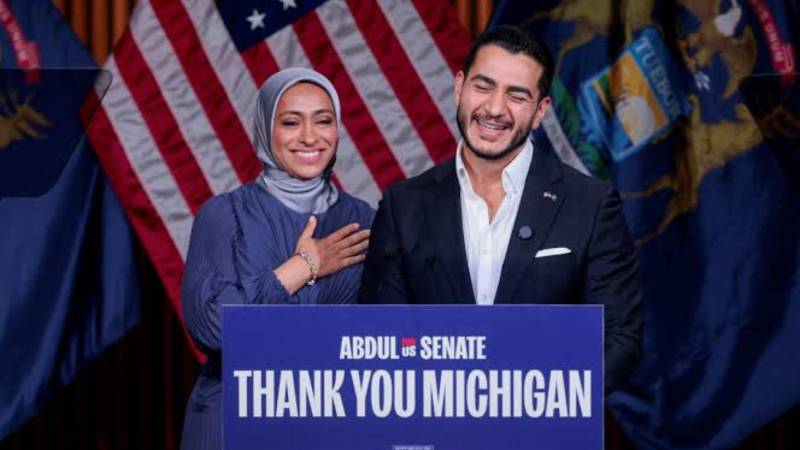
History was made in the United States midterm elections when Dr. Abdul El-Sayed won a seat in the U.S. Senate representing Michigan. In a hard-fought and closely contested race, the Democratic candidate defeated his Republican opponent, former Congressman Mike Rogers, by a comfortable 7-point margin. With this victory, El-Sayed became the first Muslim and Arab American elected to the United States Senate—an achievement of historic significance, not only for Michigan but also for the wider Muslim American community.
El-Sayed's journey to the Senate was anything but easy. As a political outsider, he had to overcome formidable obstacles, beginning with a fiercely contested Democratic primary against fellow Democrat and Congresswoman Haley Stevens. Stevens enjoyed the support of much of the Democratic establishment, including congressional leaders and Michigan's governor. El-Sayed, by contrast, built a coalition of labour unions, grassroots activists and progressive leaders, including Senator Bernie Sanders of Vermont and Representative Alexandria Ocasio-Cortez of New York. Despite being outspent by Stevens by a staggering margin of 11 to 1, he defied expectations and secured the Democratic nomination. His primary victory demonstrated the growing influence of grassroots political movements and the electorate's willingness to look beyond established political power structures.
The general election presented an even greater challenge. El-Sayed faced a barrage of attacks in which his Muslim faith and Egyptian heritage were repeatedly brought into question. His opponents sought to exploit religious and ethnic prejudice, portraying him as a threat to American values and national security. Without credible evidence, accusations linking him to terrorism, jihadism and alleged family associations with Egypt's Muslim Brotherhood were circulated during the campaign. President Donald Trump and Vice President JD Vance also actively campaigned against him, attempting to raise doubts about his patriotism, loyalty and suitability for public office.
Former President Barack Obama offered a particularly powerful response to these attacks. Speaking at a rally in Detroit in support of El-Sayed and other Democratic candidates, Obama criticised those who sought to use the candidate's name and religious identity against him. Drawing a parallel with the prejudice he encountered during his own presidential campaign in 2008, Obama observed: “And I can also tell you this from experience, whenever a movement builds to challenge that broken system, the people who benefit from the status quo will say and do anything to stop that train from coming. They will use lies and they will use fear and they will use division and they may even use your name or your faith to somehow suggest that you are dangerous and less than trustworthy and less patriotic and less American than they are. We have seen this movie before. I starred in it.”
Obama's remarks captured the essence of the campaign against El-Sayed: when political opponents cannot effectively challenge a candidate's ideas and policies, they may resort to questioning his identity and belonging. Yet, as the election results demonstrated, such tactics were not enough to prevent voters from choosing a candidate whose message resonated with their concerns.
Winning a seat in the U.S. Senate is a major political achievement. The Senate has only 100 members, with each state represented by two senators. Its members exercise considerable influence over national legislation, foreign policy and other matters of public importance. The Senate also plays a critical constitutional role in confirming presidential nominations to the Cabinet, federal judiciary, and senior Civilian and military positions. El-Sayed's election therefore places him in one of the most influential legislative institutions in the world, giving him an opportunity to shape debates and decisions that extend well beyond Michigan.
El-Sayed's journey from a political outsider to a United States senator is about more than the election of the first Muslim and Arab American to the Senate. It is also a reminder that American democracy can create opportunities for voices that have historically been excluded from its corridors of power.
Throughout his campaign, El-Sayed repeatedly emphasized that he was not asking voters to elect him simply as a Muslim American, but as an American who happens to be Muslim. This distinction was important. He sought the confidence of voters from diverse religious, ethnic, and cultural backgrounds and pledged to represent all Michigan residents, regardless of faith or identity. Nevertheless, his presence in the Senate carries an additional significance. At a time when Muslims have often been misrepresented or marginalized in American political discourse, having a Muslim senator can bring valuable perspectives and lived experiences to discussions of domestic and international affairs. Representation does not require a politician to speak exclusively for one community; rather, it enriches democratic institutions by ensuring that a wider range of voices and experiences are heard.
El-Sayed's victory was driven primarily by a progressive political agenda focused on improving the lives of ordinary Americans. He campaigned on reducing the cost of living, expanding access to affordable healthcare and addressing the economic pressures confronting working families. He also questioned the enormous sums of American taxpayers' money spent on foreign wars, arguing that greater resources should be directed towards healthcare, education, economic security and other domestic priorities. His message found support among Michigan voters frustrated by rising living costs and the consequences of the Iran war. Many also appeared ready for a new political voice, choosing El-Sayed over a candidate they viewed as a representative of the established political class.
Abdulrahman Mohamed El-Sayed's personal and professional background is equally noteworthy. Born in Michigan to Egyptian immigrant parents, he earned his medical degree from Columbia University before becoming a Rhodes Scholar and obtaining a Doctor of Philosophy (D.Phil.) in Public Health from Oriel College, University of Oxford. An epidemiologist by training, he subsequently held several leadership positions in Michigan's public health system. His academic credentials, professional experience and commitment to public service provided a foundation for his entry into electoral politics.
El-Sayed's election represents a milestone in the political participation and representation of Muslim Americans. For a community that has often faced suspicion, discrimination and political exclusion, his success demonstrates that religious and ethnic identity need not be a barrier to reaching the highest levels of elected office. Following Zohran Mamdani's election as mayor of New York City, El-Sayed's victory further underscores the growing presence of Muslim Americans in the country's political landscape. Together, these achievements may encourage a new generation of Muslim Americans to enter public service, participate more actively in civic life and seek elected office at every level of government.
More broadly, the outcome carries a message about the changing nature of American politics. For decades, sections of the political establishment have sought to exploit public fears about Muslims, reinforcing stereotypes and fuelling Islamophobia for electoral advantage. Yet the victories of politicians such as Mamdani and El-Sayed suggest that identity-based attacks do not necessarily determine electoral outcomes. Voters are increasingly prepared to judge candidates on their ideas, policies, competence and ability to address everyday concerns.
Ultimately, El-Sayed's victory will be measured not merely by its historic symbolism but by what he accomplishes in office. The challenge before him is to translate the hopes generated by his campaign into meaningful action—working across political and ideological divides to improve the lives of Michigan residents and contributing to a more inclusive and equitable America. If he succeeds, his election could mark not just a breakthrough for Muslim American representation, but an important moment in the continuing evolution of American democracy.