

Nowadays in Pakistan, ask any mother what she dreams for her son, and she will say: "CSS." Ask her daughter, and she will say the same. In what other nation on earth does an entire generation pray not to build, teach or heal, but to file? The answer to that question is the key to Pakistan's ruin because the key to everything in Pakistan, from a water tap in Sukkur to a visa counter in Islamabad, lies in the hands of one institution: the bureaucracy.
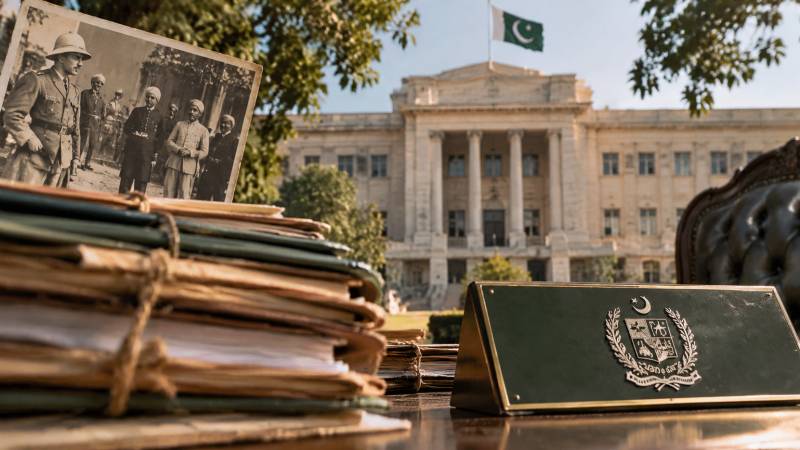
We inherit this affliction from the British Raj. The Indian Civil Service was the steel frame of the Empire — masters, not servants. When Pakistan was born in 1947, the colonial machine changed its flag but not its soul. The CSP — the Civil Service of Pakistan stepped into the shoes of the ICS, and Pakistan's elected men, mostly new to governance, found themselves guests in their own house, knocking on doors held by men in khaki files.
The history since then is a history of missed chances. In the 1960s, the Cornelius Commission proposed replacing the CSP with a Pakistan Administrative Service open to specialists — the mandarins strangled it in the cradle. The 1973 reforms merged some 622 pay scales into 22 "unified" grades — unification on paper, hierarchy in practice, for on top of every pyramid sit the same two cadres, the PAS and the Secretariat Group. The Zia era opened a back door for military induction into the elite services, entrenching the khaki-civilian condominium. Even the devolution of the 2000s, which abolished the deputy commissioner's executive magistracy, merely scattered power downward without taming it.
Today, roughly 25,000 federal officers in BPS-17 and above preside over a state of 250 million. The numbers of their dominion are staggering. A study by the Pakistan Institute of Development Economics, aptly titled "Cash Poor, Perk Rich!", found that government-owned residences are worth at least Rs 1.45 trillion at minimum market value — enough, one notes dryly, to build several hospitals in every province. In Punjab alone, nearly 20,000 domestic servants staff the official residences of officers, drawing salaries of over Rs 5 billion. Chief secretaries, inspectors-general, commissioners and deputy commissioners maintain private "camp offices" inside their bungalows at the public's expense. When the PIDE economists monetised the hidden pay, the myth of the "poorly paid" civil servant collapsed: a Grade-22 officer's total package is nearly 29 times that of the lowest-paid government worker and over 32 times once operating costs are counted. Pakistan now spends more than Rs 8 trillion a year on its public servants.
And yet the deliverables? Water that does not flow, schools that do not teach, courts that do not conclude, and a police station where the first question is never "what happened" but "what do you do." While 33 per cent of educated young people sit unemployed, more than 1.23 million Pakistanis emigrated for work in 2025 alone, and surveys suggest that more than two-thirds of the country's youth wish to leave. The dream of nation’s youth is fleeing foreign, and the reason is not merely economics — it is that merit in Pakistan means clearing an exam to join the club that runs the country as a private estate.
Observe how the elite conserves itself. The bureaucrat's son marries the businessman's daughter; the businessman's son marries the dynast's daughter; the dynast's son marries into the bureaucracy. One wedding at a time, the republic becomes a family firm, and the genteel middle class — the honest clerk, the struggling graduate is left to watch the drumbeat from outside the gate, invited to celebrate a "posting" as though it were a coronation. In our drawing rooms, a young officer's transfer is announced with more fanfare than a scientist's discovery. We have made a public duty into a private blessing.
Contrast this with the developed world we so admire. In Britain, permanent secretaries serve; they do not rule — ministers answer to Parliament, and the mandarin's anonymity is the price of his power. In Germany, the Beamte is bound by strict neutrality, forbidden from striking or politicking, paid honestly and supervised ferociously. In Singapore, civil servants are paid handsomely precisely so that they need nothing else and a single proven act of corruption ends the career and the freedom together. In the United States, a few thousand political appointees turn over with every administration while millions of career officials execute law, not whim. Nowhere in the civilised world does a file hold a minister hostage; nowhere does an officer openly run the district as a fief.
The politician, it must be said, is often a transient tenant in office a few years, illiterate in procedure, dependent on the secretary who has run the same desk for twenty. So the elected man bows, the bureaucrat rules, and the voter blames the man he can vote out while the man he cannot touches the sky. This is the genius of the arrangement: perpetual power without a single election.
So what is the ordinary citizen to do — accept the abrasive system, or abandon it? Neither despair nor flight is a policy. The middle-class father who mortgages his house to send his child abroad, and the middle-class father who mortgages it to buy books for the CSS, are both wagering on escape. The third path is harder: treat the bureaucracy not as a deity but as what law already calls it — a servant. Demand the right to information. Litigate the illegal privilege. Refuse the facilitations that turn citizens into supplicants. A servant class that is never contradicted becomes a master class; a master class never contradicted becomes a monarch. Pakistan's bureaucracy crossed the first bridge long ago. It is we, by our reverence, who let it cross the second. Crown the institution, and it will behead the nation. Starve it of awe, and it may yet remember its oath.