

“It requires conducive social conditions rather than monstrous people to produce heinous deeds.”— Albert Bandura
There are some crimes that shock because they are unusual. Others shock because they are becoming familiar. The death of 13-year-old Fatima Asghar in Islamabad belongs to the second category.
However, even before that process is complete, one fact confronts us with brutal simplicity: A 13-year-old child was inside an adult household where the law says she should never have been working in the first place. Section 3 of the Islamabad Capital Territory Domestic Workers Act, 2022 is categorical: no child below sixteen may work in a household in any capacity. Yet Fatima was there.
Ten years earlier, another child, Tayyaba, was also there. Tayyaba was less than ten when she was handed over for domestic work in the Islamabad home of a serving judicial officer. The Islamabad High Court recorded that she had been transported from her family, placed in the household without any formal employment contract and without her consent, and that Rs. 18,000 had been paid to her father. The case eventually resulted in criminal convictions.
Different families. Different homes. Different years. The same question. What happens in the human mind when an adult begins to treat a child not as a child but as an inferior instrument?
Human beings possess an extraordinary capacity to morally disengage from what they are doing. Violence is renamed discipline. Humiliation becomes correction. Hunger becomes punishment. A slap becomes “teaching manners.” The victim is blamed for provoking the very cruelty inflicted upon her. Language begins laundering conscience.
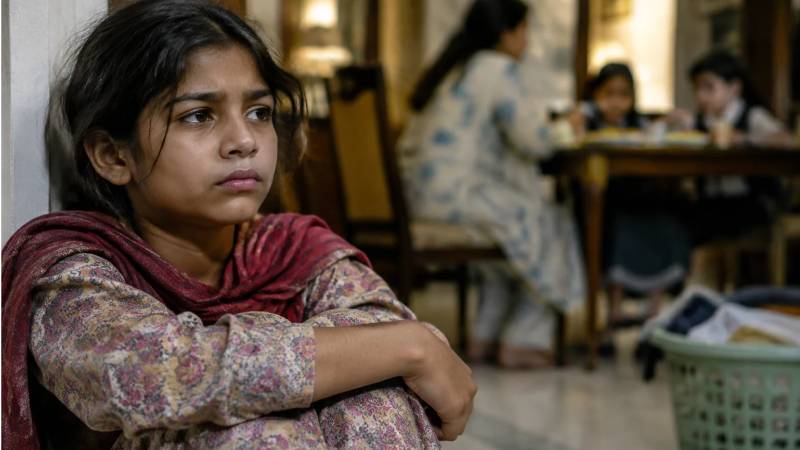
Once a child is mentally recategorised from daughter-like human being to servant, an invisible hierarchy is created. The employer eats first. The child waits. The employer’s children go to school. The domestic child cleans their rooms. One child is permitted tiredness; the other is accused of laziness. One child may make mistakes; the other is punished for them.
The tragedy begins much earlier than the first blow. It begins when inequality becomes normal. Power makes the process easier. Domestic work occurs behind walls. There are no colleagues watching, no attendance registers, no labour inspectors sitting in drawing rooms. The employer controls food, movement, sleep, communication and often the child’s access to her family. For a child, dependence may become almost total.
That is precisely why domestic child labour is so dangerous. The International Labour Organization has described it as a widespread but largely hidden phenomenon in Pakistan, with girls between roughly ten and fourteen disproportionately represented. Its research identifies poverty, family circumstances, working conditions and social attitudes among the factors that keep children in domestic labour.
Cruelty rarely survives on the strength of one cruel person alone. It survives through permission—sometimes explicit, often silent. How many ordinary people must look away before cruelty begins to feel ordinary?
The National Commission on the Rights of Child has similarly reported that more than 110,000 children aged five to seventeen were working as domestic workers in Punjab alone, according to the Punjab Child Labour Survey 2019–20. These are not servants who happen to be young. They are children whose childhood has been converted into labour. But there is another side to this tragedy that we avoid discussing because it is uncomfortable. Who sends them? Poverty explains much. It does not make the question disappear.
In Tayyaba’s case, the judicial record shows that money passed to her father when she was placed for domestic work. In countless households across Pakistan, children are sent to cities because their parents cannot feed, educate or support them adequately. The arrangement may be presented as employment, apprenticeship, protection, or even opportunity. Sometimes parents genuinely believe that a wealthy household will give the child a better life. Sometimes desperation leaves almost no meaningful choice. But somewhere along the journey from poverty to employment, society quietly begins accepting the idea that one family’s child may be transferred into another family’s service. That should disturb us profoundly.
A poor child does not become less of a child because her parents are poor. Nor does parental consent transform exploitation into legitimacy. The psychological burden on such children is devastating precisely because they are dependent upon everyone who has power over them. Imagine the world from the child's height. Your parents have sent you away. You are living among strangers. The adults in the house control your meals and movements. You may be frightened of complaining because you could lose your wages, be blamed, beaten, sent away, or told that your family needs the money.
If abuse becomes routine, even resistance may disappear. Psychologists describe forms of learned helplessness in situations where repeated attempts at escape or resistance seem futile. But one need not invoke technical terminology to understand the basic truth: a frightened child learns very quickly where power lies. Silence does not mean consent. Submission does not mean acceptance. Remaining in the house does not mean the child was safe there. The adult mind can exploit precisely that silence.
Then comes another psychological mechanism: dehumanisation.
It need not involve openly declaring someone less than human. It may appear in small acts—the servant child eating separately, sleeping on the floor, being addressed only by command, denied privacy, denied schooling, denied recreation, or expected to remain perpetually available. Repeated often enough, these practices make inequality appear natural. And once inequality feels natural, cruelty requires less explanation.
The latest case contains an additional irony that is almost unbearable. Among those arrested is a Qari who reportedly came to teach the household children the Quran. Again, his alleged role remains a matter for investigation. But the symbolism cannot be ignored. What are we teaching children when religious instruction takes place inside a house where another child may simultaneously be living without the protections that law, religion and humanity demand? We teach morality beautifully. We practice hierarchy effortlessly. That contradiction runs through our society.
Employers speak of charity while employing children. Parents speak of sacrifice while sending daughters away. Institutions speak of child protection while children continue working behind closed doors. The state passes laws, but the child remains invisible until bruises become photographs—or a body reaches a hospital.
Pakistan does not lack legislation. Islamabad has expressly prohibited household employment below sixteen. The Constitution guarantees free and compulsory education between five and sixteen. UNICEF reported in 2026 that child labour still affects millions of Pakistani children and perpetuates cycles of poverty and exploitation. What we lack is the refusal to tolerate the practice socially. No respectable household should employ a child. No parent should be compelled by hunger to surrender one. No intermediary should profit from arranging it. No policeman, judge, bureaucrat, businessman, cleric or professional should imagine that status places his household beyond scrutiny.
And when abuse occurs, our first question should not be merely who delivered the blow. We must ask who saw the child before the blow was delivered. Who knew she was working there? Who brought her? Who paid for her labour? Who visited the house? Who noticed injuries? Who remained silent? Who decided it was none of their business?
Cruelty rarely survives on the strength of one cruel person alone. It survives through permission—sometimes explicit, often silent. Tayyaba survived and forced Pakistan to look inside one privileged household. Fatima, if the allegations surrounding her death are established, confronts us again with the same mirror. Perhaps the most frightening question is therefore not why cruel people hurt children. It is this: How many ordinary people must look away before cruelty begins to feel ordinary?
Until we answer that, another child will remain at the bottom of another household—serving children her own age, invisible to the law—until it is too late.