

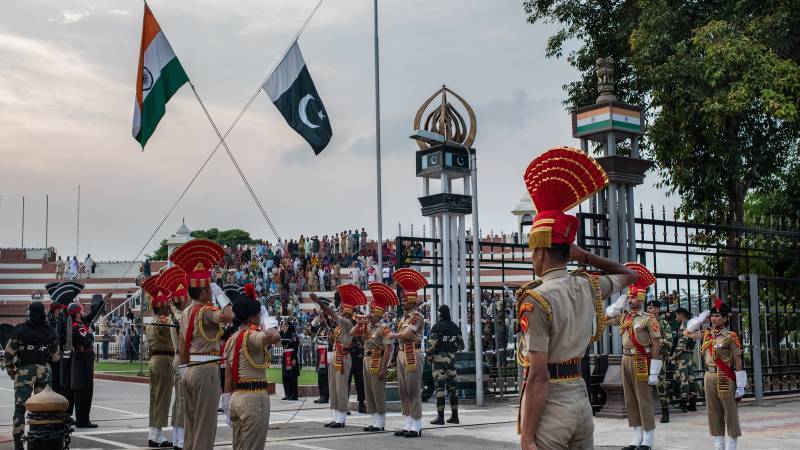
The fifth Indo-Pak war was as much one of the bombardment and imposition of an Indian narrative as it was of aerial conflict. India always had global superiority in marketing its narrative in the Western World — a narrative of a ‘shining’ and peace-loving democracy threatened by the export of Islamic terror by its western neighbour. But this narrative may well become tarnished because of its recent (6-10 May) and failed attempt to assert its kinetic superiority in Pakistan’s airspace.
The timing and genesis of this war were suspicious from the start. It had led many in Pakistan to think that it was no more than shadow boxing. Imran Khan’s sister said so publicly. It took a serious turn on the public and social media when Najam Sethi impressed upon Karan Thapar (on 28 April) the gravity of India leaving Pakistan with no option but to go nuclear. Najam did this by throwing a curveball at Karan through his provocative suggestion (that he continues to adhere to) that Pahalgam was a false flag. This exploded a depth charge in the Indian media, as I think it was meant to. The counter-charge of an Indian false flag was never going anywhere. Still, it did allow an angry and proportionate rebuttal to the off-the-cuff, routine Indian allegation that Pakistan had sponsored the Pahalgam terror. Much more important, however, in this publicly aired debate was the explicit pronouncement that Pakistan would inevitably have to resort to the nuclear option. We know that it didn’t come to that, and hope that it will never come to pass. Nonetheless, it underscores in this dangerously nuclear age the overarching truth so beautifully expressed by President Kennedy six decades back in his famous “Peace Speech” that must still resonate in our ears:
“Above all, while defending our own vital interests, nuclear powers must avert those confrontations which bring an adversary to a choice of either humiliating retreat or a nuclear war. To adopt that kind of course in the nuclear age would be evidence only of the bankruptcy of our policy — or of a collective death-wish for the world” ( JFK’s Commencement Address at American University, Washington DC, June 10, 1963)
The Najam-Karan debates of 28 April and 8 May were inconclusive, but they did eventually highlight and presage the actual issues that unfolded so swiftly in the following two days: 9-10 May. It is these that I shall try to point towards presently.
John Mearsheimer has argued with conviction that India cannot possibly be a Regional Hegemon. Besides economic insufficiencies, India lacks the military power, Mearsheimer argues, to control the “escalation ladder”— in other words, have “escalation dominance”, which Mearsheimer considers to be the ability to dictate and control the pace and intensity of any military conflict at its own will and every ‘rung’ of the military ladder, in conventional, unconventional, nuclear and other coercive forms. He has been proven right, with India suing for peace after only 5 days.
This being the objective situation, despite India’s contrary claim to be a Great Power on the world stage, with neither India nor Pakistan having “escalation dominance”, Meirsheimer suggests, as does Donald Trump and every other sensible and rational person, that a resort to arms and any attempt by either party to find a military solution on the sub-continent will inevitably reflect the ‘bankruptcy of policy’ that President Kennedy pointed out 62 years back and lead inevitably to mutual annihilation. Hence, a negotiated Peace is the only solution. This sounds eminently sensible and reasonable. But is it possible or feasible?
The answer, to my mind, is ‘No’. Both have been tried in the last 77 years. Only one military engagement (in 1971) yielded a fruitful result for one of the parties (India) —and that fruit has also turned sour, with the people of East Pakistan (now Bangladesh) turning against their erstwhile Indian ‘liberators’. The other four military engagements — in 1948, 1965, 1999 and 2025— have not yielded the desired results for either party; they have solved nothing; no permanent peace has ensued; the conflict stands frozen in a perennially temporary ‘ceasefire’.
India seeks and needs hegemony, Pakistan (above all) wants to and must survive
The other option —of a negotiated peace settlement between the two countries — has also been tried during the same 77 years but yielded only transient and illusory benefits. I need not allude to all those series of attempts (from 1 November 1947, when Mountbatten came to the Lahore Conference, onwards and onwards) to negotiate peaceful settlements, because they are all too well etched in public historical memory. Some of these attempts might be considered to have succeeded. For instance, the 1960 Indus Waters Treaty and the 1972 Simla Accord. Both have now been repudiated. Based on historical records, this further strengthens my contention that a peacefully negotiated permanent settlement between the two parties is not feasible either. We have, quite simply, exhausted all options of either a military or a civil solution.
This exhaustion, or hopelessness in finding a workable solution between India and Pakistan, stems from the fact that the objective aims and positions of the two are asymmetrical. India seeks and needs hegemony, Pakistan (above all) wants to and must survive. This has been the case ever since the exiting imperial power drew those irrational lines in 1947, about which W.H. Auden wrote so poetically:
“Shut up in a lonely mansion, with police night and day
Patrolling the gardens to keep the assassins away,
He got down to work, to the task of settling the fate
Of millions. The maps at his disposal were out of date
And the Census Returns almost certainly incorrect,
But there was no time to check them, no time to inspect
Contested areas. The weather was frightfully hot,
And a bout of dysentery kept him constantly on the trot,
But in seven weeks it was done, the frontiers decided,
A continent for better or worse divided.
“The next day he sailed for England, where he could quickly forget
The case, as a good lawyer must. Return he would not,
Afraid, as he told his Club, that he might get shot.”
This cartography, done in such indecent haste by Cyril Radcliffe at the behest of Mountbatten and Nehru and under the sway of Clement Attlee and Stafford Cripps, seems to have been a partisan act of vengeance against former Prime Minister Winston Churchill’s plan of not disturbing or altering the existing administrative and political provincial boundaries and arrangement. In other words, no partition, but a straightforward tripartite split (as he instructed, in April 1945, his Viceroy, Archibald Wavell) of British India into “Pakistan, Hindustan and Princestan” (Churchill’s own words). Churchill, like Curzon before him, but unlike all his immediate successors and decision-makers, was mindful of the geography, realpolitik, racial and military composition of the subcontinent. He baulked at the absurdity of what Cripps and Attlee were up to in 1946-1947. Here is a snippet from Hansard. It is taken from the transcript of HC Deb 18 July 1946 vol. 425 cc1394-
448 INDIA (CABINET MISSION) of the meeting in the House of Commons, with Sir Stafford reporting on the Attlee Government’s intentions following Nehru’s sabotage of the Cabinet Mission Plan:
“Churchill to Cripps:
“All this appears to raise the most formidable issues, because I can assure the (Attlee) Government —and those who have been to India know well —that the agreement of the Muslims to a new system affects the whole foundation of the problem. One cannot contemplate that British troops would be used to crush the Muslims in the interests of the caste Hindus. Whatever our responsibilities may be, whatever may be the day appointed on which we quit India, we must not make ourselves the agents of a caste Government, or a particular sectional Government, in order to crush by armed force and modern weapons, another community (Muslims of India) which, although not numerous, is numbered at 90 millions.”
Churchill had not only baulked at Hindu dominance in the Indian polity and society, which he of course had personal knowledge and experience of dating back to this participation in the Malakand Field Force Military Campaign of 1897, but he had also anticipated that the partisan geographic carving undertaken by the receding Empire would result in the hegemony of Bharat (what he called “Hindustan”).
Those fears were well-founded. The need, and desire, for post-colonial Hegemony stemmed, as Perry Anderson chronicled so lucidly, from the Indian Ideology itself. In his classic short book, banned in India ( The Indian Ideology, 2012, Verso, London/New York), the eminent historian showed how, after 15 August 1947, Bharat was built through the exercise of sheer military power by Jawaharlal Nehru in a series of annexations in utter disregard of legal, moral or political norms to gain Regional Hegemony, through continuous acquisition of territory of the Indian Princely States after the lapse (1947) of Paramountcy of the British Crown. An Ideology drove this drive for hegemony— the same fascist Ideology following which Nathuram Godse killed Mahatma Gandhi, in pursuit of which Narendra Modi conducted (2002) the Gujarat Massacre and which continues to underlie the Hindutva State policy to date.
The inhuman Partition of Punjab, captured so well by W.H. Auden above, and the almost simultaneous military usurpation of the Kashmir Valley, where most of these rivers flowed, caused the biggest rupture ever to the natural hydraulic arteries
Narendranath Modi did not start this drive for hegemony, though. It was always on the cards. Jinnah feared it most. Nehru pursued it with aggression. Swaminathan Aiyar, writing in The Times of India on August 11, 2019, was quite explicit on this point:
“It is easy for liberals to criticise the BJP, but no good liberal alternatives are on the menu. The original sin was Nehru’s decision to get the Hindu Maharaja of Kashmir to accede to India. Congress did not have to agree to partition India along Hindu-Muslim lines. Indeed, the Congress had been the greatest opponent of partition until early 1947.”
Aiyar goes on to argue that revocation of Article 370 (5 August 2019) by Modi would provide a militant backlash against the takeover of Kashmiri Statehood —
“It will mean decades of violence, as in Palestine. The BJP is ready for that. So are many other parties. Do not expect Congress resistance. After all, BJP is completing a takeover that Nehru began.”
And so the Bharati quest for hegemony has played out.
Pakistan has been ill-equipped from its inception to counter this hegemonic drive. It was bereft of resources from the start. The division of the financial assets of British India, of manufacturing capability and industry was unequal, though Pakistan met the challenge and survived. The one aspect in which it was not starved of capacity was its military share, as the erstwhile ‘Sword Arm of India’ rested within its territorial sphere in the barani plains of Jhelum, Chakwal and the rugged environs of the “martial races” of Khyber. It has indeed built upon this endowment. But its other rich natural endowment —the granary that lay in its agrarian soil— was stymied at Partition. It was starved of its water supply. One mustn’t forget that Bharat cut off the canal water supply to agriculture in West Punjab barely 8 months after the provincial partition — on 1 April 1948 — obliging Pakistan to pay for its eventual resumption. This was ample foreboding of many great crises that were to follow.
Parvez Ahmad Khan, author of several books on the Himalayas and Karakoram and arguably the greatest living geographical authority on the subject, has provided enough pictorial, graphic, and statistical data to show how Manasarovar Lake and its adjoining Mount Kailash in the Chinese Tibetan Region are the pumping heart of the hydraulic arterial system that Nature has provided to the Indus and Ganga-Jumna Plains for ample human subsistence right down to the Arabian Sea on one side and to the Bay of Bengal on the other. Rivers Indus, Sutlej, Brahamaputra and Ganga (Karnali/Ghaghara) all originate from the same Tibetan Region of China. Uninterrupted and unregulated flows through this system were, for centuries, sufficient to sustain both the Hindu Civilisation around Ganga-Jamna-Brahamputra and the Indus Valley Civilisation enveloping the Five Rivers of the Punjab. This flow was with complete insouciance towards transient sovereignties over the peoples of these lands.
Until 1947, that is! The inhuman Partition of Punjab, captured so well by W.H. Auden above, and the almost simultaneous military usurpation of the Kashmir Valley, where most of these rivers flowed, caused the biggest rupture ever to the natural hydraulic arteries.
The artificial and unnatural dissection that resulted in a stenosis for the patient (Pakistan) in 1947 was sought to be cured by the bypass surgery of 1960 (Indus Waters Treaty), when several artificial grafts were constructed to seemingly rejuvenate the enervated patient. This begs the question, however, of why this drastic bypass surgery was needed in the first place and why Pakistan acquiesced — nay, proactively solicited — in this hydraulic replacement?
There can be no doubt that the India Waters Replacement Project (embodied in the 1960 Treaty) was an ersatz solution. It was a deeply flawed alternative to all the natural waters of the Himalayan and Karakoram Ranges flowing uninterrupted from Tibet (China) to the plains of Pakistan. But a military marauder seized control (26 October 1947) over that body of water and has retained that control ever since. As a sop to Pakistan, it (Bharat) even made a small financial contribution towards the construction of the civil works of the Replacement Project!
Why did Pakistan accept this ersatz solution? There is a long answer and a short answer. I intend to give a long and comprehensive answer in a separate publication, based on historical data that I am privy to owing to my deep 45-year-long (1974-2019) personal and professional association with one of the greatest authorities on Kashmir, Mr Yusuf Buch. Here I will give a short answer.
The short answer is— David Eli Lilienthal (1899- 1981). This short answer is based on knowledge derived from Dr Aftab Ahmad Khan (a public servant whose Ph.D. thesis was on negotiations of the Indus Waters Treaty), who was a mentor of mine in the civil service from 1967 to 2004. David Lilienthal, who had been Chairman of the Tennessee Valley Authority (TVA) the U.S. Atomic Energy Commission and a host of other high-profile ventures, persuaded his friend Eugene Black (President of the World Bank) and the Washington policy establishment that there was not much mileage in the U.N. efforts for a resolution of the Kashmir conflict, even though four of the Permanent Members of the Security Council (the U.S., China (at that time Taiwan), Britain and France) were supportive of Pakistan’s case and the fifth (Soviet Union) had not as yet become hostile enough to cast a veto against Pakistan.
The five-day war has brought to the fore the final political choices that Pakistan has to make, and these might well be existential
Lilienthal wanted to replicate his TVA wonder in Pakistan. Hence, pressure ensued upon Pakistan, starting in 1951 with Eisenhower’s Presidency, accelerating after 1953 when Pakistan joined the U.S.-sponsored Defence Pacts, which altered the context of Kashmir in two important ways. Firstly, Pakistan’s Western Defence Alliances, instead of helping Pakistan, allowed Nehru to wriggle out of his commitments to the UN on Kashmir. Secondly, successive Pakistani Governments allowed themselves to be diverted from their fundamental interests that were tied inextricably to Kashmir (for reasons I have enunciated) in a quest for Anglo-American approbation and kudos.
The high point of this abandonment of Kashmir and the preference for the Alternative (Indus Waters Replacement project) was reached with Ayub Khan’s Military takeover of the country. Ayub Khan, as C-in-C, had already gone completely into the American camp in pursuit of his higher anti-communist (meaning anti-Soviet, anti-Peoples’ China) objective that overrode any desire to fight for Kashmir. As President (from 27 October 1958) he was even more unabashed. It is reported that at a Cabinet Meeting on 24 December 1958 (I have seen the Minutes of that meeting), he told his Commerce Minister (Z.A. Bhutto) not to press the Kashmir issue. And then, crucially, on 4 August 1959, he informed his Cabinet that the Americans and the British had told him specifically to hold back on Kashmir at the Security Council lest the UN proceedings jeopardise the more important negotiations on the Indus and Canal Waters. The Anglo-American advice was also for direct bilateral talks on Kashmir between India and Pakistan, and that no further reference be made (by Pakistan) of the Kashmir issue to the Security Council until after the Canal Waters matter had been settled. Pakistan complied completely with this advice. No bilateral talks were held. The Waters Agreement went ahead. It was signed on 23 September 1960, with Prime Minister Nehru coming as a State Guest for the event.
It is instructive that the text of the Communiqué issued on this historic event was highly conciliatory, as if to placate Mr Nehru:
“There was a frank and friendly exchange of views between the Prime Minister (Nehru) and the President (Ayub) in regard to Kashmir. The talks were conducted in an atmosphere of cordiality. They came to the conclusion that this was a difficult question which required careful consideration of all aspects. The President and the Prime Minister agreed to give further thought to this question with a view to finding a solution.”
Note that this was the first time that Pakistan had agreed to omit any reference to the Kashmir dispute —- which was pending in the United Nations (and is in fact still pending, in theory —- in any Joint Communique or Declaration. Nehru was free to interpret the words “friendly exchange of views in regard to Kashmir” any way he wanted.
Ayub Khan thus buried the Kashmir dispute at the United Nations. But even he couldn’t bury it in the ground. He did, however, succeed in carrying out David Lilienthal’s Tennessee Valley facsimile reproduction on the Indus Valley, giving India the two rivers (Ravi and Beas) that rise in Himachal Pradesh and also the bonus of River Sutlej coming from Chinese Tibet.
I rest my case about the Indus Waters Treaty, which India has, in any case, repudiated now. My argument has been that it was a poor consolation prize, which has also been withdrawn. Why Pakistan accepted it as a substitute for the Valley of Kashmir is a deeply disturbing question that I will not dwell upon here. What I will say, though, is that, if we analyse some of our past decisions in this regard, we might find that “the fault …is not in our stars, but in ourselves, that we are underlings.”
Yet, Divine Providence might well have resurrected a part of us that we had buried. Like the ghost of Hamlet, it has appeared again on the parapet. We are confronted once again by the dichotomy of India’s perennial quest for hegemony versus Pakistan’s need for survival. The five-day war has brought to the fore the final political choices that Pakistan has to make, and these might well be existential.